
A quiet revolution in the way we work
Since the global health crisis of 2020, the world of work has undergone a profound transformation. Widespread remote working, the office-home hybrid model and a growing demand for flexibility have upended traditional norms. Faced with these changes, many companies have had to rethink their organisational and property models. The costs of office space, fluctuating space usage and changing employee expectations have brought to the fore a concept that was previously marginal: the flex office.
Growing in popularity, particularly in major cities where rents are skyrocketing, the flex office addresses several key challenges: optimising available floor space, offering a more flexible working environment, and promoting team mobility and autonomy. In a context where the hybrid model (on-site + remote) is becoming the norm, the idea of assigning a fixed desk to every employee is becoming obsolete.
This comprehensive guide aims to explain the flex office in depth: its origins, how it works, its advantages and limitations, the steps involved in setting it up, the tools required, and the trends shaping the future of the office.
The flex office: where does it come from and what does it really entail?
The concept of an unassigned office is not new. It dates back to the 1990s, notably at Andersen Consulting, where mobile staff did not have a fixed desk. But it is only recently, with the rise of remote working, the widespread adoption of digital tools and the acceleration of working from home, that the term ‘flex office’ has really taken hold.
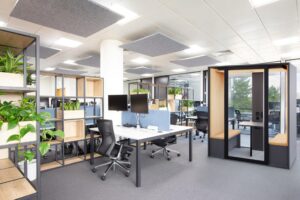
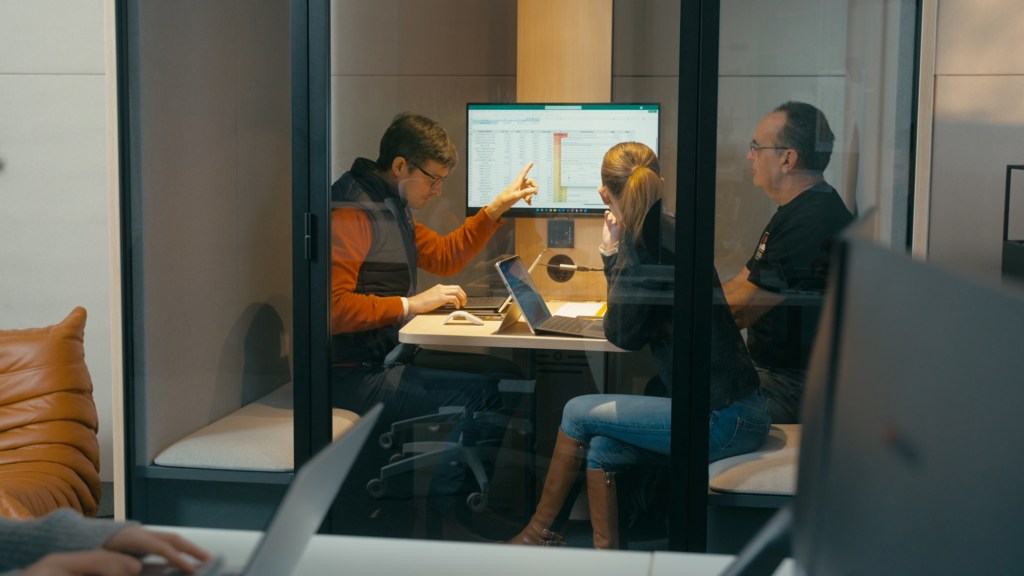
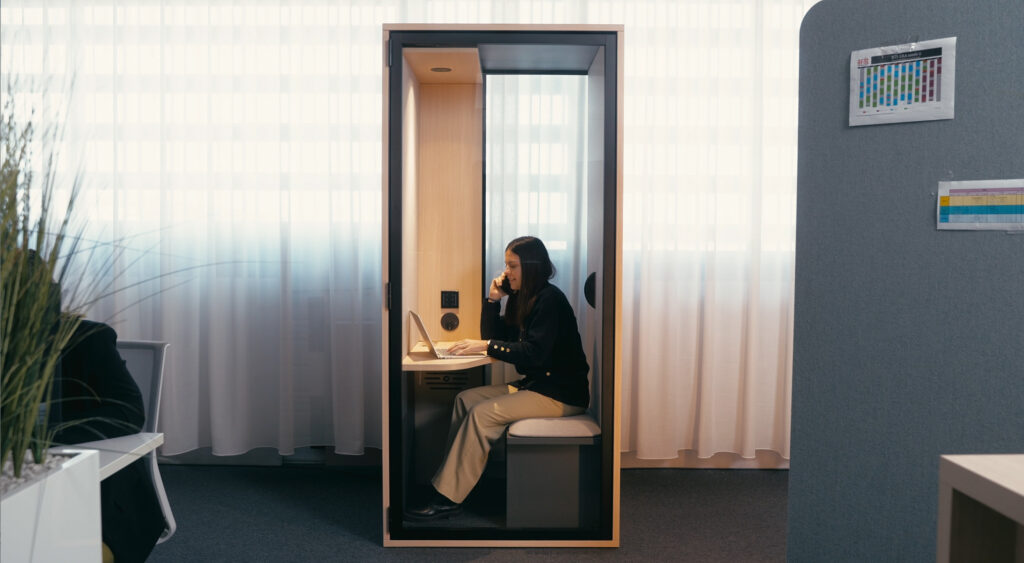
In practical terms, the flex office refers to a workplace where employees no longer have a fixed desk. Each day, they choose a space based on their activities: a quiet corner to concentrate, a collaborative room for a team workshop, a booth for a video call, or an informal area to chat over a coffee. The company therefore designs different types of zones to cater for this variety of uses.
Contrary to certain misconceptions, the flex office is not synonymous with a total lack of structure. Certain critical roles or individuals with specific needs may retain a priority workstation. And all of this relies on an infrastructure: booking applications, individual lockers, rules of use (notably the famous ‘clean desk’ policy).
It is important to distinguish the flex office from other related concepts. desk sharing or hot desking involves several people using the same workstation at different times, but without the element of layout tailored to specific uses. Coworking, on the other hand, often takes place off-site, in spaces shared by several companies.
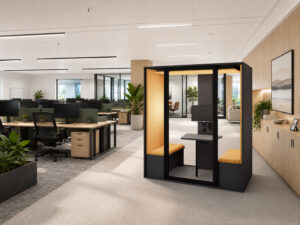
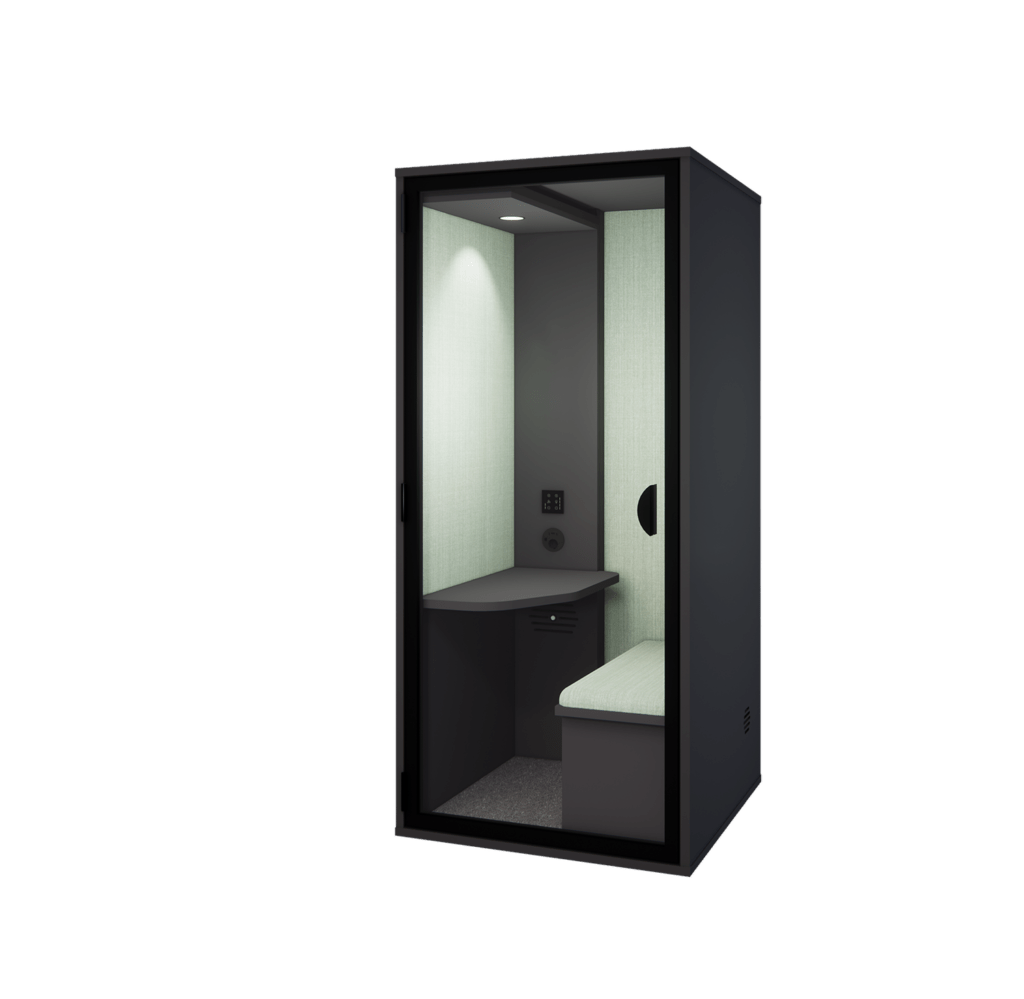
In everyday language, we also refer to ‘nomadic workstations’, ‘flex rates’, or even ‘phone booths’ to describe small individual work cubicles. The flex office is therefore a model that is at once cultural, technological and logistical.
How does the flex office work?
Setting up a flex office environment is by no means improvised. It relies on a rigorous organisation of spaces and clear rules of use. The premises are divided into several zones: concentration areas (total silence), modular open-plan spaces, individual work pods, meeting rooms, informal areas, coffee or break corners, and sometimes even hybrid zones that can be reorganised as needed.
Staff book their workstations via an app. Some spaces may be accessible without a booking, but the trend is towards planning to avoid conflicts of use. Once the day is over, everyone must vacate their workstation, leave it clean (clean desk policy) and store their belongings in a personal locker.
This setup also assumes that not everyone comes into the office at the same time. This is where the flex office ratio comes in, a key indicator: a ratio of 0.7 means there are 7 workstations for 10 people. This ratio is based on attendance data (remote working, travel, leave), and must be regularly adjusted.
Finally, technology plays a vital role: presence sensors, desk booking apps, occupancy dashboards, integration with calendars (Google, Outlook), smart lockers, notification systems… everything is designed to make the use of space fluid and measurable.
The proven benefits of the flex office
The first tangible benefit of the flex office is financial. By eliminating unoccupied fixed workstations, companies can significantly reduce their office space, and therefore their rent, service charges, maintenance and equipment costs. This rationalisation is all the more relevant in major cities where every square metre counts.
But beyond cost optimisation, the flex office offers a new way of experiencing work. Employees gain greater autonomy: they choose where and how to work. This power to decide on their working environment boosts motivation, efficiency and well-being. The change in daily routine (not always being in the same place) also encourages cross-team interaction, breaks down silos, fosters chance encounters, and thus the flow of ideas.
The flex office is also a tool for HR attractiveness. It projects a modern, agile and open image, and aligns with the expectations of the younger generations. Finally, it acts as a lever for organisational resilience: during periods of remote working, absences or peaks in activity, it enables better management of fluctuations in attendance.
Limitations, challenges and risks of the flex office
Flexible working is not a magic solution. Like any transformation, it provokes resistance, misunderstandings and even operational difficulties. The first limitation, often cited, is the sense of losing one’s bearings. No longer having a designated desk can be perceived as a loss of status or comfort. Some employees regret no longer being able to personalise their workspace or easily find their colleagues. This can affect the sense of belonging or even create a climate of instability.
Another challenge: occupancy during busy periods. If the flex office ratio is poorly calibrated, on certain ‘busy’ days there may no longer be enough spaces available. Frustration quickly mounts when an employee has to search for a desk for 20 minutes.
Concentration is also an issue. In an open-plan environment, noise or people walking past can disrupt tasks requiring concentration. Without clearly designated quiet zones, productivity may suffer.
Ergonomics is another often-overlooked limitation. Not all workstations are equally comfortable. If employees change chairs or positions every day, this can lead to discomfort or even physical ailments.
Finally, change management is key. Without support, clear communication or training, the transition to a flex office can generate strong resistance. Anxiety about “finding a good spot” or the fear of being monitored by space management tools are very real.
Nor should the regulatory aspects be overlooked: in France, the introduction of a flex office in companies with more than 50 employees must be subject to consultation with the Social and Economic Committee (Article L. 2312-8 of the Labour Code).
How to implement a flex office in a company
The success of a flex office depends on thorough preparation. The first step is to carry out an audit of current usage: which areas are used most? What are the teams’ expectations? How many days of remote working on average? This assessment can be supplemented by an internal survey of employees.
Next, it is recommended to launch a pilot scheme: a team, a floor or a department can trial the system. This test helps to identify any glitches in the system, adapt the rules, and, above all, reassure the teams.
Then comes the time for the rules of the game. It is essential to define a clear usage policy: who can book what, when, and with what priorities? Do you have to vacate your workstation if you are away for two hours? A “clean desk” policy must also be introduced: you leave your workstation clean and empty after use.
In terms of tools, you need to equip yourself with booking solutions, personal lockers, shared screens, and even occupancy sensors. The physical layout must follow suit: ergonomic workstations, quiet booths, collaborative zones, clear signage…
But above all, you must support the teams. This involves training, practical guides, internal ambassadors, and regular updates. The aim is for every employee to understand the benefits of the flex office and feel comfortable with the new way of working.
Finally, you need to measure and adjust: actual occupancy rates, employee satisfaction, and feedback. The flex office is not a static model. It evolves with the organisation.
Real-world examples of companies
Several major French and international companies have already taken the plunge. AXA France, for example, has adopted the flex office (source: https://www.journaldunet.com/management/ressources-humaines/1500449-les-lecons-de-trois-entreprises-pour-passer-au-flex-office/). Danone has redesigned its workspaces to encourage freedom of choice based on the day’s needs (source: https://www.deskare.io/blog/danone-passage-flex-office-5-etapes).
According to a study by JLL, 26% of service sector companies in France had already adopted some form of flex office by 2023. This figure could reach 40% by 2026.
In terms of figures, the feedback is often positive: up to 30% savings on property costs according to some well-supported companies. And on average, the occupancy rate of fixed workstations before the introduction of flex-office was often below 60%.
Common mistakes to avoid include: removing too many workstations at once, misconfiguring tools, or neglecting the importance of quiet zones. Rolling out the scheme too quickly can create more tension than benefits.
Tools & solutions to support the flex office
The flex office market has seen the emergence of a multitude of software and hardware solutions. On the software side, there are desk booking tools such as Deskare, MOFFI, Flowee, Skedda and Lucca. These platforms allow employees to book their workspace, view the availability of areas, or integrate their presence into their calendar.
The most comprehensive tools also incorporate occupancy analytics: you can see which areas are overused or underused, adjust the flex ratio, and redefine the layout.
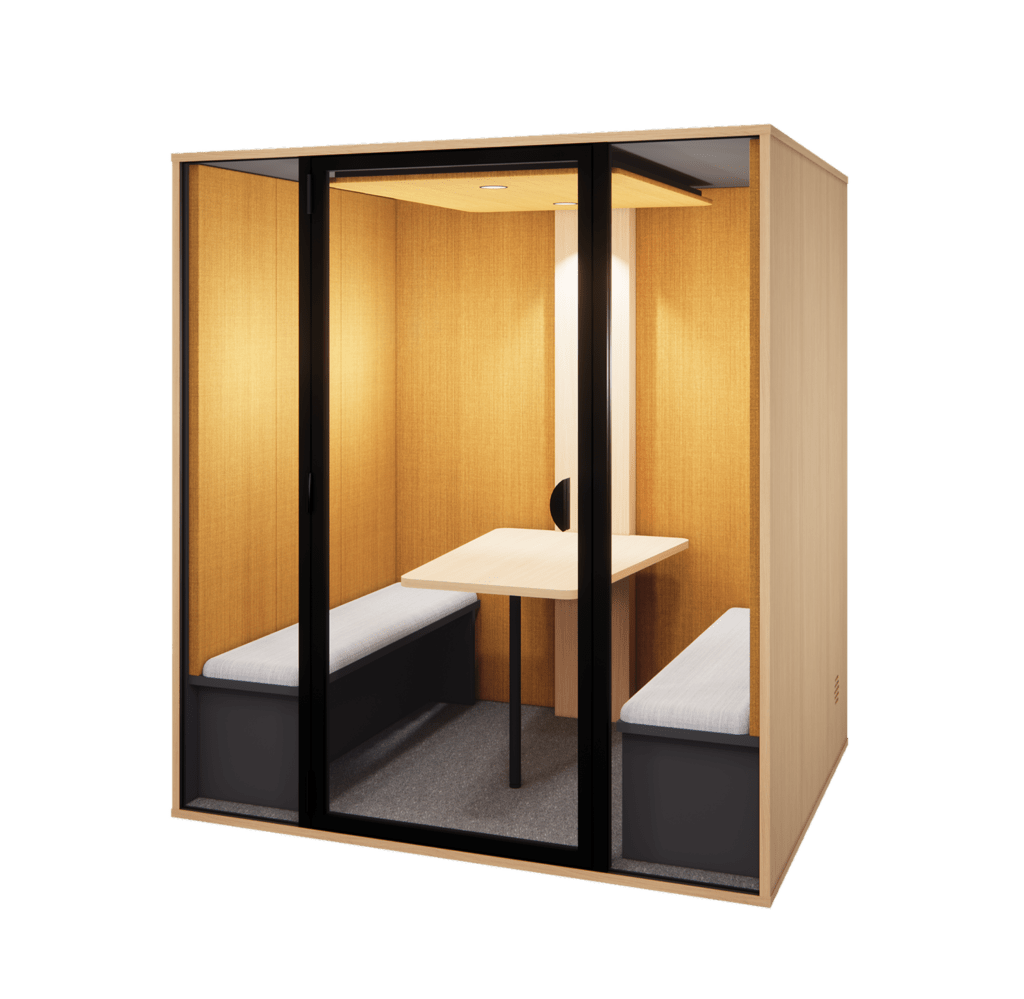
In terms of equipment, smart lockers allow employees to store their personal belongings securely. acoustic solutions – sound-absorbing panels, phone booths, soundproof pods – are essential for ensuring comfort. Finally, furniture must be modular, ergonomic, and sometimes even mobile: height-adjustable desks, detachable screens, adjustable chairs…
Trends & outlook: where is the flex office heading?
The flex office is evolving. Today, it extends beyond the company’s walls. The concept of “work from anywhere” is taking hold: employees can work from third places close to home, such as co-working spaces integrated into the company’s network.
The office is becoming a meeting place, rather than merely a place of production. It hosts key activities: brainstorming, team meetings, internal events. Concentrated work, however, takes place elsewhere.
The digitalisation of spaces is accelerating: sensors, IoT, digital twins of premises, and the automation of lighting or ventilation based on occupancy. The flex office connects to the entire work ecosystem.
Finally, we are seeing the emergence of the concept of “workspace as a service”. The company no longer necessarily owns all its spaces. It rents, shares and adapts. The office becomes a service: flexible, scalable and modular. A subscription-based, pay-as-you-go model is taking shape. And with it, a more fluid, more mobile, more human… vision of work.
Conclusion
The flex office is not simply a change in office layout. It embodies a deeper transformation of working practices, in response to contemporary aspirations: greater flexibility, greater autonomy, but also greater economic and ecological rationality.
Despite its many advantages – optimisation of space, cost reduction, improved collaboration, HR appeal – we must not overlook the challenges it presents: loss of familiar landmarks, resistance to change, ergonomic and acoustic issues, and risks of overcrowding or disorganisation.
Successfully transitioning to the flex office is, above all, a matter of method, listening and iteration. Usage audits, pilot phases, choosing the right tools, change management and long-term monitoring are all essential levers.
Before rushing in headlong, ask yourself: is your company ready to challenge its habits? If the answer is yes, start with an audit. If the answer is no… it may be time to open the debate.
FAQ: Flex office — frequently asked questions
Is the flex office suitable for all businesses?
No. Some businesses, particularly those in manufacturing, retail or highly regulated sectors, require fixed workstations or a specific organisational structure. However, service sector businesses with a significant proportion of office-based work are more likely to benefit.
How can you ensure ergonomics without fixed workstations?
It is crucial to invest in adjustable furniture (height-adjustable desks, ergonomic chairs), modular equipment, and to train staff to set themselves up correctly each time they start work.
What should be done if too many people want to come into the office on the same day?
Booking systems allow you to anticipate and manage footfall. It is also possible to introduce ‘open/closed’ days or to limit attendance through a rota system. The flexible working ratio must be adjusted regularly.
What proportion of workstations should be allocated relative to the number of employees?
There is no single rule. Generally, companies aim for a ratio of 0.6 to 0.8 workstations per employee, depending on remote working rates, critical roles and habits. This ratio must be measured and adapted using analytical tools.
Is a flex office the same as a coworking space?
No. Coworking refers to a space shared between several companies or freelancers, often located externally. Flex office is an internal arrangement, within the company’s own premises.
Can you have a partial flex office?
Yes. Many companies retain some of their allocated workstations (particularly for certain roles) and only apply the flex office model to specific areas or days. This is referred to as ‘mixed-use spaces’.
What tools should you choose to manage a flex office effectively?
Desk booking software, occupancy tracking, smart lockers, internal communication tools and analytical dashboards are the most commonly used. The choice depends on your needs, your budget and the company’s digital maturity.
Will the flex office completely replace fixed desks?
Probably not. The assigned desk retains symbolic and functional value for certain roles. But the trend is towards diversification of spaces, modularity and freedom of choice. The flex office is a tool, not an obligation.