
The flex office is no longer just a trend; it’s a reality. Since the rise of hybrid working, companies of all sizes have been rethinking their office spaces. But how can you transform static office space into agile, productive and pleasant environments? This article provides you with all the keys to making this transition a success. At the heart of it all is an often-overlooked factor: acoustics.
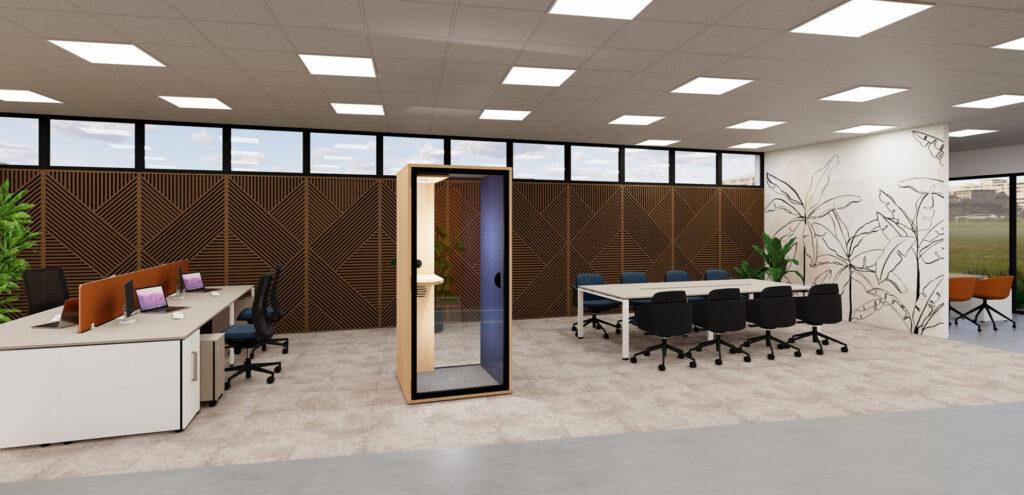
Understanding the flex office: an office without fixed desks
The flex office, or flexible office, is based on a simple principle: no more assigned desks. Each employee settles in according to their needs at any given moment. Meetings, focused work, video calls, breaks… the space adapts to its use.
Why is this model so appealing? Because it addresses three key challenges:
- Reduced property costs
- Increased team mobility
- Optimisation of floor space
But it also presents challenges: a sense of disorientation, noise, cognitive fatigue. Hence the importance of a well-thought-out layout.
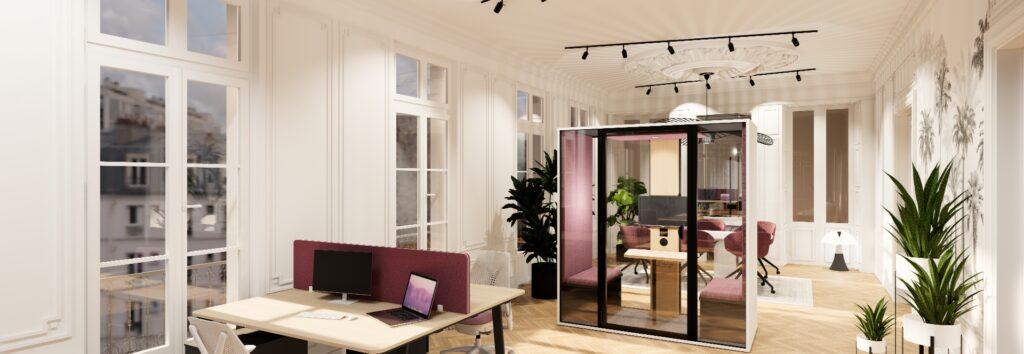
Getting off to a good start: involve, listen, structure
A flex office isn’t something you simply decree. It’s something you build. Involving employees from the outset is essential. Why? Because only they can say:
- “I need peace and quiet to concentrate.”
- “I’m on a lot of video calls.”
- “I switch tasks frequently.”
Next, assess actual occupancy rates, peak attendance times and your teams’ habits. Set clear rules: booking, occupancy times, tidiness and noise management. The success of a flex office relies on a fluid yet structured organisation.
Create zones suited to every purpose
Good layout is based on diversity. A single space cannot cater to every need. Here are the four key zones to create:
1. Collaborative spaces
High tables, modular furniture, walls for brainstorming. These spaces are designed for discussion, socialising and creating together.
2. Focus areas
Ergonomic chairs, natural light, low footfall. Here, silence is respected. This is ‘deep work mode’.
3. Relaxation and informal spaces
Kitchen, alcove, sofa area. Spaces where you can unwind, and where the best ideas sometimes emerge.
4. Personal storage
Lockers, drawers, smart lockers: an essential for the clean desk.
Never overlook acoustics
One of the main obstacles to the flex office is noise. Phone calls, keyboards, overlapping conversations… it all blends together. The result: reduced concentration, increased stress, mental fatigue.
Yet, the solution exists.
Acoustic treatments for walls and ceilings help absorb some of the noise. But they aren’t enough. It is acoustic booths that provide a real break from the noise.
Integrating acoustic booths: a no-brainer for the flex office
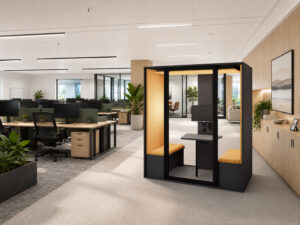
Acoustic booths meet a simple need: to be able to shut oneself off. Making a call, conducting an HR interview, dealing with a confidential matter… all of this requires peace and quiet.
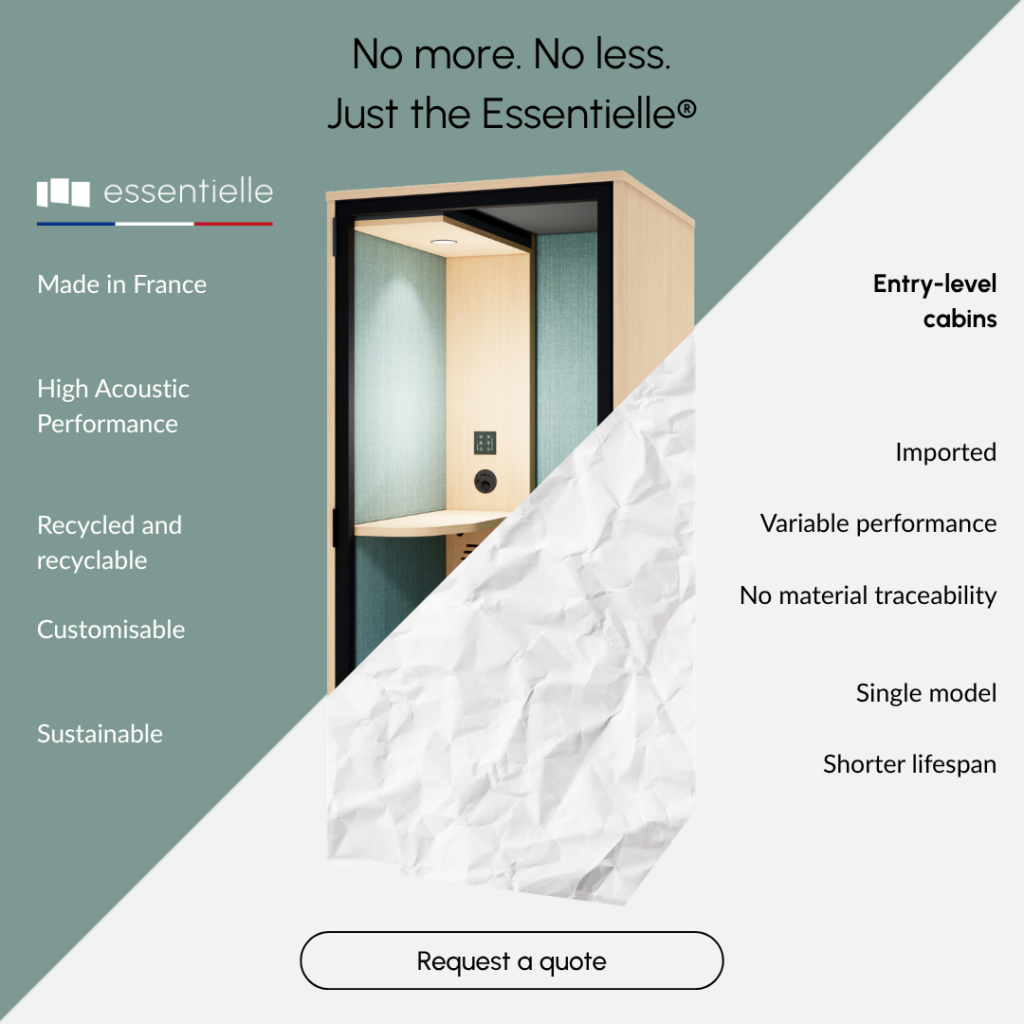
The Essentielle range, designed by Buronomic, goes beyond a simple soundproof enclosure. It is designed for modern, hybrid, demanding work.
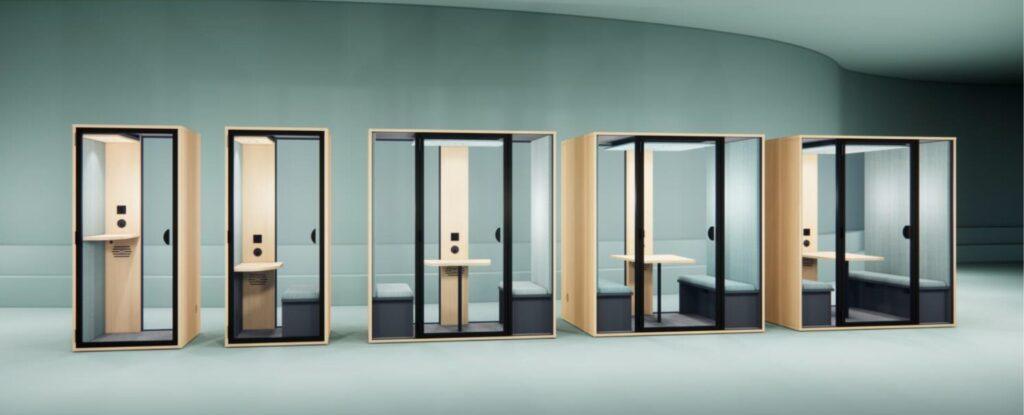
Why choose an Essentielle booth?
Speech level reduction: -30.3 dB
Ultra-quiet ventilation: air renewed in under 40 seconds
Mobile and stable structure: invisible castors, installation without building work
Full connectivity: 220 V power socket, USB-C, USB-A, RJ45
Premium comfort: 800 lm LED lighting with touch-sensitive dimmer, multi-layer acoustic insulation
Eco-design: recycled panels, fabric made from plastic bottles, controlled carbon footprint
The right ratio: 1 single booth + 1 duo booth for 15 people
The Essentielle S (1-person) and Essentielle M (2-person) models cover the majority of uses. They allow you to handle calls and moments requiring privacy without monopolising a room.
In a flex office environment, this is a key tool for maintaining both fluidity and comfort.
Modularity and scalability: think agile!
Flexible office spaces require adaptable layouts. Your layout must be able to change within 24 hours, not six months.
Focus on:
Furniture on castors
Modular partitions
Mobile, repositionable booths
And above all: measure actual usage. Using sensors or simply user feedback, adjust the space as needed.
Best practices to remember
Draw up a usage charter: who does what, when and where
Limit usage conflicts through online booking
Train your teams in new practices (digital, posture, audio)
Encourage feedback: continuous improvement is essential
A good flex office isn’t just about the furniture. It’s an ecosystem designed for agility, comfort and performance. Acoustic booths play a central role in this. They balance mobility and concentration, collaboration and privacy. And with the Essentielle range, you’re making a reliable, sustainable… and French choice.