
All phone box manufacturers tout their eco-friendly credentials. “Sustainable materials”, “eco-friendly design”, “responsible manufacturing”: the buzzwords are endless.
But behind the marketing hype, the environmental reality of a phone box varies enormously from one manufacturer to another.
This guide examines what a recycled sound booth really entails:
- actual composition,
- certifications to look for,
- the distinction between recycled and recyclable,
- and criteria for assessing the sincerity of an eco-friendly approach.
Recycled phone box: what does that mean?
A recycled phone box incorporates, right from the production stage, materials from a previous life cycle: PET bottles for the fabric, wood offcuts for the panels, and reclaimed steel for the structure.
The marketing trap is well known. A phone box containing 10% recycled materials can be marketed as “recycled”. The serious benchmark is 50 or 60%, and requires external certifications to be substantiated.
Four levels of commitment coexist. Greenwashing, limited to a sales pitch. Partial eco-design, documented for two or three components. Full eco-design, certified across the entire booth. And Cradle to Cradle, which takes the logic all the way to complete dismantling at the end of life.
What does an eco-designed soundproof booth consist of?
Five families of materials make up a phone booth.
Here is the state of the market and Essentielle’s figures for each.
The interior fabric. Recycled polyester from PET bottles is the current standard. Essentielle’s Chili range (designed by Gabriel) is made from 100% recycled polyester.
Wood panels. PPSMHD compressed melamine contains over 50% recycled wood in the Essentielle range.
Foam. This is the acoustic component that is most difficult to recycle. Essentielle uses foam that is 100% recycled in the Ardèche region. Acoustic performance equivalent to new.
Steel. 98% recycled, it is the most established material in the chain.
Glass. 8 mm Silence laminated glass remains the most complex material to recycle, with a current recycled content of 20%.
Packaging. It is 83% recycled.
Recycled or recyclable: the nuance that changes everything
The two terms are often mistakenly confused in product specifications.
A recycled material has already been used. Its manufacture did not consume new resources. The carbon footprint is reduced right from the production stage. This is an immediate benefit, verifiable through certification.
A recyclable material can be recycled at the end of its life, provided that a recycling chain exists and the user takes the necessary steps. At the production stage, the impact remains the same as for virgin material.
The ideal scenario combines both. This is the Cradle to Cradle principle: recycled material at the start, components that can be fully disassembled at the end. Essentielle cabins, designed without permanent bonds between wood, fabric and metal, can be fully dismantled at the end of their life.
A habit to adopt when checking a product specification sheet: demand both percentages. The percentage of recycled materials at the start. The recyclability rate at the end.
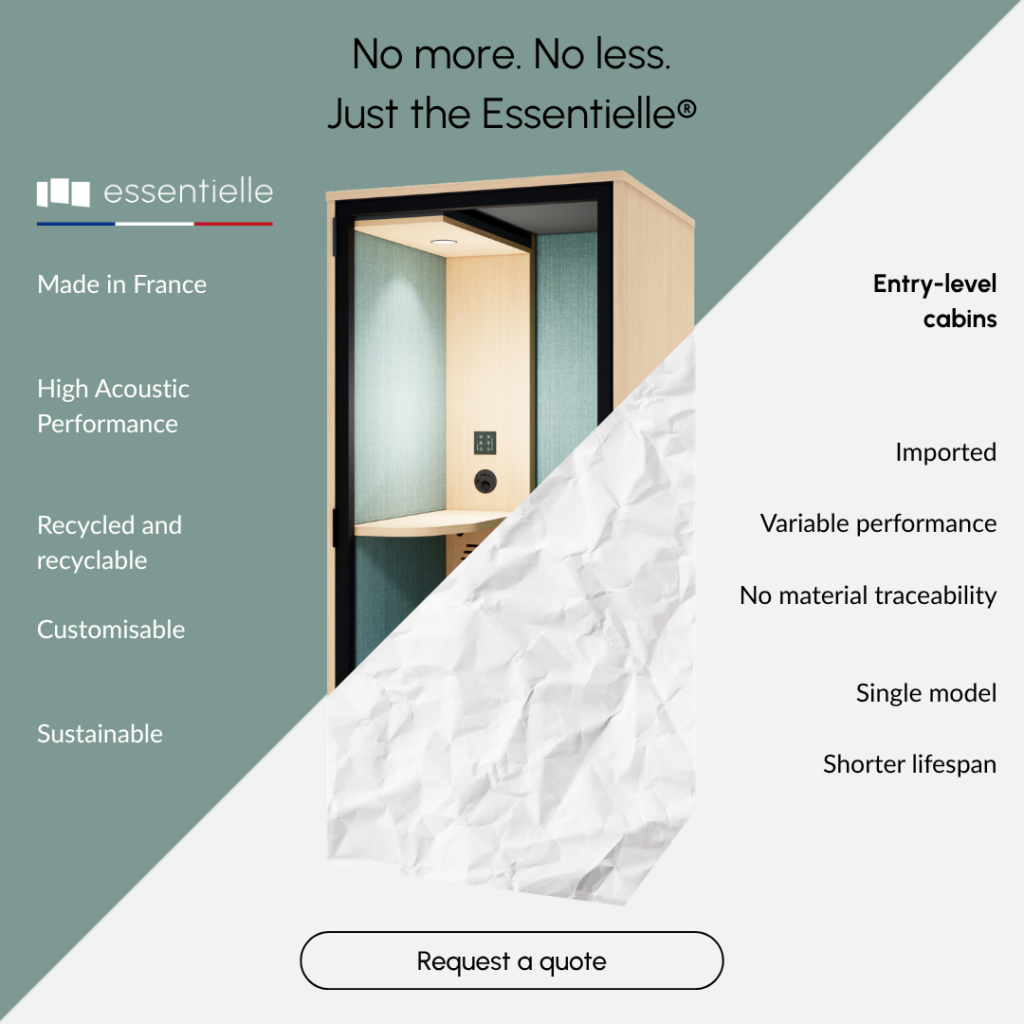
The Essentielle approach: 60% recycled materials
Three commitments underpin Essentielle’s eco-responsible approach.
Detailed composition by material. 60% recycled materials across the entire cabin. Fabric 100%, packaging 83%, wood over 50%, steel 98%, glass 20%. Data audited as part of the Eco Impact rating (criterion A on the A to E scale).
Traceable short supply chain. Wood and steel sourced in Drôme, foam in Ardèche, benches in Isère, glass in Drôme. Geographical proximity reduces the carbon footprint of transport. ‘Origine France Garantie’ certification.
Internal circular economy and end-of-life management. In the workshop, wood offcuts feed the industrial boiler that heats all the premises: no production waste is lost. Unsold items are sent to a local recycling centre for a second life. At the end of its useful life, each cubicle can be fully dismantled and each component sent to its specific recycling stream.
Questions to ask your supplier
Four questions make all the difference before you buy.
What is the exact percentage of recycled materials?
Ask for an overall figure and a breakdown by component. Below 40%, the environmental argument remains weak. Above 50%, the approach starts to be taken seriously.
What certifications can you provide?
PEFC, Oeko-Tex, Origine France Garantie, Éco Impact. With certification numbers for verification on the official websites.
Where is each component manufactured?
A cabin assembled in France may incorporate imported materials. Insist on the location of each material individually, not just a mention of final assembly.
Can the phone box be 100% dismantled at the end of its life?
This is the Cradle to Cradle test. A documented response, including a dismantling procedure, distinguishes a genuine approach from a marketing promise.
Choosing a recycled phone box is not a symbolic gesture. It is a measurable CSR lever, a real gain in terms of material quality, and a more sustainable investment in the long term. Provided you know how to read the product specifications and avoid vague wording.
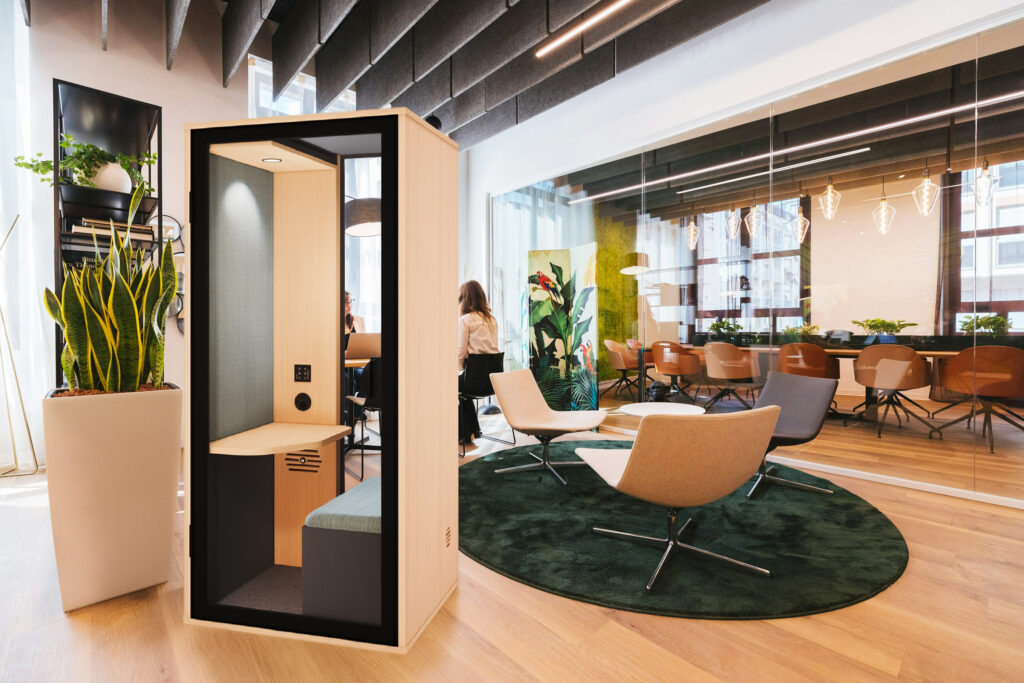
Essentielle offers five eco-designed models (1-person phone box, 1-person office phone box, 2-person phone box, 4-person phone box, 6-person phone box), all rated Eco Impact criterion A and manufactured in the Drôme region.