
Why a soundproof booth is more than just a piece of furniture when working with patients
In the healthcare sector, confidentiality is not just a bonus. It is a fundamental requirement of the job, a matter of respecting privacy, and a prerequisite for calm and respectful interactions between patients, families and healthcare professionals.
However, in practice, situations where a separate space is lacking are common: reception areas that can be noisy, busy corridors, open-plan back-offices, team coordination over the phone… and teleconsultations that require both quiet and genuine confidentiality.
The problem is that rooms are not always available. And even when we know a room needs to be created, we don’t necessarily have the desire — or the means — to start building work. Many establishments are therefore looking for a quick, plug-and-play solution that can be deployed without major building work and is robust enough for daily use.
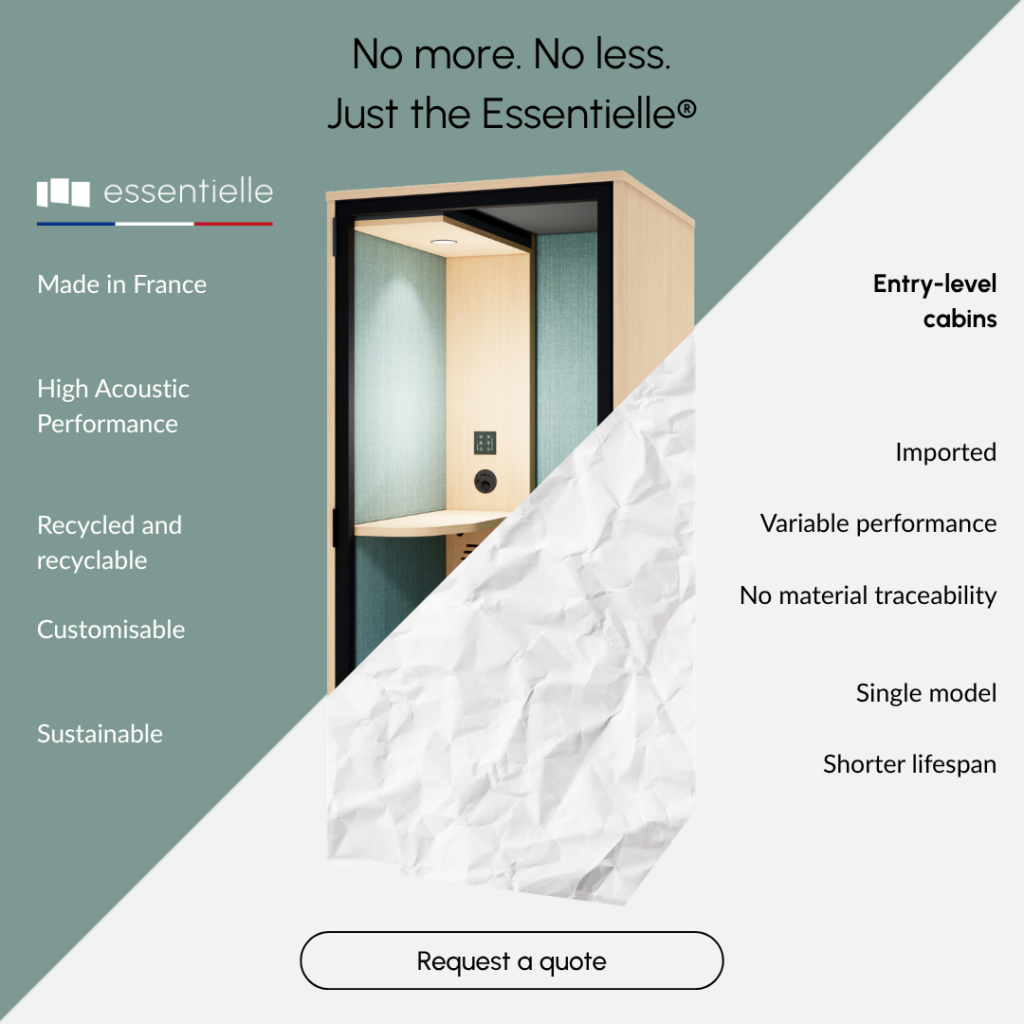
This guide helps you decide, quite simply: when an acoustic booth is the right solution in healthcare, where to install it, what to check before buying (acoustics, ventilation, usage, maintenance), and how a range such as Essentielle can address key constraints, with concrete technical specifications (acoustics, ventilation, lighting, connectivity, materials, environmental impact, made in France).
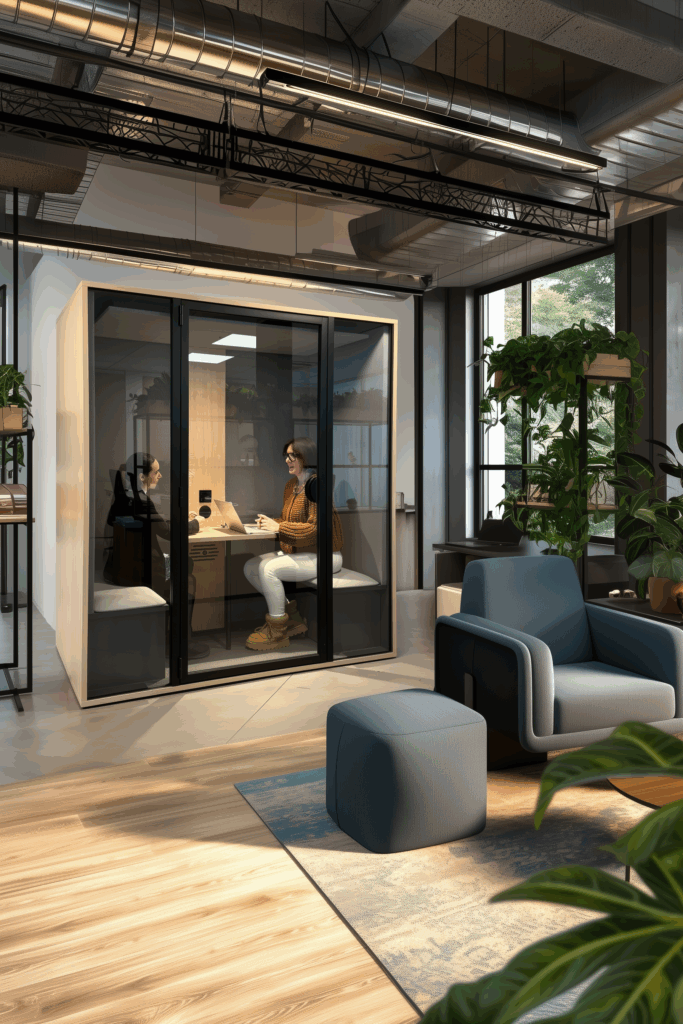
Yes, an acoustic booth can solve three major problems in healthcare settings
An acoustic booth is often a relevant solution in healthcare because it addresses three very specific issues.
Problem 1: confidentiality of conversations
The aim is not to eliminate all noise, but to limit audibility from outside: to allow a normal conversation without words being understood in the immediate surroundings (patient, corridor, waiting room, neighbouring office).
Problem 2: teleconsultations
For a teleconsultation, a video call with a colleague, or remote coordination, you need a space where you can hear clearly and be heard: less background noise, greater comfort over 10 to 30 minutes, and a sense of a professional setting.
Problem 3: staff concentration
Between patient files, coordination, calls and administrative tasks, ambient noise is tiring and disruptive. A booth can become a calling/video area or a space for occasional focus that reduces the impact of noise on work.
A phrase that avoids false expectations: a booth does not eliminate noise from a building; it creates a bubble of privacy and comfort in the right place, without major construction work.
The most common use cases in healthcare
Teleconsultation and telehealth
Typical scenarios are easy to spot: pharmacy, lobby, clinic, health centre, reception area… practical locations because they are accessible, but not designed as consultation spaces.
In these contexts, the requirements become very specific:
a door that closes properly to create a real separation,
reduced external noise to ensure the conversation is clear,
thermal and air comfort that lasts for more than 10–30 minutes,
stable lighting,
connectivity that avoids the need for makeshift solutions.
Sensitive calls and medical coordination
Calls with laboratories, colleagues, service providers, insurers, families, sometimes in emergencies… In real life, we soon end up making calls ‘as best we can’, in a corridor or behind a counter, with that constant awkwardness: we don’t want to speak too loudly, but we must be clear.
The need here is simple: to be able to speak normally without disturbing the department and without being overheard. A booth can accommodate these coordination moments and prevent high-traffic areas from becoming makeshift meeting places.
Open-plan administrative spaces in hospitals and clinics
Without exaggerating, noise has a clear effect on staff: fatigue, irritability, lapses in concentration, and more tense interactions. A booth does not replace a comprehensive layout policy, but it often delivers a quick win by creating a dedicated space for:
- calls,
- video calls,
- micro-meetings,
- or focus sessions.
The advantage is simplicity: we shift some of the noise into a closed bubble, without bringing a worksite to a standstill.
Acoustic booth or acoustic treatment
What the booth actually achieves
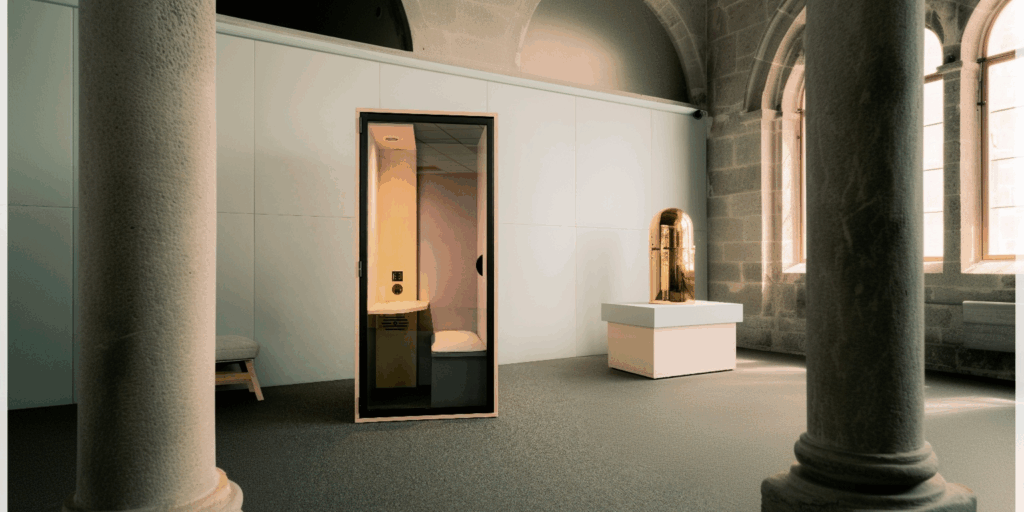
An acoustic booth (soundproof booth, phone box) serves a very clear purpose: a closed space that provides better insulation than simple open-plan furniture. It is particularly effective when you need to ensure confidentiality and quality of communication in a specific location: teleconsultations, sensitive calls, coordination.
What panels and absorbent materials improve
Acoustic panels and absorbent materials play a different role: they reduce reverberation and make a room more acoustically comfortable. This is particularly useful in waiting areas or very hard-surfaced offices (where there are many surfaces that reflect sound).
The key message: absorption ≠ total confidentiality. Very often, the most sensible strategy is hybrid: improving the overall comfort of the space (absorption) and creating a genuine bubble for sensitive conversations (booth).
The 6 essential criteria in healthcare
Speech confidentiality
In healthcare, the primary objective is confidentiality. The aim should be a booth that reduces intelligibility from outside, rather than a promise of total silence.
Essential benchmark:
- reduction in speech level down to -30.3 dB. This is a useful figure because it relates directly to the voice — and therefore to patient consultations and calls.
Ventilation:
A booth that feels hot or cramped is a booth that people avoid. And in healthcare, an underused booth quickly becomes a frustrating investment.
Key figures (ventilation rates):
- S / S Office: 280 m³/h (3 fans)
- M: 575 m³/h (6 fans)
- L / XL: 750 m³/h (8 fans)
- Air renewal: 40 seconds
The idea is simple: airflow and air renewal determine the ability to hold a full session without discomfort.
Lighting
Lighting has two direct effects: comfort (visual fatigue) and perceived video quality. A professional teleconsultation also depends on a stable and pleasant image.
Essential specifications:
- LED spotlight(s), 800 lm, 3000 K, with touch dimmer to adjust lighting and ventilation.
Connectivity
In a healthcare setting, a dedicated solution is better than a makeshift system. If the booth is designed for practical use, it should avoid extension leads on the floor and haphazard connections.
Essential Connectivity: 220 V + 2 USB-C + 1 USB-A + 1 RJ45.
Put simply: power supply, charging, and a wired network where needed.
Layout and clearances
Even a very good booth can be disappointing if it is poorly positioned. The logic is simple:
- avoid placing it right up against a wall if this disrupts air circulation,
- avoid high-traffic areas,
- choose a location consistent with its intended use (telemedicine, calls, coordination).
Essential operational rule: allow approximately 10 cm between the wall and the air inlets/outlets to ensure optimal air circulation.
Maintenance and materials
In healthcare settings, usage is intensive and cleaning must be regular, without complicating day-to-day operations. The aim is not to invent a protocol, but to plan ahead: surfaces, flooring, fabrics, cleaning frequency, internal responsibility.
Essential design elements:
- exterior cladding in compressed wood,
- floor covering in polyester carpet.
This information is primarily intended to raise a practical question: how do you organise maintenance to ensure the cubicle remains comfortable and presentable, week after week?
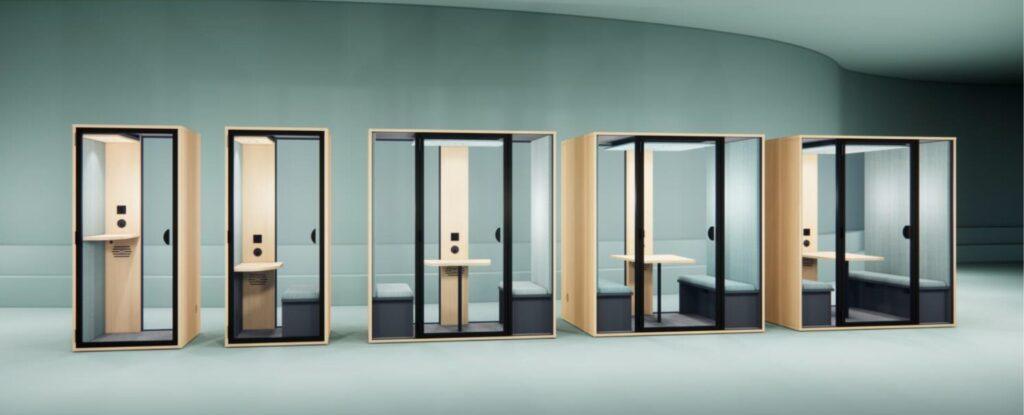
Which size to choose for healthcare settings
Single-person cubicle
This is the go-to option when you need a dedicated space available at short notice: calls, video calls, brief confidentiality, occasional teleconsultations.
Essentielle S specifications:
- External dimensions: 95 × 96 × 212 cm
- Internal dimensions: 87 × 83 × 198 cm
- Floor area: 0.9 m²
- Weight: 255 kg
- Ventilation: 280 m³/h; air change rate < 40 s
- Lighting: 800 lm, 3000 K
- Connectivity: 220V + 2 USB-C + 1 USB-A + 1 RJ45
- Glazing: 8 mm laminated “Silence” (glazed door)
This format is ideal when the aim is to provide a private space for a conversation without tying up a meeting room.
1-person booth with desk/seating
The key difference isn’t the acoustics: it’s the ergonomics. As soon as the session lasts more than a few minutes, posture makes all the difference (taking notes, reviewing files, drafting documents, slightly longer teleconsultations).
2–4-person booths
As soon as you have a one-to-one discussion (interview, confidential matter) or a coordination meeting with 3–4 people, the booth becomes a practical alternative: an enclosed space without monopolising a large room.
Key specifications for planning:
- Essentielle M: area 1.8 m², ventilation 575 m³/h, air change rate < 40 s
- Essentielle L: area 2.4 m², ventilation 750 m³/h, air change rate < 40 s
These formats make sense when you want to accommodate short meetings and sensitive discussions without creating a bottleneck in the meeting rooms.
Where to install an acoustic booth in a healthcare facility
Reception, lobby and waiting areas
The advantage is obvious: it’s accessible to patients. But the risks are just as clear: ambient noise, prying eyes, and the feeling of being on display. The right approach is to choose a location close to reception, whilst avoiding the main thoroughfare.
Accessible, yes — exposed, no.
Administrative and back-office areas
This is often the area where adoption comes most naturally. The rule is simple: the closer it is to users, the more it is used. A booth that is too far away becomes a hassle, so it goes unused.
Proximity to clinical areas
Proximity can be useful for coordination, but it must not create a bottleneck. The aim is not to disrupt traffic flows, not to turn the booth entrance into a waiting area, and to remain consistent with the department’s activities.
Conclusion
In the healthcare sector, the real question is is this a good use: confidentiality, teleconsultation, coordination, concentration, without major building work.
To make a quick and sound decision, follow a simple logic:
confidentiality of conversation,
real comfort,
lighting and connectivity,
coherent layout,
proactive maintenance.