
Why have small meeting rooms for 2 to 4 people become essential in open-plan offices?
With open-plan offices, flex offices and co-working spaces, the workplace has been transformed. We’ve gained flexibility, sometimes in terms of floor space, and often in terms of team dynamics. However, one need has become clear: the need for intermediate spaces. Between the phone booth, for one person, and the large meeting room – which is rarely available, booked out or oversized – there is a lack of a simple, readily available format for day-to-day meetings.
This is precisely the role of small meeting rooms for 2 to 4 people. They cater to very specific situations:
- quick, unscheduled meetings,
- team updates,
- interviews,
- video calls with two or four people,
- and project coordination without having to book a large room.
They also address recurring issues: background noise, insufficient privacy, difficult video conferencing (Teams, Zoom, Google Meet), unavailable rooms, and booking friction.
In this article, we help you choose the right format for a mini meeting room for 2 to 4 people, determine the right size, check the key criteria (acoustics, ventilation, lighting, USB ports, table, comfort), and compare solutions without falling for marketing hype.
The best meeting room for 2 to 4 people depends on 3 criteria: usage, privacy and layout
Before comparing products, clarify these three points. They determine the right solution to use.
First criterion: actual usage.
If your main need is for one-to-one meetings, interviews or a video call between two people, an acoustic booth for one to two people may suffice.
If your requirement clearly targets “2–4 people” (team meetings, mini-meetings, client meetings, hybrid video calls), you need a dedicated, enclosed mini-room with a suitable table and seating.
Second criterion: the expected level of confidentiality.
A confidential discussion does not have the same requirements as an informal brainstorming session. The question to ask is not “is it quiet?”, but “is it difficult enough to hear what is being said from outside?”.
Third criterion: the layout.
A mini room for 2–4 people must fit into an open-plan office: floor space, circulation, access, ventilation, ceiling height. A good solution on paper can become a bad solution if it is poorly laid out.
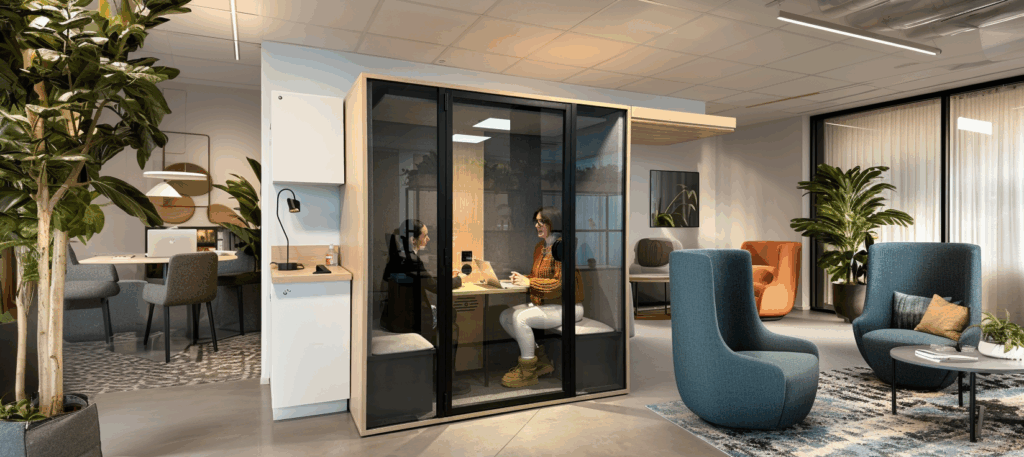
Meeting room for 2 to 4 people: what exactly are we talking about?
2.1 Closed mini-room vs open “meeting corner”: two very different effects on noise
There are two main approaches.
A closed mini-room (soundproof booth) has an immediate effect: greater privacy and less disruption to the open-plan area. Voices remain “contained” within the space, which helps both the occupants and those working nearby.
An open meeting area (alcove, open cubicle) can be useful for informal chats, but it quickly reaches its limits when you need to talk for a long time, discuss a sensitive topic, or hold a high-quality video call.
2.2 “2-person” soundproof booth vs “4-person” mini room: what really changes
The difference between a 2-person and a 4-person format is not simply a matter of “two extra chairs”.
- The 2-person format is mainly used for interviews, one-to-one meetings, video calls between two people, and brief discussions.
- The 4-person format is used for mini-team meetings, briefings, client updates, and more frequent hybrid uses (screen sharing, document sharing).
2.3 The 4 most common use cases
Four uses regularly crop up in research and in teams’ day-to-day work:
- unscheduled quick meetings within the open-plan office;
- video conferences for 2 to 4 people on Teams, Zoom or Google Meet;
- HR interviews and discussions requiring confidentiality;
- brainstorming and project updates without blocking out a large room.
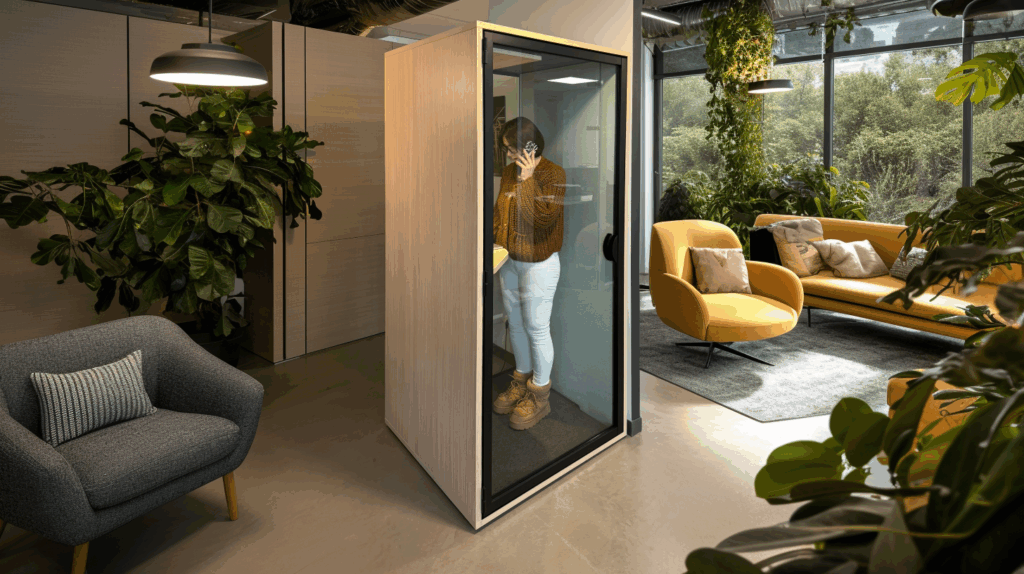
3) Sizing the meeting space: capacity, floor area and comfort (without making a mistake)
3.1 The stated capacity (2–4): how to translate this into actual comfort
The stated capacity does not guarantee comfort. What matters is the reality inside: the table, space between people, seating, movement, posture, and positioning during video calls.
Before making a decision, you must check the interior dimensions and ask yourself some simple questions: do people’s legs fit? Can the screen be positioned without the table being too short? Can people enter and exit without disturbing everyone else? Can people sit for 30 to 60 minutes without feeling ‘cramped’?
3.2 Floor area and footprint in an open-plan office: the key figure that makes (or breaks) the project
In an open-plan office, what makes a project go ahead or stalls it is the available floor space. Always ask for three pieces of information: external dimensions, floor area, and the necessary clearance around the unit.
According to Essentielle’s guidelines, the figures are clear:
And that’s not all: you must also factor in circulation and ventilation requirements. A mini room isn’t a piece of furniture you simply “stick” against a wall. You need to allow space for the cubicle to function properly.
3.3 Table, seating, screen: is the mini meeting room really a “modern meeting space”?
A small meeting room that’s useful in 2026 must be designed for modern uses:
- laptops,
- video conferencing,
- screen sharing,
- calls,
- and occasionally a hybrid meeting.
This requires a table at the right height, sufficient depth, comfortable seating, and accessible connectivity. The connectivity expected in these formats, when integrated, follows a simple logic: power supply and ports to avoid DIY solutions.
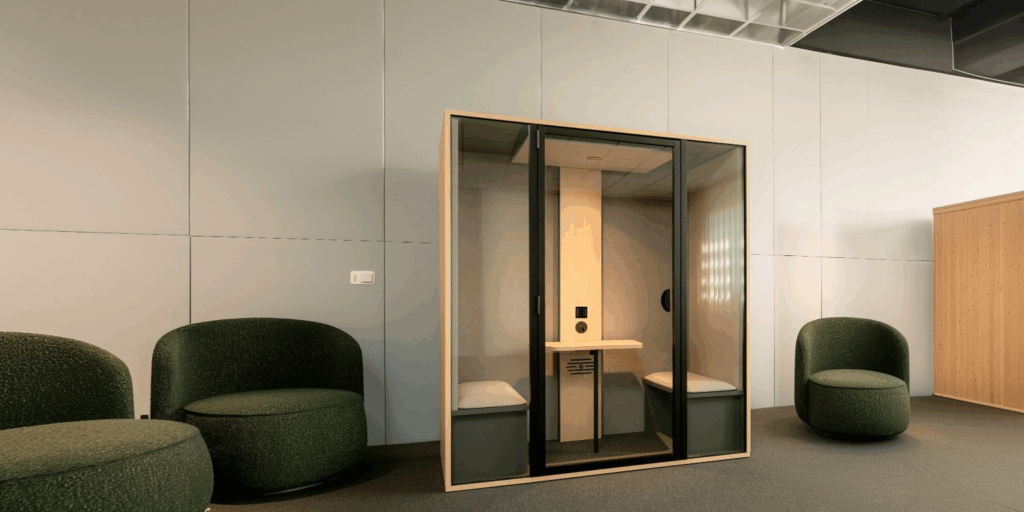
4) The 6 technical criteria that make a good room for 2–4 people
4.1 Acoustics: the aim is not “silence”, it is confidentiality
The right question is not “is it 100% soundproof?”. The right question is: is speech sufficiently difficult to understand from outside, and can the meeting take place without disturbing the open-plan office?
Essentielle’s benchmarks:
- Model M: A reduction in speech level of up to –30.3dB for optimum confidentiality.
- Model L: A reduction in speech level of up to –30.3dB for optimum confidentiality.
4.2 Ventilation: essential for sitting for 30 to 60 minutes without discomfort
This is a factor that many people realise too late.
A small room is an enclosed space. If the air is not properly renewed, it gets hot, you tire more quickly, and the space is used less.
Essentielle’s guidelines:
- M: ventilation 575 m³/h, air renewal time < 40 s.
- L: ventilation 750 m³/h, air renewal time < 40 s.
And installation matters: a guideline is to allow a clearance of at least 10 cm between the wall and the air inlets/outlets for optimal airflow.
4.3 Lighting: comfort and professionalism on video calls
On video calls, lighting is immediately noticeable. It affects fatigue and the perception of professionalism.
Essentielle’s guidelines:
- M: 1 LED spotlight 800 lm, 3000 K.
- L: 2 LED spotlights 800 lm, 3000 K.
4.4 Connectivity and “modern meetings”: USB, PC, RJ45, and the reality of laptops
In a small meeting room, connectivity is not a “bonus”. It’s what avoids power strips, cables lying about and meetings that start with “who’s got an adapter?”.
On the Essentielle M and L booths, the connectivity specifications are as follows: 1 x 220V PC socket, 2 x USB-C, 1 x USB-A, 1 x RJ45, with a ventilation/light dimmer.
4.5 Door, closure, psychological comfort
The door plays an important role: perceived privacy, psychological comfort, and adoption. A mini-room that “closes properly” is more readily used for sensitive topics and calls.
The Essentielle specifications mentioned include:
- reversible door (useful for layout and traffic flow);
- glazed door 8 mm laminated “Silence” (on Essentielle M and L).
4.6 Logistics, installation and building constraints
Finally, there are the actual building constraints. These recur in all projects: ceiling height, access, corridors, lift, handling.
A benchmark cited for ceiling height is: minimum 230 cm, with 240 cm recommended to facilitate assembly and maintenance.
5) Relevant Essentielle models for a small room for 2 to 4 people
5.1 Essentielle M: the compact meeting booth for 1–2 people
The M model is positioned as a compact solution for one-to-one meetings, video calls between two people, and brief discussions.
Essentielle specifications:
- External dimensions: 95 x 190 x 212 cm
- Internal dimensions: 88 x 177 x 198 cm
- Door dimensions: 90 x 204 cm – 8 mm Silence laminate
- Net weight: 400 kg
- Floor area: 1.8 m²
- Shelf dimensions: 51 x 78 cm
- Shelf height: 73 cm
- Bench dimensions: 88 x 38 cm
- Bench height: 45 cm
5.2 Essentielle L: the mini meeting room for 1–4 people
The L model is clearly designed for ‘mini room’ uses: team briefings, client meetings, small hybrid meetings, and video calls with several participants.
Essentielle specifications:
- External dimensions: 136 x 190 x 212 cm
- Internal dimensions: 129 x 177 x 198 cm
- Door dimensions: 90 x 204 cm – 8 mm Silence laminate
- Net weight: 490 kg
- Floor area: 2.4 m²
- Tabletop dimensions: 78 x 92 cm
- Tabletop height: 73 cm
- Bench dimensions: 129 x 38 cm
- Bench height: 45 cm
6) Where should a mini meeting room for 2–4 people be installed in an open-plan office?
6.1 Locations that work: close to teams, but out of the way of foot traffic
A mini meeting room is only useful if it is used. And usage depends heavily on the location. If it is too far away, it becomes a forgotten space. If it is too exposed, it becomes uncomfortable.
Locations that work are often close to teams, but out of the main flow of traffic. Problematic locations are generally corridors, printer areas, and break areas.
6.2 Distances to be observed for ventilation and comfort
Two simple guidelines apply:
- leave at least 10 cm between the wall and air inlets/outlets;
- check the ceiling height: 230 cm minimum, 240 cm recommended.
These details prevent poor performance that has nothing to do with the quality of the product and everything to do with the installation.
7) Showroom checklist:
7.1 ‘Real meeting’ test: 10 minutes with 3–4 people
Hold a real meeting, not a theoretical test. Assess the sense of space, external noise, perceived privacy, and the clarity of communication.
Also test the ventilation: how it feels after 10 minutes is a good indicator. Finally, check the lighting: eye strain, glare, and overall comfort.
7.2 “Video call” test: Teams / Zoom / Google Meet
Start a video call. Check for internal echo, voice clarity, and how easy it is to position the laptop and microphone.
And above all, check that the connectivity options are practical: USB-C, USB-A, 220V socket, RJ45. A small room can be “well-designed” yet difficult to connect on a day-to-day basis.
7.3 Ergonomics test: table, posture, movement
Ergonomics can be assessed quickly: seating comfort, legroom, ease of entry/exit, movement when there are several people.
8) Delivery and installation: issues to resolve before signing
8.1 Installation constraints to anticipate
Three constraints almost always arise:
- ceiling height: min. 230 cm / 240 cm recommended;
- access: lift, doors, corridors;
- ventilation space: minimum 10 cm on air inlet/outlet sides.
Anticipating these avoids unpleasant surprises and unforeseen additional costs.
9) FAQ — Mini meeting room for 2 to 4 people: the most frequently asked questions
9.1 How much floor space should be allocated for a mini meeting room for 4 people in an open-plan office?
You need to consider the floor area and add clearance around it. As a guide, the Essentielle L pod has a floor area of 2.4 m², excluding circulation space.
9.2 What is the minimum equipment required for a mini ‘video-conferencing’ room?
You need comfortable lighting, suitable ventilation, and simple connectivity: USB-C, USB-A, 220V, RJ45. If you’re using a hybrid setup, a screen mount and a cable management system (depending on the configuration) may also be useful.
9.3 Can a mini meeting room be placed right up against a wall?
This is not recommended if it blocks airflow. You need to allow for a minimum clearance, particularly around the air inlets and outlets.