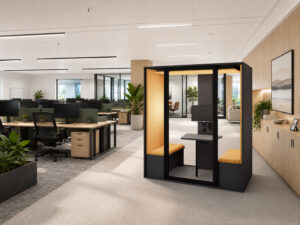

Modern open-plan offices offer open, collaborative spaces… but often at the cost of constant noise pollution. Phone calls, overlapping conversations, keyboard clatter and video calls disrupt concentration and cause very real cognitive fatigue.
Faced with this reality, two solutions stand out for improving the acoustic environment: acoustic panels and acoustic booths. But their objectives and performance are fundamentally different.
This article offers an objective, data-driven and well-sourced comparison to help you make an informed choice.
Definitions and objectives
Acoustic panels
Acoustic panels are designed to absorb sound, particularly echoes and reverberation within a room. By treating walls or ceilings, they improve sound clarity and reduce ambient noise.
The key indicator is the NRC (Noise Reduction Coefficient), which measures absorption capacity. An NRC ≥ 0.75 is recommended for open-plan offices.
Acoustic booths
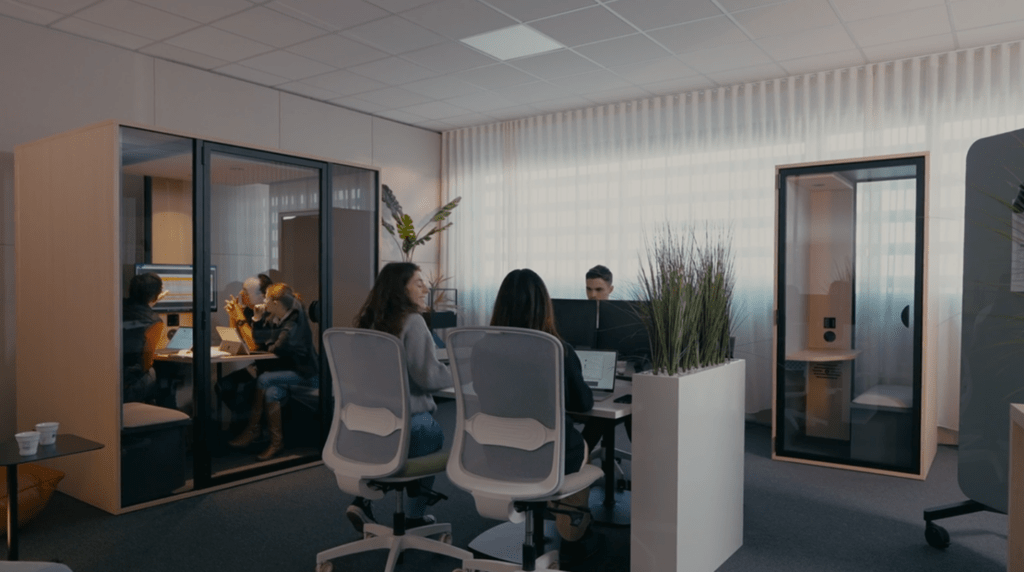
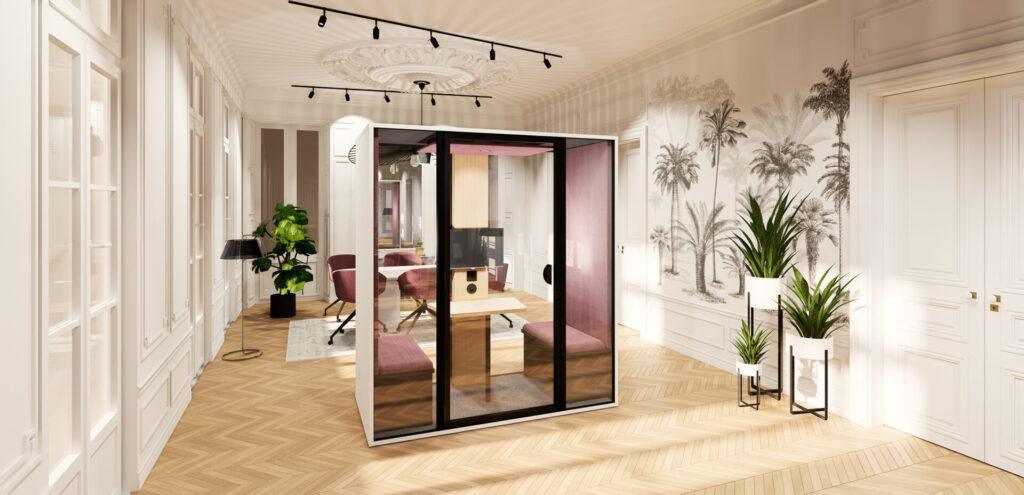
Acoustic booths are enclosed structures. Their purpose is to isolate a space from the rest of the office so that you can make calls, hold video meetings or concentrate without interference.
Acoustic performance: comparison
Speech reduction
- Essential Booth: speech reduction of −30.3 dB.
- Acoustic panels: are not designed to block speech. They absorb sound but do not prevent its transmission.
Overall insulation
- Essential: overall insulation measured up to −30.7 dB.
- Acoustic panels: difficult to quantify. Their performance depends on the type of surface, thickness and installation, but they are not soundproof in the strict sense.
Reverberation vs. soundproofing
- Panels: excellent treatment of internal reverberation (ambient sound), but voices remain audible in the surrounding environment.
- Booths: offer a dual action: echo reduction and blocking of speech transmission.
Uses and application scenarios
In summary:
- Panels are useful for treating an entire room.
- Booths create individual or shared isolation bubbles, without the need for building work.
Studies and feedback
Studies highlight the tangible impacts of noise on performance:
- An open-plan office at 60 dB causes fatigue and reduced concentration.
- Acoustic cubicles improve concentration, reduce stress and enhance the quality of individual work.
Advantages and disadvantages
The benefits of acoustic panels
- Attractive price: acoustic panels are a cost-effective solution, particularly suited to large areas requiring treatment.
- Ease of installation: lightweight, modular and often freestanding or designed to be fixed to walls or ceilings, they do not require major building work.
- Improved acoustic environment: by absorbing resonance and echo, they significantly improve the overall acoustic comfort in a room.
The disadvantages of acoustic panels
- No sound insulation: the panels reduce reverberation but do not prevent the transmission of speech, which limits their effectiveness in situations requiring confidentiality or during phone calls.
- Limited impact on background conversations: in an open-plan environment, direct noise (voices, telephones) remains audible despite the panels.
The benefits of acoustic booths
- Voice insulation: the tested booths offer a measurable reduction in speech transmission, ensuring privacy and concentration.
- Turnkey solution: delivered ready for use, they require no major fitting-out work, unlike a soundproofed meeting room.
- Mobility & flexibility: demountable and reusable, the booths adapt to changing spaces without structural investment.
- User comfort: silent ventilation, integrated lighting, and ergonomics designed for extended calls or video conferences.
The drawbacks of acoustic booths
- Higher unit cost: the initial investment is significant compared to panels, although justified by the overall performance.
- Physical footprint: each booth occupies approximately 1 m² of floor space — a factor to consider in confined spaces.
Conclusion
Acoustic panels and acoustic booths serve distinct yet complementary purposes:
- Panels improve overall acoustic comfort by reducing reverberation.
- Booths offer genuine individual sound insulation.
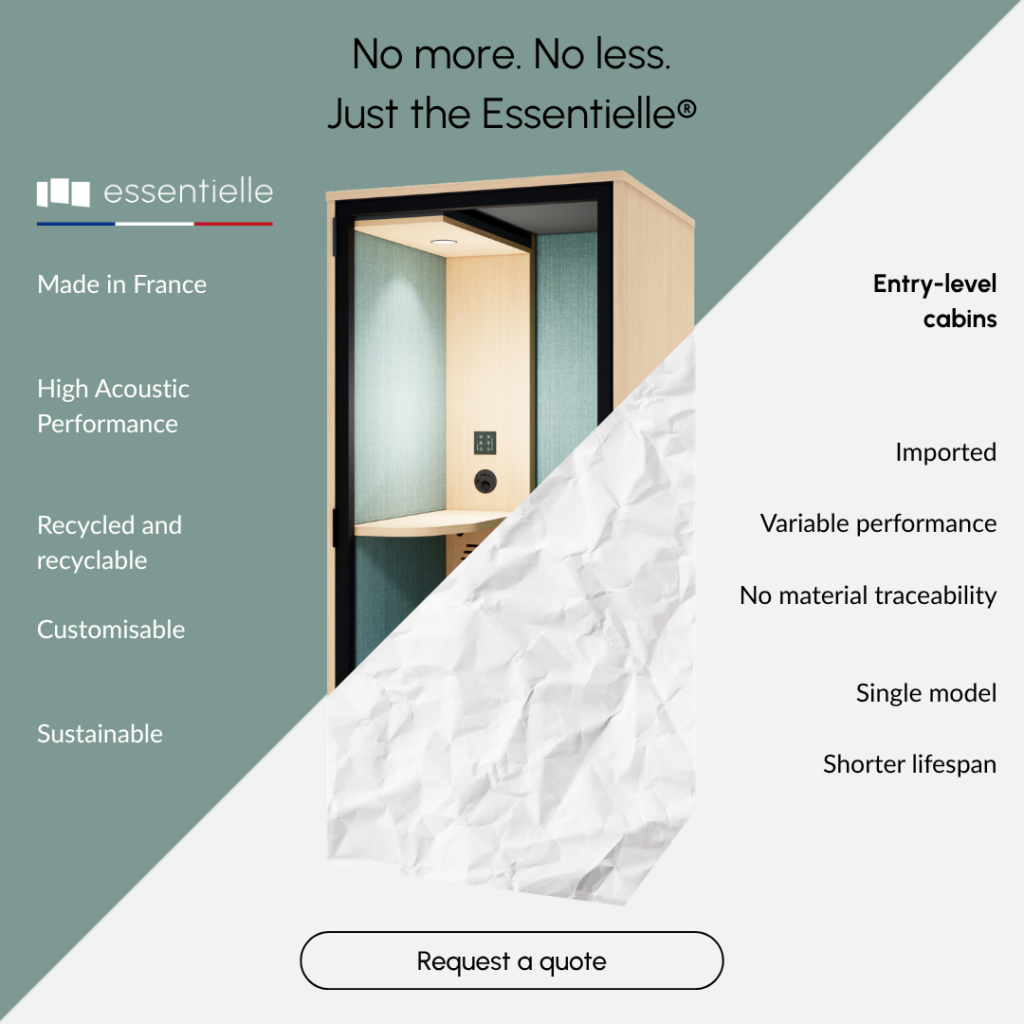
For an effective and measurable approach, the Essentielle booth combines proven effectiveness with rapid deployment requiring no building work.