
Noise isn’t just a nuisance: it’s a direct barrier to performance
In a call centre, sound is part of the job. But as soon as it builds up, it becomes a structural constraint. Incoming calls, outgoing calls, scripts, SDR/BDR, volume pressure, noise peaks, vocal fatigue: everything takes place in an environment where the voice is both the tool… and the main nuisance.
The effects are very tangible. When the environment is too noisy, intelligibility drops, concentration wanes, errors increase, stress levels rise and confidentiality is compromised. It is also a question of headphone audio quality, mental resilience over time, and sometimes video image quality when part of the communication takes place online.
The aim of this article is practical:
- to clarify when an acoustic booth is the best solution,
- to propose a method for fitting out booths and implementing acoustic treatment without major building work,
- to provide a purchasing checklist,
- and to include technical specifications for Essentielle booths: reduction in speech level down to -30.3 dB, ventilation, connectivity, assembly, dimensions and weight.
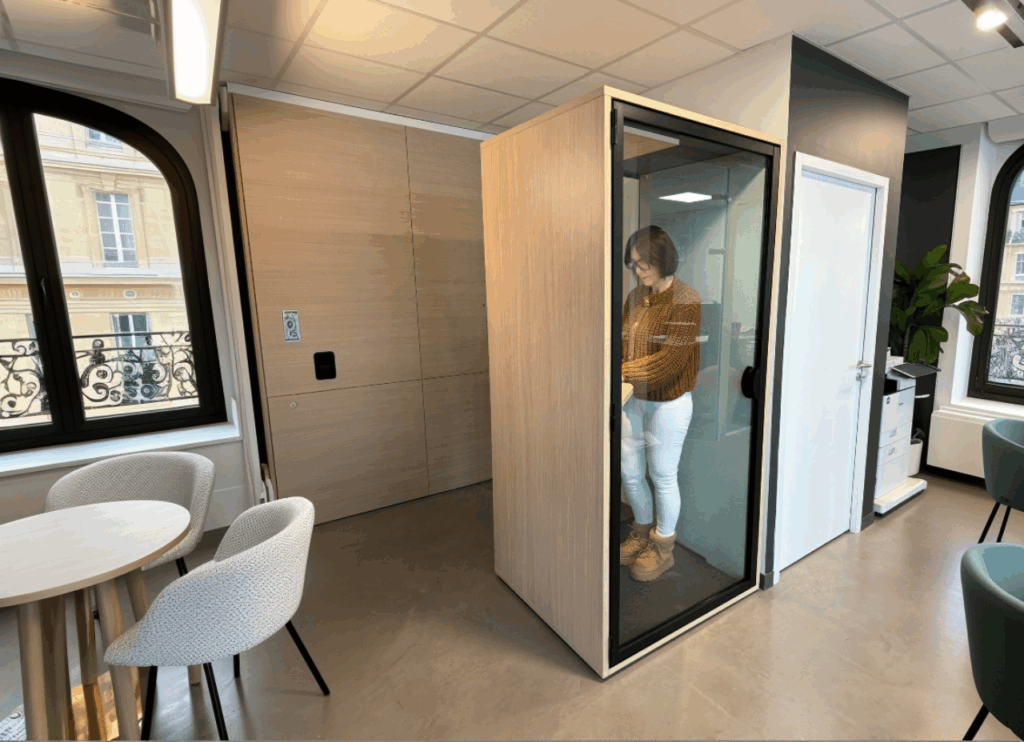
Is an acoustic booth suitable for a call centre?
Yes, if your primary concern is confidentiality and a significant reduction in voice intelligibility
An acoustic booth is particularly suitable when the main objective is to reduce voice transmission. In call centres, this covers common scenarios: sensitive calls, qualified appointments, commercial negotiations, customer management, HR or management situations on the floor — and more broadly, any conversations where you want to be able to speak without being understood by nearby colleagues.
The key point is simple: a booth is primarily designed to ensure speech confidentiality. It serves to make conversations less intelligible from the outside, rather than promising absolute silence across the entire open-plan office.
No, if your main problem is general background noise: you need to treat the open-plan office’s acoustics in parallel
If the main complaint is constant hubbub, auditory fatigue throughout the day or a sensation of continuous reverberation, the booth alone is not enough. It provides a localised solution, but does not transform the overall acoustics of the open-plan office.
In this case, the right approach is to combine booths with acoustic treatment of the open-plan area: panels, ceilings, sound-absorbing zones, and the organisation of traffic flow.
The deciding factor: intelligible speech at 3 metres vs overall fatigue over 8 hours
A simple benchmark allows for a quick decision:
If the main issue is intelligibility of nearby conversations at close range, the booth is a direct solution, because it creates a dedicated bubble.
If the main issue is overall fatigue over the course of a day, reverberation and constant noise levels, you must first treat the room, then use booths for strategic calls, sensitive video conferences and moments when confidentiality is essential.
Why a sales floor is so noisy
Noise becomes a nuisance as soon as it adds up
On a sales floor, it is not a few isolated sources that cause the problem. It is the cumulative effect. Voices pile up, ringtones add to the mix, movement creates peaks, and coordination exchanges slip in between calls.
The dominant factor in a call centre remains ambient noise, particularly voices. And this noise has a distinctive feature: it grabs your attention, even when you don’t want it to. This is what makes concentration difficult, even with a headset.
The business impact
When the environment undermines concentration, the business impact is immediate. Scripts are followed less closely, transitions are less smooth, listening quality drops, and campaign execution becomes less consistent. Without putting a figure on it, we can link this to what all teams observe: the quality of a call depends as much on the content as on the context.
Confidentiality
Confidentiality is often addressed too late, because it’s invisible when everything is going well. But on a call centre floor, sensitive information is inevitably exchanged: client details, disputes, negotiations, and sometimes personal information. The real need is for a space immediately off the floor, without tying up a meeting room.
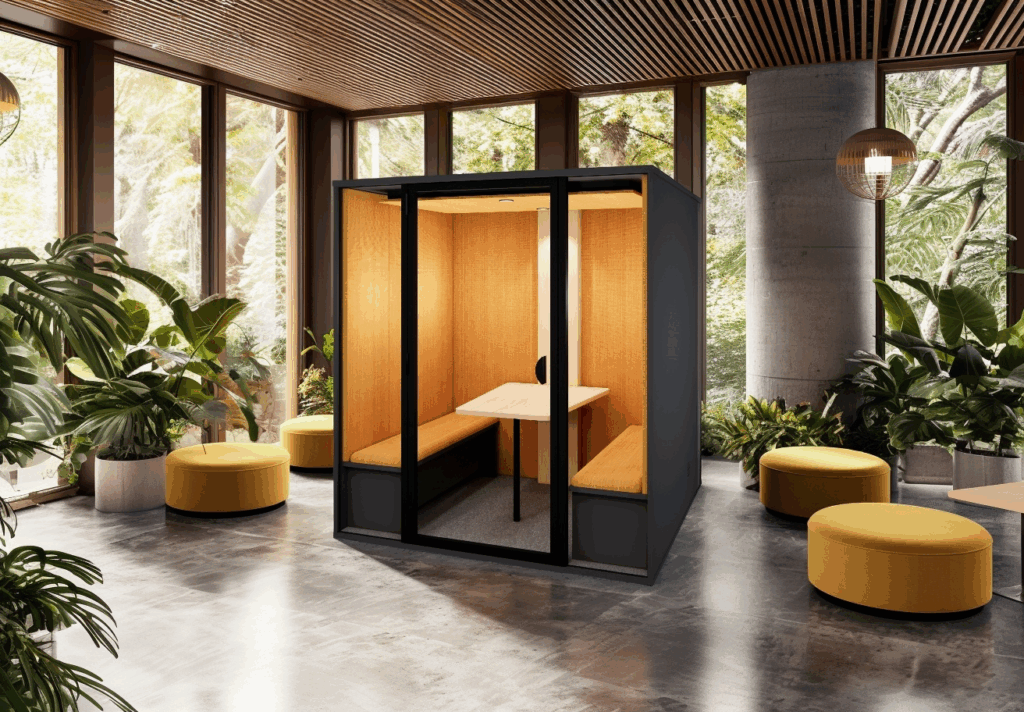
Soundproof booth, panels, partitions
Sound insulation vs sound absorption
Much of the poor decision-making stems from a simple misunderstanding.
- Sound insulation: limiting what goes out and what comes in. This requires a sealed enclosure, with particular attention to the door, seals, glazing, service ducts, and air flow, which must remain compatible with the acoustics.
- Sound absorption: reducing echo and reverberation. This involves using wall-mounted or suspended acoustic panels, absorbent materials, and sometimes treated ceilings.
These two approaches are not mutually exclusive: they complement each other, particularly in call centres.
The strategy that works in call centres
The robust strategy is a hybrid approach:
- Treating the open-plan area to reduce reverberation and overall fatigue.
- Creating ‘bubbles’ with telephone booths or acoustic cubicles near the teams, dedicated to strategic calls, sensitive video calls, coaching or quick debriefs.
This results in a more liveable open-plan area and spaces that provide a safe haven during critical moments.
What uses to cover in a call centre
Telephone booth / phone box
The telephone booth is a performance tool when used for the most important calls: closing deals, difficult calls, VIP clients, supervisory calls, training or coaching.
In this case, the requirements are clear: voice privacy, effective ventilation, simple connectivity, comfortable lighting.
Single-person workstation-style booth
There is a clear difference between a tablet designed for a quick call and a proper workspace. For writing, note-taking, CRM and post-call follow-up, ergonomics become paramount: posture, seating and a desk at the right height. These are practical criteria, not mere details.
2–4-person booth
In call centres, there is a need for collaborative work: script coaching, call monitoring, quick debriefs, and hybrid meetings for 2–3 people. For this type of use, we check the table, seating, connectivity and more generous ventilation.
The technical criteria that really make the difference for a call centre
Acoustic performance
A functional booth must provide a clear performance indicator. Essentielle booths reduce speech levels by up to -30.3 dB. For a call centre, the benefits are immediate: greater confidentiality, and above all, reduced audibility from outside.
It is also worth noting what makes a booth vulnerable in real-world use: doors and seals, ventilation, and service ducts. Good performance depends as much on the overall design as on a single figure.
Ventilation
In a call centre, booths are potentially under heavy use. A booth that gets hot or causes fatigue will be avoided, even if it provides good sound insulation.
Ventilation data forEssentielle booths:
- S / S Desk booth: 280 m³/h
- M booth: 575 m³/h
- L / XL booth: 750 m³/h
- Air change rate: 40 seconds
The link to the floor is direct: back-to-back calls = heat + fatigue, so ventilation is a priority.
Lighting and visual comfort
Lighting is just as important for reading (scripts, CRM) as it is for video calls. Essentielle booths are fitted with 800 lm LED spotlights. These features reduce eye strain and stabilise the perceived quality of video calls.
Connectivity
In a call centre, connectivity must be straightforward; otherwise, things quickly descend into a makeshift mess with cables on the floor. Each booth featuresa 220V socket, two USB-C ports, a USB-A port and an RJ45 socket. This covers laptops, headsets, phone charging, and the option of a wired network if required.
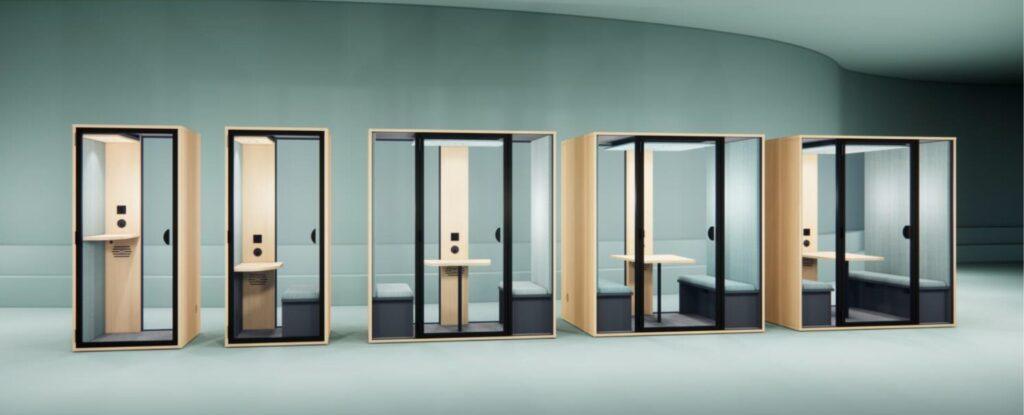
Which models are suitable for a call centre?
Essentielle S
The compact telephone booth for short calls and sensitive video calls
- External dimensions: 95 × 96 × 212 cm
- Internal dimensions: 87 × 83 × 198 cm
- Floor space: 0.9 m²
- Door: 90 × 204 cm, 8 mm “Silence” laminated glass
- Desk: 33 × 79 cm, height 103 cm
- Ventilation: 280 m³/h
- Lighting: 1 LED spotlight 800 lm
- Net weight: 255 kg
- Assembly: 2 people / 40 mins (excluding handling)
- Connectivity: 220V + USB-C/USB-A + RJ45
Essentielle S Desk:
The workstation format for longer calls and note-taking.
- External/internal dimensions: same as S, footprint 0.9 m²
- Shelf/desk: 43 × 79 cm, height 73 cm
- Bench: 88 × 38 cm, height 45 cm
- Net weight: 270 kg
- Assembly: 2 people / 45 mins (excluding handling)
- Ventilation/lighting/connectivity: same specifications as S
Essentielle M
The 1-to-1 booth for coaching, debriefs and two-way calls.
- External dimensions: 95 × 190 × 212 cm
- Internal dimensions: 88 × 177 × 198 cm
- Floor space: 1.8 m²
- Table: 51 × 78 cm, height 73 cm
- Benches: 88 × 38 cm, height 45 cm
- Ventilation: 575 m³/h
- Weight: 400 kg
- Assembly: 2 people / 60 mins (excluding handling)
Essentielle L
The mini-room for briefings, team coaching and short meetings.
External dimensions: 136 × 190 × 212 cm
Internal dimensions: 129 × 177 × 198 cm
Floor space: 2.4 m²
Ventilation: 750 m³/hLighting: 2 LED spotlights 800 lmWeight: 490 kgSet-up: 3 people / 60 mins (excluding handling)
Essentielle XL
The meeting pod for team updates, video calls and short workshops.
External dimensions: 160 × 190 × 212 cm
Internal dimensions: 153 × 177 × 198 cm
Footprint: 3 m²
Ventilation: 750 m³/h
Lighting: 2 LED spotlights, 800 lm
Net weight: 610 kg
Assembly: 2 people / 60 mins (excluding handling)