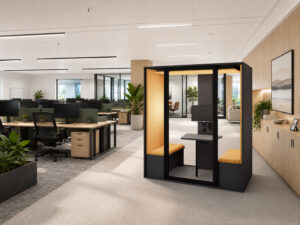

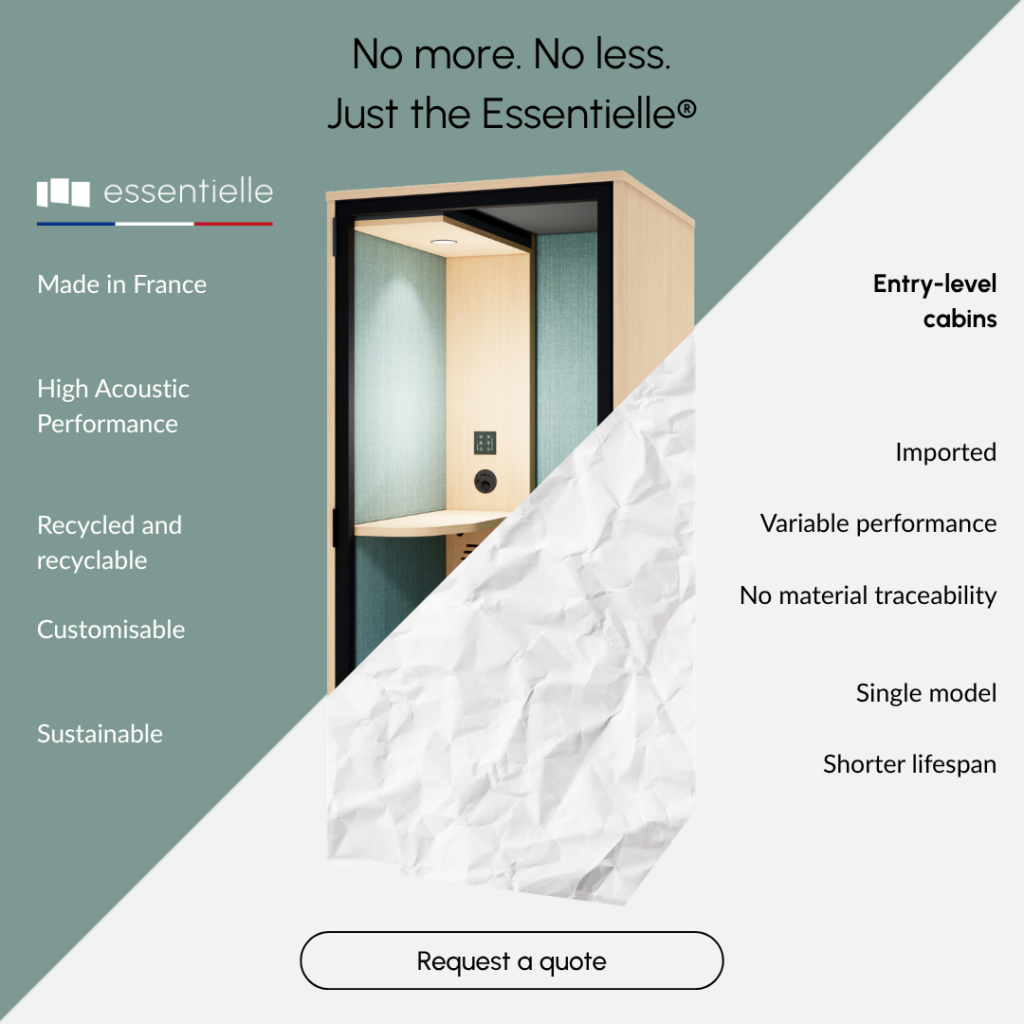
Strategic calls and open-plan offices rarely go hand in hand
A strategic call is not just a simple phone call. It is a conversation where the content matters just as much as the form, and where confidentiality is non-negotiable: commercial negotiations, HR interviews, legal or financial discussions, management decisions, or high-level client relations. In all cases, the challenge is to speak freely, without being interrupted, without feeling observed and without the risk of sensitive information being overheard.
However, in open-plan offices, these conditions are rarely met. Between ambient noise, nearby conversations, reverberation and the simple fear of being overheard, many calls are cut short, of lower quality and more stressful. We lower our voices, hold back, avoid certain topics or postpone the discussion. The problem isn’t just the noise — it’s the combination of noise, lack of privacy and discomfort.
The aim of this article: a simple method for choosing the right solution, actionable checklists, and technical insights into what really influences sound insulation and usability.
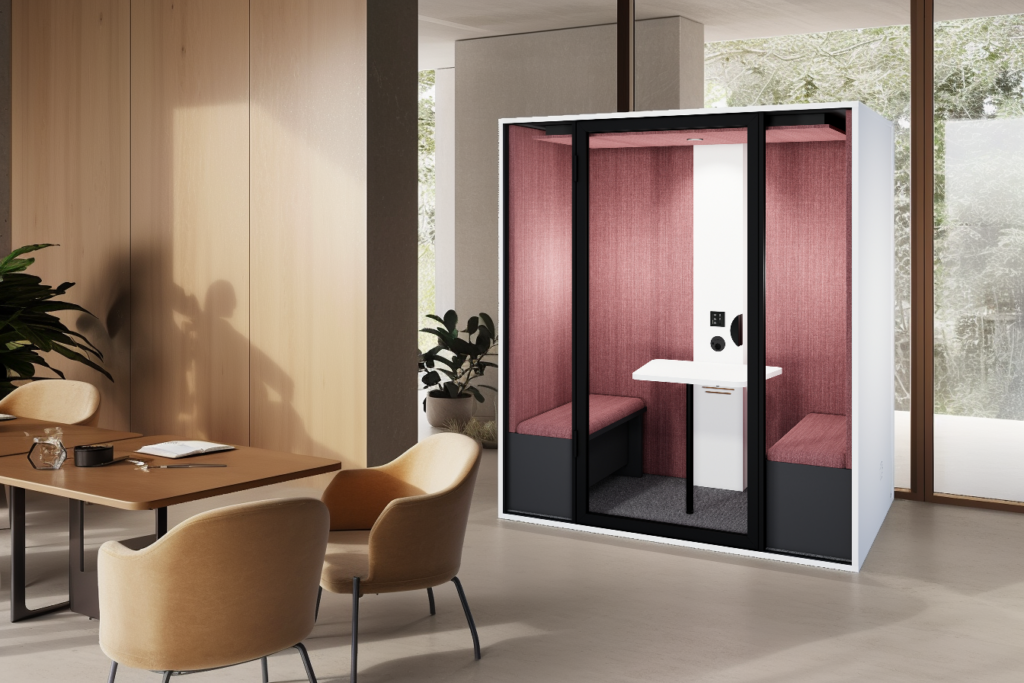
The most reliable solution in 80% of cases
When it really comes to privacy, the most reliable solution remains a closed acoustic booth. The logic is simple: create a dedicated space, isolate the voice and reduce audibility from outside. We’re not trying to silence the whole open-plan office — we’re protecting the conversation in the right place, at the right time.
Alternatives and their limitations
Acoustic panels and alcoves improve comfort by reducing reverberation, but they do not guarantee confidentiality. Partitions and closed-off desks are effective, but involve building work, greater rigidity and delays. Headsets and informal call rooms can help, but are not enough when the content is sensitive and there is a risk of eavesdropping nearby.
The conclusion is pragmatic: for strategic calls, you need a closed, ventilated solution designed to limit sound leakage.
What we’re trying to protect: confidentiality, quality, usability
Not being able to understand rather than not being able to hear anything
Confidentiality isn’t just about making a call inaudible. The realistic goal is to ensure that the voice becomes unintelligible from the outside. Even if sound is present, the content is no longer usable. This is why high-quality booths emphasise a ‘speech-oriented’ measurement — an indicator that reflects usage rather than a promise of absolute silence.
Communication quality: being heard clearly without straining
A strategic call also depends on the quality of the conversation. Minimising internal echo makes the voice clearer during calls and video conferences. And comfort is a decisive factor: a booth that gets too hot, strains the eyes or forces an uncomfortable posture will be underused, even if it performs well on paper.
Real-world use: availability and integration into daily life
The best booth is one that integrates into daily life. For incoming and outgoing calls, immediate availability is essential: proximity to teams, clear signage and simple rules of use.
Sound insulation vs acoustic comfort: the distinction that prevents mistakes
Insulation: limiting sound transmission between the booth and the office
Sound insulation limits sound transmission between two spaces. The simplest image is that of a barrier that must remain consistent: airtightness, continuity and management of weak points. The critical areas are well known: door, glazing, joints, air gaps. A fundamental principle: a small air leak can cause a significant loss of performance, because speech escapes precisely through the areas that let air through.
Acoustic comfort: reducing internal echo
Acoustic comfort does not block speech in the same way. It serves to reduce internal echo so that people can speak and hear better — sound-absorbing foam, panels, fabrics and interior materials. A booth can be closed off yet still sound poor inside if the echo is not dealt with.
Why panels alone are not enough
Acoustic panels are useful for improving the overall comfort of a space. But for a strategic call, they do not create localised privacy. The booth meets the need for isolation; the panels meet the need for acoustic ambience. These are two categories of solutions.
The six levers that truly protect a call
Structure and walls
A booth works primarily through its enclosure: walls designed to limit sound transmission. But the structure alone is not enough — the devil is in the detail.
Sealing: the number one factor
An effective booth is one that actually seals properly. Sealing is crucial: a hermetic magnetic closure, a continuous acoustic seal. These are the elements that make the difference in real-world situations.
Laminated glazing
The glass door is a key area: it must provide transparency without becoming a weak point for sound transmission. The hallmark of the Essentielle range: 8 mm ‘Silence’ laminated glazing. The door is the most heavily used interface — and therefore a natural point of sound transmission if poorly designed.
Micro-leaks and service penetrations
Leaks do not come solely from the door. Joints, service penetrations and cable management also play a part. The Essentielle range provides for cable outlets at the top or bottom (rear), which must be checked during installation to avoid creating unwanted openings.
Interior treatment
Acoustic foam, interior panels and fabrics have a direct impact on the experience: less echo, a clearer voice, and better understanding during video calls. For a strategic call, this interior comfort is just as important as external confidentiality.
‘Acoustic’ ventilation: breathe without creating leaks
A booth must be well-ventilated — otherwise it will be underused. But ventilation can become an open door if poorly designed. The Essentielle range incorporates an acoustic airflow system with a sound trap: ventilate without sacrificing insulation.
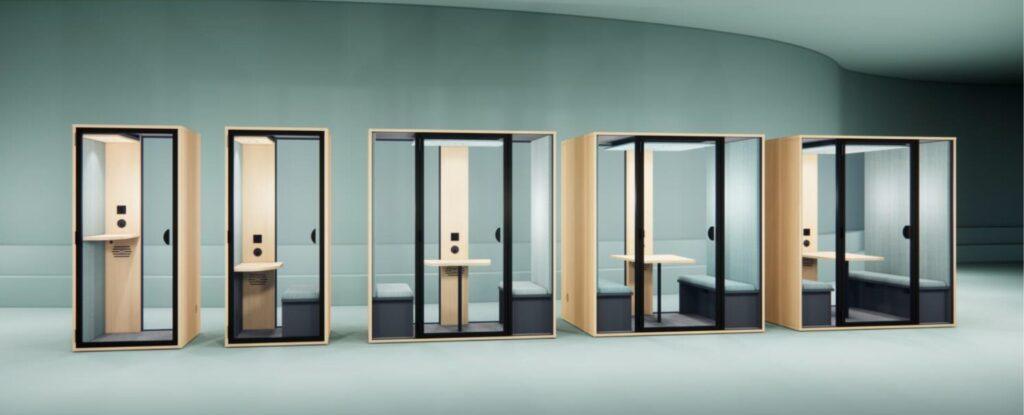
What to check on a product spec sheet
A speech-oriented measurement
For privacy, ask for voice-centred data. The Essentielle benchmark: speech level reduction of up to −30.3 dB, measured by an independent acoustic consultancy. This is a usage-oriented indicator, more useful than a vague promise.
Ventilation: flow rate, air change rate, noise
Ventilation is critical when handling back-to-back calls.
Model Air flow rate Fans Air change rate
S and S Office 280 m³/h 3 < 40 seconds
M 575 m³/h 6 < 40 seconds
L and XL 750 m³/h 8 < 40 seconds
These figures help you plan your usage: long calls, prospecting, daily routine.
Lighting and visual comfort
To prevent eye strain, especially when a call switches to video: adjustable LED spotlight up to 800 lm in warm white (3,000 K), with touch-sensitive dimmer.
Plug & play connectivity
A booth that requires you to rig up power strips loses its appeal. The Essentielle range includes as standard: 1 x 220 V socket, 2 x USB-C ports, 1 x USB-A port, 1 x RJ45 port and a ventilation/light dimmer. Enough to cover a headset, PC charging, a phone and a stable video call.
Mobility and reversible door
The reversible door (opening direction of your choice) and the mobile base with castors and height-adjustment jacks are key features that make adoption easier when your layout changes or the setup needs to adapt.
Installation: mistakes that ruin insulation
Allow the booth to breathe
Allow at least 10 cm between the wall and the air inlets/outlets for optimal airflow. A booth fitted flush against the wall can impair ventilation — and therefore usability — even if the insulation is good.
Ceiling height
230 cm minimum, 240 cm recommended to facilitate installation. This is the sort of requirement to check before ordering, not on the day of delivery.
Location within the open-plan office
Avoid two pitfalls. The first: high-traffic areas (more noise, feeling of being watched). The second: a location that is too far away (under-use). The aim is to stay close to users, without placing the booth where colleagues gather or talk ‘through the glass’.
Check that the soundproofing is adequate: the 5-minute test
The most reliable test is the simplest: make a real call and ask a colleague to stand 2–3 metres away. The aim is not to check if any sound is audible, but whether the words remain intelligible.
Take the opportunity to check comfort levels: ventilation perceived after 5 to 10 minutes, eye strain, posture.
Four quick checks prevent most unpleasant surprises: a door that closes properly with clean seals, adequate ventilation clearance, a clean (not open) cable duct, and a booth that is properly levelled (jacks adjusted).
Conclusion
Protecting a strategic call in the office without building work amounts to ensuring a realistic and usable level of confidentiality. This depends on speech reduction, soundproofing (door, seals, laminated glazing), ventilation designed not to create sound leakage, and a layout that follows simple rules.
The specifications of the Essentielle range provide a concrete framework: speech level reduction down to −30.3 dB, an 8 mm Silence laminated glass door, air renewal in under 40 seconds, full connectivity, and clear installation requirements (10 cm clearance, 230/240 cm ceiling height).
The best starting point is still a test in real-world conditions: make a call, check the privacy at 2–3 metres, and assess comfort over 10 minutes. It is this test that makes the difference — not the product spec sheet.