

Why is there so much talk about hybrid working?
Since the health crisis, remote working has grown significantly. What was once the exception has become the norm for millions of employees. But a new way of working has emerged: hybrid working.
Unlike 100% remote working, the hybrid model combines on-site and remote work. This model is now widely favoured by companies for its flexibility, its positive effects on quality of life at work (QLW) and the productivity of teams.
What is hybrid remote working?
Hybrid remote working refers to a working arrangement in which employees alternate between working in the office and remote working on a regular and structured basis.
Unlike occasional remote working, it is integrated into the company’s HR policy.
Related terms:
- Hybrid working
- Flexible working
- Hybrid remote work
The different models of hybrid remote working
There is no single hybrid remote working model, but several configurations depending on the corporate culture and the roles involved:
| Hybrid model | How it works | Advantages | Disadvantages |
| Flexible / à la carte | The employee chooses their remote working days | Maximum autonomy | Potential lack of coordination |
| Structured | Defined remote working days (e.g. 2 days at home, 3 days in the office) | Predictability, work-life balance | Less flexibility |
| Rotational | Alternating by team or by day (e.g. Team A in the office on Mondays) | Space optimisation | Management complexity |
The benefits of hybrid remote working for the company
Companies that adopt hybrid remote working benefit from numerous competitive advantages:
- Cost reduction: lower property costs (less space required).
- Organisational flexibility: better management of peak periods and unforeseen events.
- HR appeal: improved employer brand and talent retention.
- Increased productivity: studies (INSEE, Harvard Business Review) show that hybrid working increases average productivity by 5 to 15%.
The benefits of hybrid remote working for employees
From the employees’ perspective, hybrid working is also highly valued for:
- A better work-life balance
- Less time wasted on commuting
- A quieter working environment, conducive to concentration
- Greater autonomy in organising daily routines
- Increased job satisfaction
Limitations and risks of hybrid remote working
Despite its many advantages, this way of working requires a clearly defined framework to avoid certain pitfalls:
- Social isolation: a lack of human connection for certain roles.
- Communication difficulties: coordination between hybrid teams can sometimes be complicated.
- Inequalities in access: depending on the role (e.g. production vs. support functions).
- Lack of clarity: in the absence of a policy or rules, misunderstandings mount up.
How to successfully implement hybrid working?
Here are the best practices for effectively implementing a hybrid working model:
Conduct an HR and equipment assessment: tools, equipment, employee expectations.
Define a clear policy: terms and conditions, permitted days, responsibilities.
Adapt the offices: create collaborative spaces and quiet zones to optimise face-to-face time.
Install acoustic booths for video calls and confidential conversations.
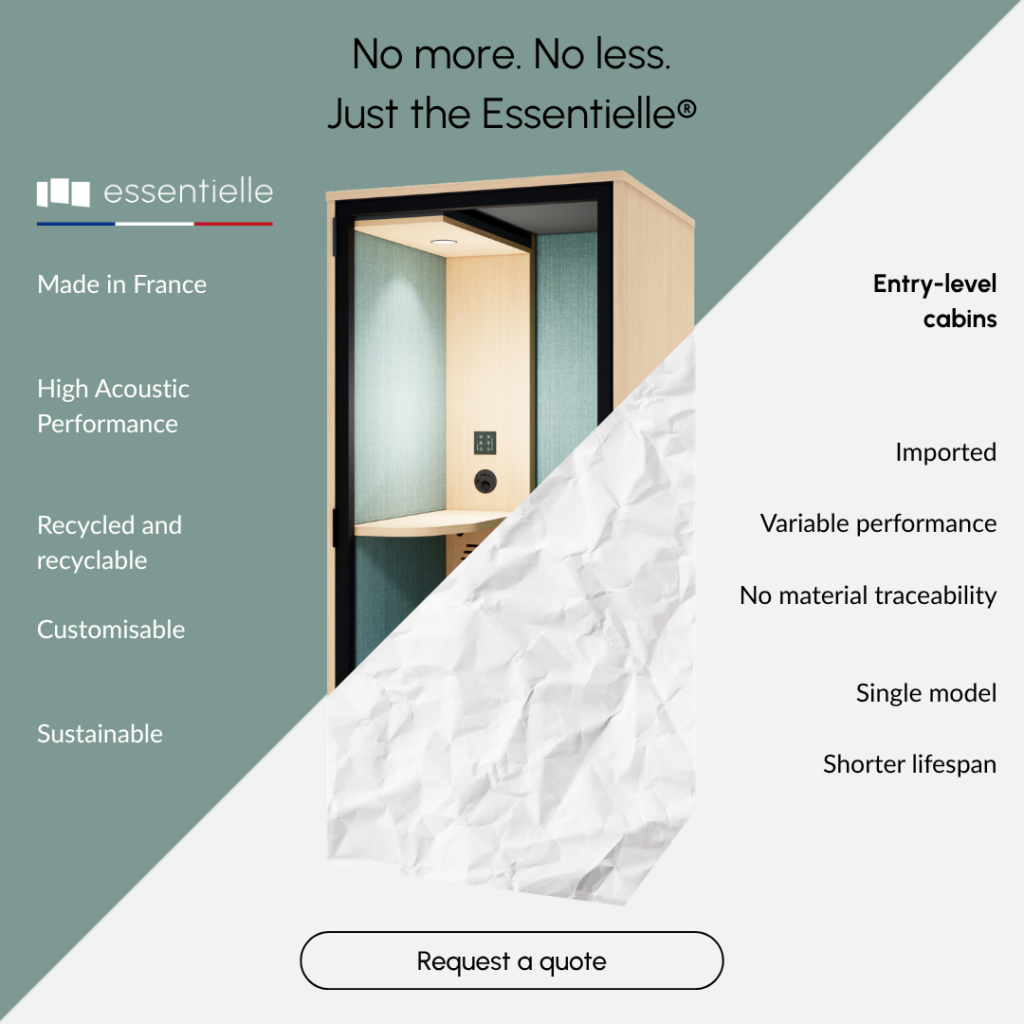
Example: the Essentielle range, for 1 to 6 people, offers soundproofing, ventilation, comfort and mobility.
Benefits: noise reduction, confidentiality, improved concentration.Train managers in hybrid management: managing remote teams, monitoring performance.Monitor KPIs: well-being, engagement, attendance rates, office usage.
Results:
- Increased productivity
- Reduced staff turnover
- Improved employee satisfaction
Conclusion: a new norm, to be structured
Hybrid working is no longer just a trend: it is a new professional standard. When properly managed, it allows for a balance between performance, well-being and flexibility.
The challenge for businesses? Providing the right spaces, the right tools and the right managerial support.
FAQ – Hybrid working: what you need to know
Hybrid working vs fully remote?
Fully remote is 100% remote, whilst the hybrid model combines the office and home.
Can hybrid working be imposed?
No, unless there is a collective agreement or a contract amendment. It must be voluntary and properly managed.
What is a remote working day?
A day on which an employee can carry out their duties remotely, under the agreed conditions.
What is a flex desk?
An unassigned desk that can be booked depending on the days you are in the office.
What tools are available to organise hybrid working?
Video conferencing tools (Zoom, Teams), project management tools (Notion, Asana), and desk booking platforms (Woby, Deskare…).