
Installation, delivery, assembly: what exactly do we mean when we talk about “installation costs”?
When you type “soundproof booth installation costs” into Google, you’re quickly met with a jumble of figures and promises… and a great deal of uncertainty.
The reason is simple: many websites confuse the price of the booth with the price of installation. Yet these are not the same items, nor do they involve the same constraints.
In this article, we are referring to the installation cost in the operational sense of the term:
- on-site delivery,
- handling (access, lift, floors, corridors, parking),
- assembly,
- positioning,
- adjustment / levelling,
- and commissioning (ventilation, lighting, connections).
This topic applies to all configurations: open-plan offices, phone booths, soundproof booths, office cubicles for video calls and phone calls, quiet working areas… and it has a direct impact on usage.
A poorly installed cubicle isn’t just “less attractive”: it is sometimes less comfortable, less quiet, and more complicated to use on a day-to-day basis.

The average cost of installing an acoustic booth (depending on size and service level)
There is no single price, but we can provide a useful answer by considering different scenarios.
In practice, the installation cost is often a few hundred euros for a single-person booth, and can rise to around €800 to €1,500 or more for meeting booths, depending on access and the service provided.
The difference is mainly due to two factors: the format (single-person vs meeting booth) and the complexity of the site (access, floors, constraints).
There are three typical scenarios:
- In-house “kit/self-assembly”: The direct cost is low, but you pay in other ways: time spent and the risk of incorrect fitting (door/seals/waterproofing), leading to perceived reduced performance and sometimes the need for rework.
- Standard installation by professionals: This is the “average” scenario in a business: delivery + installation + commissioning. Some quotes include everything, others charge for installation separately.
- Complex installation: Meeting booths, difficult access, building constraints, long carrying distances, fixed time slots… In this case, the cost rises.
To provide concrete benchmarks, here are some market examples:
a installation quoted at €300 for a single-person model from a distributor,
an installation charged at €800 for a complex meeting booth from a manufacturer,
and an offer stating transport/installation included from €1,500.
The idea is not to “set in stone” these figures, but to understand what they represent: the booth itself is not difficult to assemble; it is the environment (access, handling, constraints) that causes the cost to vary.
What is included (or not) in the term “installation”: avoiding misleading comparisons
The most common pitfall is comparing two quotes that do not cover the same scope.
“Installation” can mean “assembly only”… or “turnkey” delivery.
2.1 Delivery, handling, assembly, commissioning: the 4 elements to be priced separately
To compare properly, always break it down into four blocks.
- Delivery: transport, time slot, tailgate, protection, unloading.
- Handling: corridors, doors, lift, floors, parking.
- Assembly: panel assembly, glazing/door fitting, adjustments.
- Commissioning: ventilation, LED lighting, electrical/USB sockets, testing.
A quote may be very competitive on “assembly”, but become expensive if handling is charged at cost — or vice versa.
2.2 “Installation included” vs “installation on quote”: how to read online quotes
Some brands and retailers highlight “delivery and assembly included” as a selling point. Others operate more on a “charged separately on quote” basis.
In any case, the right approach is simple: insist on a separate “installation” line on the quote, with a breakdown of the items. Otherwise, you’re comparing headings, not services.
Factors affecting installation costs in an office
3.1 The size of the booth: solo, desk, duo, meeting (direct impact on time and complexity)
The format determines the time required, the team needed, and the logistics. We can group them into categories:
- solo / phone box,
- desk (workstation),
- duo,
- meeting booth.
In terms of technical benchmarks, at Essentielle, we have installation times that help illustrate the workload:
- S: 40 mins, 2 people
- S Office: 45 mins, 2 people
- M: 60 mins, 2 people
- L: 60 mins, 2 people
- XL: 60 mins, 2 people
These figures already highlight a key point: the assembly itself is relatively manageable. It is often the surrounding factors that cause the budget to skyrocket.
3.2 Site access: the variable that causes the budget to skyrocket (more so than distance)
Two offices 10 km apart can cost very differently depending on whether one is easily accessible and the other is not.
The factors that make all the difference:
- lorry parking / delivery bay,
- height and width of access points,
- lift (dimensions, load capacity),
- stairs, corridors, doors,
- time slots imposed in a commercial building,
- security constraints.
It is these parameters that turn a “standard” installation into a “complex” one.
3.3 Floor level, weight and volume: what the technical data sheet allows us to anticipate
Weight and volume are not just a matter of curiosity: they determine handling, the resources required, and sometimes the type of operation.
Examples of net weights for acoustic booths at Essentielle:
- S: 255 kg
- S Desk: 270 kg
- M: 400 kg
- L: 490 kg
- XL: 610 kg
And one must also consider the “logistical aspect”: desks/packages, temporary storage, movement within the open-plan office.
A useful reference point: a desk measuring approximately 120 × 120 × 235 cm, 330 kg, 3.4 m³ on an S model.
3.4 Building constraints: ceiling height and ventilation
Two constraints come up all the time, and they have a direct impact on cost.
Ceiling height: 230 cm minimum, 240 cm recommended.Ventilation: allow 10 cm between the wall and the air inlets/outlets.
If these constraints are not met, you may end up with a poorly positioned cubicle that needs to be moved or rebuilt. And in that case, the additional cost comes not from the installation, but from the rectification.
3.5 Number of cubicles: the ‘construction site’ effect and economies of scale
Installing a single cubicle often involves paying a fixed cost for travel and organisation. Installing 3 to 10 cubicles is a different story: optimised logistics, batch installation, a team already on site… and a unit cost that is often lower.
This is a real bargaining chip when negotiating quotes: if you’re planning to install several booths, make this explicitly clear.
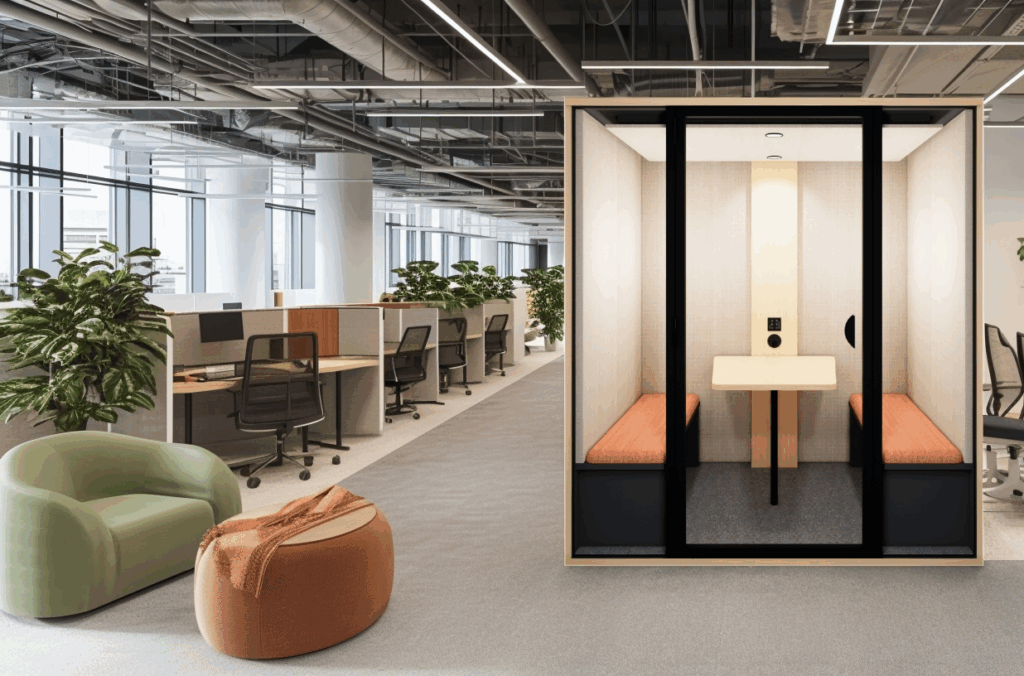
Estimating installation costs based on 3 realistic scenarios
4.1 Scenario 1: in-house assembly (kit)
It’s tempting: “we’ll do it ourselves, it’ll be cheaper”. On paper, yes, the direct cost is low.
But you need to be clear-eyed about the risks:
- door and seal adjustment,
- levelling,
- sealing (and thus acoustic performance),
- more complicated after-sales service if the issue is related to the installation.
The time estimate (Essential) helps to set the context: it typically takes 40 to 60 minutes for two people depending on the model. The real issue is less the duration than the quality of the installation.
4.2 Scenario 2: standard installation by professionals — the “average” in a business setting
This is the most common approach: the contractor handles delivery, assembly and commissioning.
We see price points on the retail side, for example assembly quoted at €300 for a single-person model. But it must be made clear: assembly ≠ complex handling ≠ electrical work.
Assembly can be inexpensive but becomes more costly as soon as there are difficult floors or restricted access.
4.3 Scenario 3: complex installation — meeting pods, difficult access, site constraints
As soon as we move on to meeting pods or complicated sites, the cost moves into a different category.
Here are some examples:
- assembly charged at €800 for a complex meeting pod,
- transport/installation included from €1,500 for a 2/4-person pod.
What explains these figures: weight/volume, access, team required, time on site, coordination with the building. This is closer to a small-scale construction project than a simple “assembly”.
“Hidden” costs to expect beyond assembly (which cause the budget to spiral)
5.1 Special handling: furniture lifts, aerial platforms, long-distance carrying
When the lift isn’t suitable, or when the maximum load capacity is insufficient, you’re dealing with a different set of logistical challenges. The same applies if the carrying distance is long: remote car parks, corridors, access badges, and access restrictions.
These are costs that are often invisible on a simplified quote, but very real on the ground.
5.2 Electricity and networking: when a simple connection becomes a mini-project
Modern control units are equipped with: 220V sockets, USB-C/USB-A, and sometimes RJ45. This is an advantage… provided there is a nearby, clean power supply.
Otherwise, you may end up with a mini-project: installing a socket, cable ducting, secure cable routing, and compliance.
And here, the “installation” task is no longer limited to assembly.
5.3 Unpacking, waste disposal and site restoration
Desks and boxes take up space. In an open-plan office, this can block traffic flow, create noise, or impose building restrictions.
The point to clarify: who manages temporary storage and waste disposal — the contractor, the building management, or you?
5.4 Subsequent relocation of the cubicle (flex office): reconfiguration costs
Some cubicles rest on a mobile base, with castors and jacks, which makes adjustments easier. But you need to be realistic: moving a pod from one corner to another isn’t always “free”, especially if you’re changing floors or sites. Reconfiguration comes at a cost, even if it’s simpler than an initial installation.
A simple method for obtaining a reliable (and comparable) average price within 48 hours
6.1 The quote request brief (copy and paste): the 12 details to provide
If you want comparable quotes, provide the same information to everyone:
- Site address + floor
- Lift: dimensions and load capacity
- Parking / delivery area
- Width of doors and corridors + points of friction (stairs, bends)
- Building’s time constraints
- Number of cabins + models (single/desk/dual/meeting) + options
- Desired date
- On-site contact
- Photos / access map / floor plan
- Ceiling height (min. 230 cm, 240 cm recommended)
- Ventilation clearance (10 cm from the wall)
- Security requirements (access, badges, reception)
This way, you avoid an “optimistic” quote that blows the budget on the day.
6.2 The quote comparison grid: what to demand line by line
Demand a quote that clearly separates:
- delivery,
- handling,
- assembly,
- commissioning,
- collection / disposal of packaging.
And check the terms: inclusions/exclusions, additional charges for upper floors, additional charges for time slots. Finally, don’t forget the “warranty” and after-sales service aspects: this is no minor detail if the booth is used every day.
Installation and acoustic performance: why poor installation can cost more than the fit-out itself
An acoustic booth is a system. If the door is misaligned, if the seals are not properly compressed, if the booth is not properly levelled, you can create “acoustic leaks”.
Result: perceived performance drops… and you end up paying for a return visit.
The right approach is to include a quality check after installation:
- Door: smooth closing, alignment, correct compression
- Sealing: seals in place, no gaps
- Levelling: levelling feet adjusted, stability
- Ventilation: working correctly
- Lighting: working correctly
And let’s recall what is expected of a modern booth: ventilation with an air change rate (< 40 sec), LED lighting (up to 800 lm), full connectivity. These are valuable features, provided they are operational from day one.
FAQ — Cost of installing a soundproof booth in a business
9.1 Is installation always included in the price of the booth?
No. It depends on the supplier: included, quoted separately, or as an option. Some offers highlight that installation is included, whilst others charge for it separately.
9.2 How long does it take to install a soundproof booth?
Essentielle’s technical guidelines provide a good indication: 40 to 60 minutes for two people depending on the model. However, it is important to distinguish between assembly time and the time required for handling and access, which can be the real issue.
9.3 Can an acoustic booth be installed without any building work?
Often yes, as a ‘plug & play’ solution. However, you must ensure there is a nearby power supply and comply with clearance requirements (particularly regarding ventilation).
9.4 What are the most common additional costs?
Floors without a suitable lift, difficult parking, restricted access points, long carrying distances, and electrical and network connections.
9.5 What total budget should be allowed for (booth + installation) if starting from scratch?
The method is simple: booth price (depending on model) + installation (depending on scenarios) + any electrical work. If in doubt, refer to guides or market benchmarks, without trying to ‘standardise’ a single figure.