
Why a cold-calling booth is a game-changer
A cold-calling booth is a dedicated space for making calls — usually a enclosed soundproof booth — designed to allow you to cold call without noise, without disturbing other teams, and with a level of privacy that an open-plan office cannot offer. It is a sales station designed for the telephone, not simply a place to isolate oneself.
Without this space, the problems remain the same: ambient noise, vocal fatigue, loss of concentration, and deteriorating listening quality.
And above all, a barrier that many salespeople know all too well: not daring to make a call because everyone can hear the conversation. In sales prospecting, this barrier is costly, as it affects consistency, energy levels and the ability to carry out call sequences.
The aim of this guide: to help you choose the right booth, set it up effectively, equip it correctly, structure your calls using a proven method, and measure a tangible ROI.
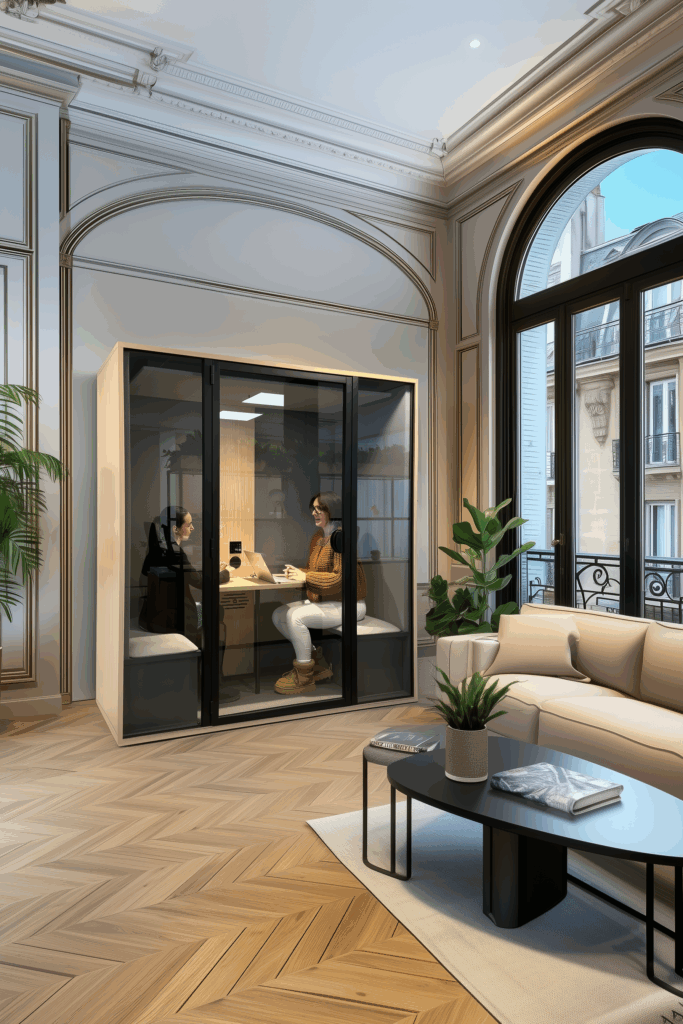
The best booth for prospecting
In most setups, the choice boils down to a few simple principles.
- For a sales representative who makes calls regularly, a single-person soundproof booth with a tablet, ventilation, lighting and connectivity is enough to deliver a significant boost in performance and comfort.
- For long sessions on a computer (CRM, call sequences, note-taking), it’s best to opt for a booth with a built-in desk. Ergonomics and posture are non-negotiable when prospecting for 1 to 2 hours a day.
- For an SDR/BDR team on continuous calls, the booth should not be conceived as a single unit. You need to combine several booths, establish usage rules and ensure availability. An effective booth is one that is accessible when needed.
The pitfall to avoid: the gimmicky booth, without effective ventilation, without proper soundproofing, or placed too far from the teams. It will end up unused, and the entire investment will be wasted.
Booth, soundproof booth, phone booth: what exactly are we talking about?
The word ‘box’ is an industry term. It refers to the intention of providing an enclosed space dedicated to calls, installed at the heart of workspaces.
The key distinction lies in the difference between an open alcove and a closed booth. The alcove allows for visual privacy, but it does not offer the same level of confidentiality. The closed booth, on the other hand, is designed to limit the intelligibility of speech from the outside — a crucial factor in prospecting.
Practical use cases
Cold calls, follow-ups, incoming calls, lead qualification, appointment booking, and sometimes customer service: anything that requires a steady voice, attentive listening and a minimum of privacy is best carried out in a protected space.
What a booth alone cannot solve
A booth is no substitute for a good prospect database, a clear offer, a call script, a CRM system or coaching. However, it removes a major obstacle — the working environment — which is often underestimated because it is perceived as a ‘logistical’ issue, whereas it directly impacts prospecting performance.
Why the soundproof booth is the most effective format
Confidentiality
The aim is not to eliminate all sound. It is to reduce the intelligibility of speech to the outside. When a sales representative knows they cannot be heard, they speak more naturally, handle objections better and maintain a calmer tone. In prospecting, this is a tangible advantage.
Concentration
The booth reduces distractions and helps sales reps stay focused on the script, listening and follow-up. It also reduces vocal fatigue: they speak less loudly and can sustain their performance over longer periods.
Comfort
A booth used for 30 minutes a day is not the same as one used for two hours a day. Without proper ventilation, pleasant lighting or a comfortable posture, sales reps cut their sessions short, avoid the booth or put it off until later — and ‘later’ often ends up meaning ‘never’.
The essential criteria for a prospecting booth
Acoustics: the key metric to monitor
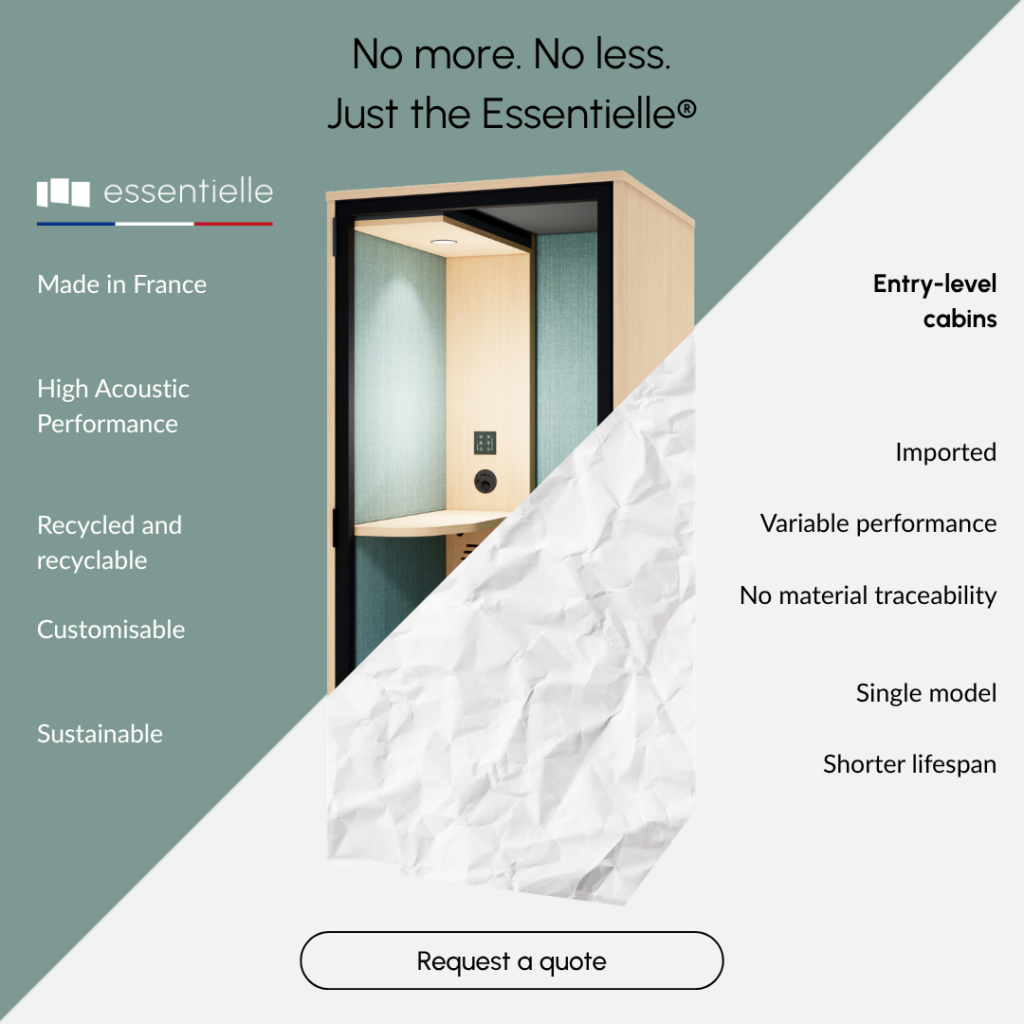
You need to look for a clear metric focused on speech and confidentiality. A concrete benchmark: the Essentielle range offers a reduction in speech level of up to −30.3 dB, measured by an independent acoustic consultancy. This is a clear indicator, far more reliable than marketing slogans.
Ventilation: the factor that makes people abandon a booth
A closed booth must renew the air quickly — otherwise it becomes uncomfortable and underused. The figures for the Essentielle range, by model:
Model Airflow Fans Air renewal
S and S Office 280 m³/h 3 fans < 40 seconds
M 575 m³/h 6 fans < 40 seconds
L and XL 750 m³/h 8 fans < 40 seconds
When canvassing, the ventilation must remain tolerable during back-to-back visits. If comfort drops, productivity drops with it.
Lighting
The booth must make you want to step inside. The Essential range features one (or two for the XL) 800 lm LED spotlights in warm white (3,000 K), with a touch-sensitive dimmer to adjust the brightness.
Connectivity
The aim is to avoid makeshift cables and DIY solutions. In the Essentielle range, each booth comes as standard with: 1 x 220 V socket, 2 x USB-C ports, 1 x USB-A port, 1 x RJ45 port and a ventilation/lighting dimmer. This is what makes the space immediately operational for a business developer.
Ergonomics
When prospecting, you often work on a computer — CRM open, ongoing sequences, taking notes. The built-in desk is a real bonus for long sessions.
Which booth should you choose for a prospecting box?
The single-person format: the natural choice
Prospecting is an individual activity. The single-person format meets the need for privacy and concentration, without the risk of it being diverted to other uses.
The real choice is often: single phone box (Essentielle S) or workstation (Essentielle S Bureau).
When to opt for the workstation
As soon as sessions get longer or prospecting involves CRM data entry and multi-tab browsing, the standard-height desk (73 cm) and the seat become crucial. Posture and stamina are key factors in day-to-day performance.
The 2-person booth: useful or a false good idea?
The Essentielle M (1 to 2 people) is suitable if the team carries out live coaching, dual listening or pair-based training. Otherwise, it risks becoming a mini-meeting room and reducing availability for prospecting.
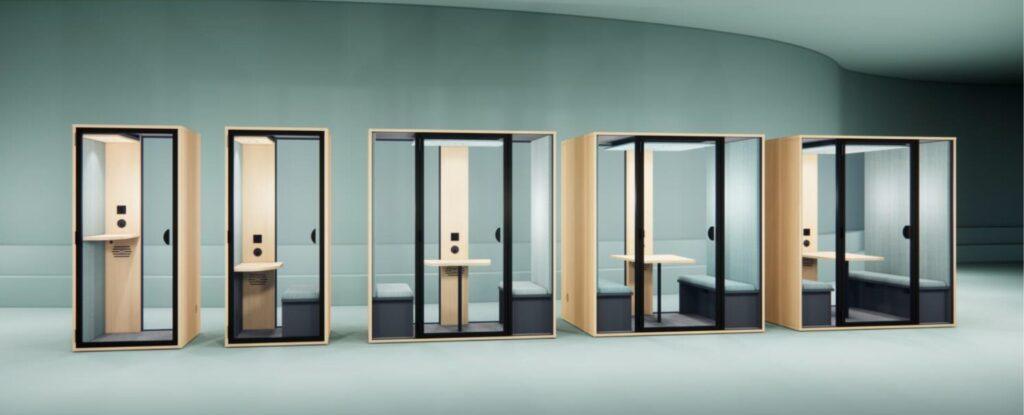
Practical example: a prospecting booth with the Essentielle range
Box-ready features useful for sales prospecting
Three elements of the range are particularly suited to sales use: the reversible door (opening direction selectable depending on the layout), the mobile base on castors with height-adjustment jacks (easy to rearrange), and the touch-sensitive dimmer to adjust lighting and ventilation to suit individual comfort.
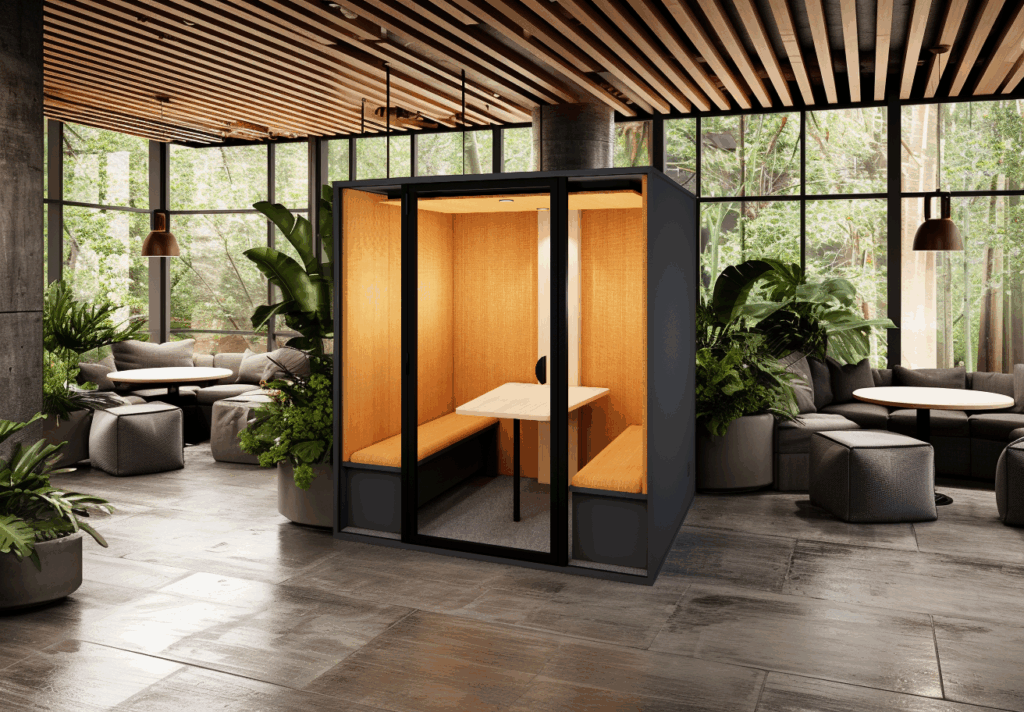
Where to install the box so it is used — and performs well
Close to sales staff, not in a corridor
The rule is simple: close = used, far = forgotten. However, avoid placing it in a constant thoroughfare. Too much footfall generates noise and creates social discomfort: the sales representative feels as though they are being watched.
Do not compromise ventilation
The booth must not be ‘stifled’: a clearance of at least 10 cm between the wall and the air inlets/outlets is necessary to ensure optimal airflow. The ceiling height must be at least 230 cm (240 cm recommended for installation).
Equipping the booth: the minimum kit for prospecting
Audio: suitable headphones and microphone
The aim is a clear voice and long-lasting comfort. A computer microphone is rarely the best option for back-to-back calls. Dedicated headphones reduce fatigue and stabilise audio quality.
Technical setup: minimise friction
Prospecting is a repetitive task. Anything that creates friction slows down the pace. The setup must be simple: PC, USB-C charging, tidy cable management, and an RJ45 connection if the Wi-Fi is unstable.
Long-term comfort
The height adjustment and ventilation are key comfort features in their own right. During long sessions, the seat becomes a factor in consistency. The workstation should make you want to return to it.
Team organisation
Sizing guidelines
The ratio depends on usage intensity — low, medium or high — and the distinction between campaign peaks (when everyone is calling at the same time) and day-to-day usage.
Planning to avoid bottlenecks
Structured prospecting blocks help organise access. If the booking system becomes too cumbersome, it will hinder adoption. A simple system — time slots and basic rules — is often enough to prevent conflicts.
Coaching without compromising confidentiality
Coaching must be integrated into the system: either outside the booth (post-call debrief) or via dedicated one-to-one sessions. However, the tendency to ‘chat through the glass’ undermines both confidentiality and user comfort.
Measuring effectiveness: KPIs for a prospecting booth
Before/after indicators
Key metrics to monitor: volume of calls made, contact rate, qualified appointment rate and conversion rate. Alongside these quantitative indicators, qualitative signals are also revealing: perceived fatigue, consistency of prospecting, and the team’s adoption rate of the booth.
Quality and compliance
Call quality is improved through scripts, handling objections and active listening. Regarding data management and the GDPR, the framework depends on each company’s context and the tools used.
Budget: how much does a lead generation booth cost?
Factors affecting the purchase price
The price depends on the size (single-person vs. meeting formats), the level of equipment, the finishes and the options selected (glass back panel, Category B fabric, screen mount, etc.).
Installation costs to be anticipated
You must factor in delivery, handling (floor level, access), assembly and the removal of packaging. Approximate assembly times for the Essential range: 40 mins for the S, 45 mins for the S Office, 60 mins for the M, L and XL (excluding handling, 2 to 3 people depending on the model).
Long-term use
To be expected: regular cleaning, checking of seals and the door, and maintenance of the ventilation system depending on the intensity of use.
Alternatives: when a booth isn’t necessarily the answer
An acoustic alcove may suffice for short calls in a moderately noisy environment, but privacy remains limited.
Panels and acoustic treatment in open-plan spaces reduce overall reverberation without creating a private space.
Remote working or existing meeting rooms meet certain needs, though availability constraints may hinder regular use.
Conclusion
The telephone performs best when the environment is no longer a barrier. A prospecting booth is more than just a booth: it is a system that combines acoustic privacy, user comfort, team organisation, calling methods and results measurement.
Four key pillars to remember:
Acoustics and privacy — to speak freely and naturally
Ventilation and comfort — to ensure long-term use and encourage adoption
Organisation — to guarantee availability and structure usage
Scripts and metrics — to drive performance and make progress
It is this combination that transforms a simple booth into a genuine driver of sales performance.