
The issue isn’t silence; it’s confidentiality and quality of service
In the public sector, day-to-day work rarely takes place in perfectly quiet offices. There are reception areas, counters, echoing lobbies, shared offices, open-plan administrative spaces, incoming and outgoing calls, and a constant stream of video conferences. There are also sensitive moments: staff meetings, HR discussions, mediation, and sometimes medical consultations.
In these situations, the challenge is not to achieve an unrealistic total silence. It is to protect confidentiality, reduce audible information and maintain a consistent quality of service — for both the user and the staff member.
The problem is well known: ambient noise and a lack of enclosed spaces lead to conversations being too audible, causing discomfort that leads to fatigue, a loss of concentration, and a deterioration in the experience at the counter or on the phone. And when rooms are full, people improvise: a sensitive call in a corridor, a video call in a shared office, a meeting ‘as best they can’.
This guide has a practical aim: to explain when an acoustic booth is the right solution, where to install it, what to check before buying, and how to secure a public procurement contract using comparable quotes.
Choose in 60 seconds: start with the use case
The logic is simple — we size the booth based on usage and the expected level of confidentiality, not on square metres.
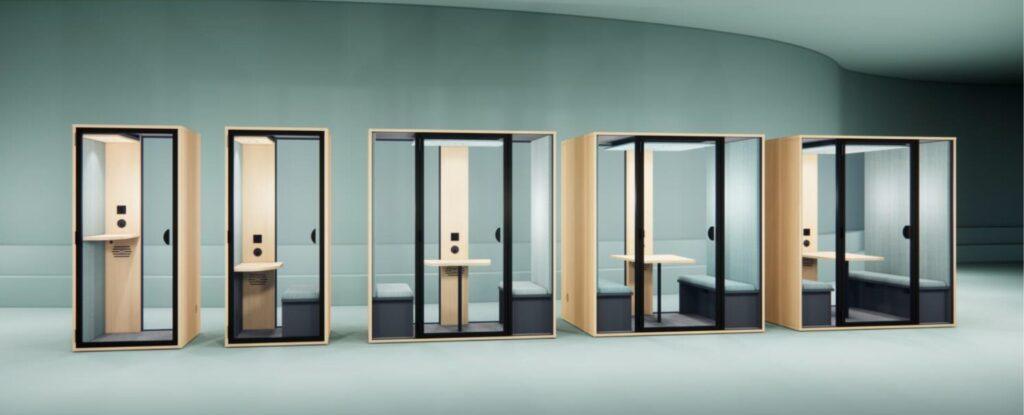
Calls, video calls, handling short files → 1-person phone-box-style booth, compact and for quick turnover.
Isolated workstation for focused work (drafting, administrative tasks) → 1-person desk-style booth with seating and a proper table, designed for long-term use.
Confidential 1:1 meeting (HR, social, support) → 2-person booth with a table and two seats.
Team meetings or hybrid video calls → 4-person booth, a micro-meeting room requiring no building work.
Workshops, service points, extended meetings → 6-person booth, with more space and adequate ventilation.
Use cases justifying a booth in the public sector
Reception and service desks: creating a bubble of privacy
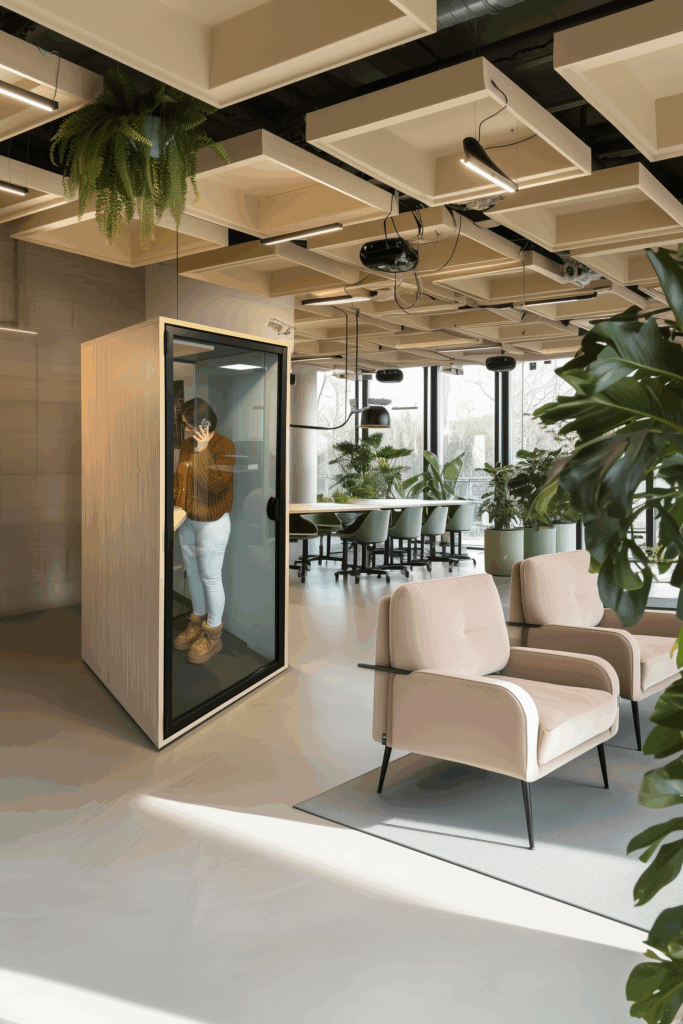
At reception, the information exchanged is often personal. However, reception areas can sometimes be echoey, with high ceilings, a constant flow of visitors and background noise that makes everything more audible than one would like. The acoustic booth creates a bubble of privacy where it is needed, without the need for building work. The aim: to limit the audibility of conversations and improve the visitor experience.
Open-plan administrative offices: protecting calls and concentration
In administrative departments, open-plan offices foster collaboration but also create friction: calls from users, discussions with partners, video calls, drafting, and tasks requiring concentration. The booth becomes an organisational tool: a dedicated area for calls and video calls, and depending on the layout, a place to work on a file without being disturbed. The most tangible benefit: less need to ‘speak loudly’, fewer interruptions, greater perceived comfort.
HR, social services, mediation: ensuring secure interviews
Certain conversations cannot tolerate any approximation: disciplinary hearings, social support, mediation, staff/manager meetings.
A booth is useful when it offers two guarantees: confidentiality of conversation (conversations cannot be overheard from outside) and comfort during the session (ventilation, seating, lighting), because a meeting rarely lasts just three minutes.
Short meetings and video calls: freeing up overloaded rooms
The public sector, too, operates at the pace of video calls and quick updates. When large rooms are monopolised for a 20-minute video call, everyone wastes time. A booth for four or more people serves a simple purpose: to accommodate short, hybrid and unscheduled meetings, and free up traditional rooms for proper workshops.
Closed booth, alcove or panels: which solution for which problem
The word ‘acoustics’ encompasses several aspects. A closed booth is designed for localised privacy: it reduces the transmission of speech. panels or absorbers are designed for overall comfort: they reduce reverberation and make a room less tiring.
In many public spaces, the best approach is a combination of both: treating the lobby or open-plan area to reduce reverberation, and adding a booth for the privacy of sensitive discussions.
The booth becomes difficult to replace as soon as there is sensitive information, strategic calls, HR or social interviews, or video calls where the audio must be clear. This is when we realise that panels alone are no longer enough — they improve the atmosphere but do not create an enclosed space.
Technical criteria that matter in public buildings
Acoustics: ensuring speech confidentiality
The booth is judged on one thing: does the conversation remain confidential? The metric to look for is voice-oriented. The benchmark for the Essential range: a reduction in speech level down to −30.3 dB, measured by an independent acoustic consultancy. The aim is to make conversation less intelligible from outside, by limiting sound leakage through the door, seals and ventilation.
Ventilation: comfort as a key factor in adoption
In the public sector, usage is intensive and users are diverse. A booth may be technically efficient yet remain empty if people feel uncomfortable in it after 10 minutes.
| Model | Airflow Rate Air | Change Rate |
| S et S Bureau | 280 m³/h | < 40 seconds |
| M | 575 m³/h | < 40 seconds |
| L and XL | 750 m³/h | < 40 seconds |
These figures help to illustrate a key point: comfort is not a minor detail; it determines adoption.
Lighting and connectivity: avoid a gimmicky booth
Lighting affects reading, fatigue and video call quality. The Essentielle range features an 800 lm LED spotlight in warm white (3,000 K) with a touch-sensitive dimmer (two spotlights for the XL).
When it comes to connectivity, a booth that forces staff to fiddle with cables quickly loses its appeal. Every Essentielle booth comes as standard with: 1 x 220 V socket, 2 x USB-C ports, 1 x USB-A port and 1 x RJ45 port. This is what transforms the booth into an operational tool that is immediately ready for use.
Mobility and robustness: keeping pace with operations
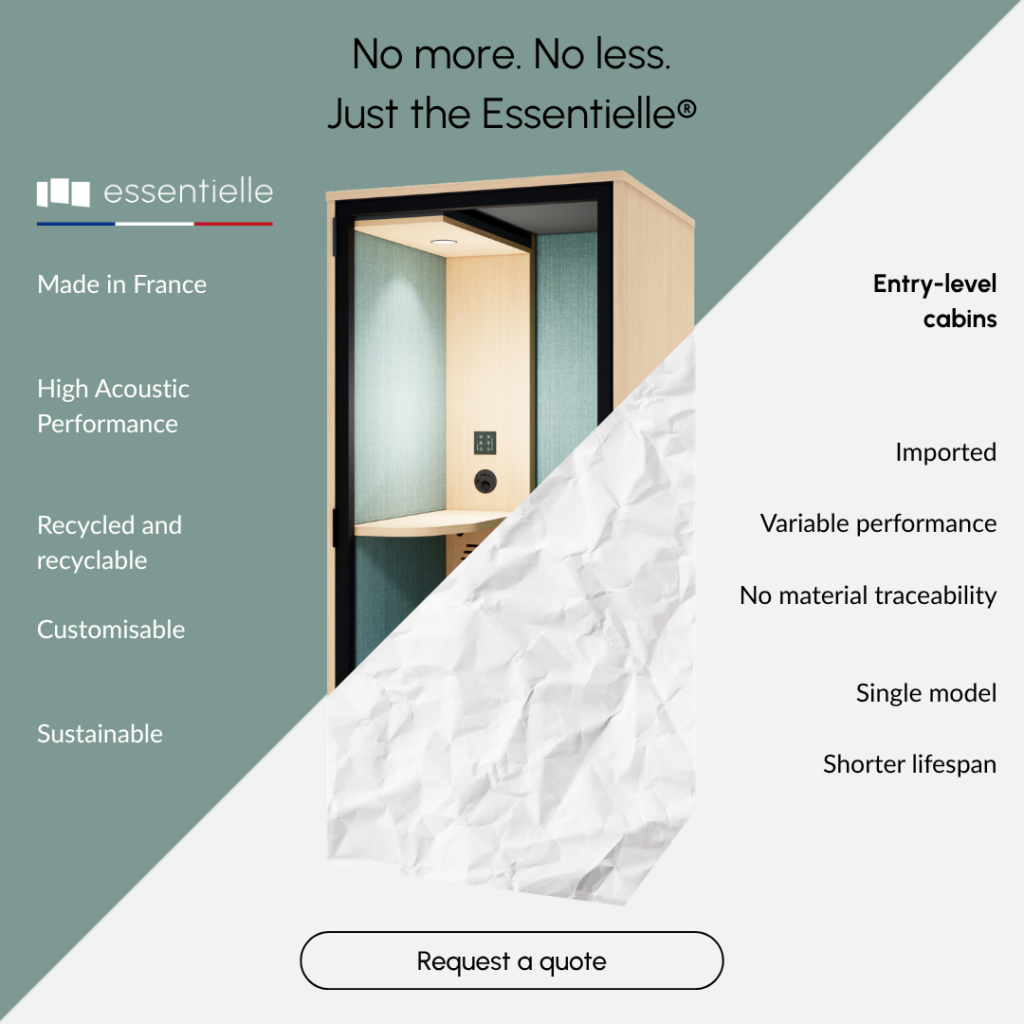
Workspaces evolve: reorganisation, internal relocation, department changes. The Essentielle range is based on a mobile base with integrated castors and height-adjustable legs, featuring a reversible door (opening direction of your choice). The booths have been awarded an Eco Impact A rating and carry the Origine France Garantie label — factors that are often beneficial in a public procurement context.
Recommended formats
1-person phone box (Essentielle S) — Calls and video, quick rotation
External dimensions: 95 × 96 × 212 cm, floor area: 0.9 m², worktop: 33 × 79 cm at a height of 103 cm, net weight: 255 kg. Assembly: 2 people, 40 minutes excluding handling.
1-person workstation (Essentielle S Bureau) — Long documents and concentration
Same outer dimensions, with a desk measuring 43 × 79 cm at a height of 73 cm and a bench seat measuring 88 × 38 cm at a height of 45 cm. Net weight 270 kg. Assembly: 2 people, 45 minutes. The ‘settling in’ format for extended administrative work.
2 people (Essentielle M) — Confidential meeting
External dimensions 95 × 190 × 212 cm, floor area 1.8 m², table 51 × 78 cm (73 cm high), benches 88 × 38 cm. Net weight 400 kg. Assembly: 2 people, 60 minutes. The natural format for a confidential one-to-one meeting.
4 people (Essentielle L) — Mini meeting room requiring no building work
External dimensions: 136 × 190 × 212 cm, floor area: 2.4 m², table: 78 × 92 cm. Net weight: 490 kg. Ventilation: 750 m³/h. Ideal for quick updates, hybrid video calls and micro-meetings without taking over a large room.
6 people (Essentielle XL) — Meetings and workshops
External dimensions: 160 × 190 × 212 cm, floor area: 3 m², table: 78 × 115 cm, benches: 153 × 38 cm. Net weight: 610 kg, 2 LED spotlights. The ideal format for departmental meetings, workshops or extended meetings.
For the M, L and XL models, a screen mount with a dedicated socket and cable grommet is available as an option.
Placement: where to position the booth so it gets used
At reception: close to the flow of traffic but slightly set back. If it’s right in the way, the user feels exposed and the promise of privacy is lost. Two classic mistakes to avoid: the ‘corridor’ booth (noise and stress) and the ‘aquarium’ effect (the feeling of being watched through the glass).
In open-plan offices: within easy reach of teams, but away from noise hotspots (printers, corridors, coffee corner). A ‘buffer zone’ approach works well: position the booth between a noisy area and a focus area.
Clearances: allow at least 10 cm between the wall and the air inlets/outlets for optimal airflow, and the ceiling height must be at least 230 cm (240 cm recommended for installation).
Purchasing in the public sector: securing the project
Compare as a service, not as a product
The right approach is to break down the scope line by line: booth, delivery, handling, installation, commissioning, packaging collection, after-sales service. Without this framework, you’ll be comparing prices that don’t cover the same things — and surprises will arise during the installation phase.
Central purchasing body or direct purchase
Using a central purchasing body is appropriate when you need administrative certainty, speed or a multi-brand offering. Direct purchase from the manufacturer becomes attractive when you are seeking technical consistency (options, installation, support) and a controlled configuration. Arguments regarding French manufacturing and eco-design are often useful during consultations.
Logistics and building constraints
Before ordering, draw up an access checklist: door and corridor dimensions, safety constraints, delivery slots and temporary storage areas. Many projects become complicated not because of the booth itself, but because of the process of getting it to the right place.
Essentielle booths take between 40 and 60 minutes to assemble, depending on the model, with 2 to 3 people excluding handling. The key point in public spaces: plan the installation outside peak visitor times or sensitive periods.
Conclusion
In the public sector, a soundproof booth is not a mere furnishing accessory. It is a tool that delivers on a concrete promise: to protect confidentiality, improve the quality of interactions and restore stable working conditions in shared environments.
To ensure the project’s success, three key areas are paramount: performance (speech privacy, soundproofing, consistent ventilation), comfort (lighting, connectivity, ergonomics) and location (proximity to users, out of the way of foot traffic, with clear access routes). And to ensure a secure purchase, compare the full service package — booth, delivery, installation, commissioning — line by line. This is what transforms a quote into a solution that is actually used on a daily basis.