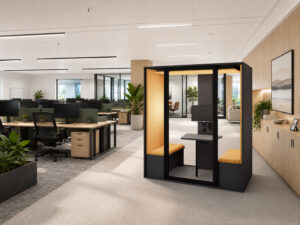

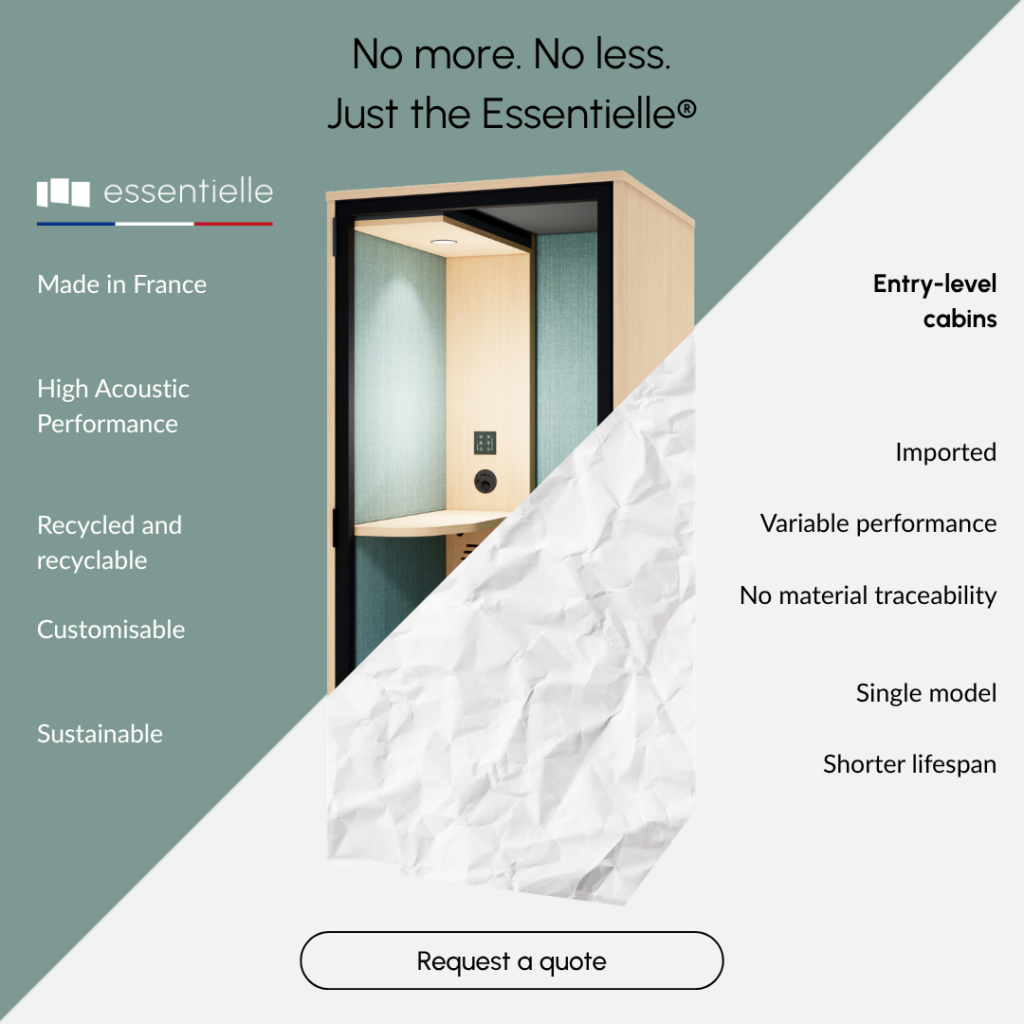
The meeting pod: the most cost-effective solution when meeting rooms are in short supply
In many offices, the same scenario plays out time and again. Meeting rooms are scarce, often already booked, yet the need keeps growing: quick team updates, one-to-one discussions, hybrid meetings on Teams, Zoom or Google Meet, and sensitive calls that cannot be held in the middle of the open-plan office. The result: video calls spilling into the open-plan space, rising noise levels, conversations audible to everyone, and a sense of privacy that vanishes.
It is against this backdrop that the ‘no-construction’ meeting pod has emerged. The principle is simple: to create a mini meeting room at the heart of workspaces, without permanent partitions, without planning permission, without major building work, and with rapid deployment. You add a ready-to-use room rather than renovating. And in a context where office layout is becoming more flexible — flex offices, frequent reorganisations — the fact that the solution is reversible, movable and plug-and-play makes a real difference.
This guide explains exactly what a meeting pod is, what it’s suitable for, how to choose one (for 2 to 6 people), and, most importantly, what to check before buying: acoustics, ventilation, lighting, connectivity, dimensions, delivery and installation.
What a ‘no-construction’ meeting pod really is
A ready-to-use mini room, installed right in the heart of the office
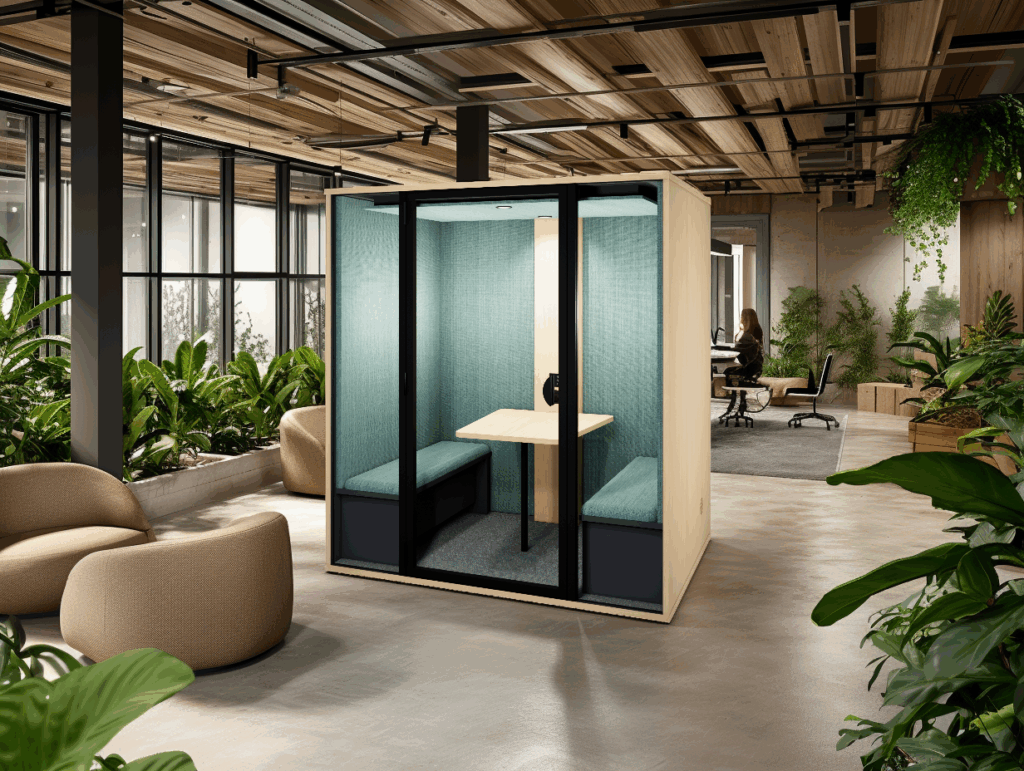
A meeting pod is a self-supporting structure that recreates the function of a small meeting room directly within an open-plan office. It is delivered, assembled and commissioned on site. The aim: to have an immediate meeting space available, without going through the usual process of booking a large meeting room, without relocating a team and without altering the layout.
In day-to-day use, the bubble becomes a natural meeting point for short meetings, group video calls, confidential exchanges or discussions that need to remain private. It is a ‘room within a room’, designed to provide privacy and limit noise disturbance, whilst remaining accessible to all.
What ‘no building work’ means in practice
‘No building work’ does not mean ‘no preparation’. It means avoiding fixed partitions, renovation projects and major works that bring offices to a standstill. We do not transform the building — we add a reversible solution.
However, there are still factors to consider: delivery access, location, power supply, sometimes the network, and traffic flow around the pod. For it to work, it must be usable on a daily basis, comfortable and integrated into the circulation plan.
Closed pod vs acoustic alcove: two distinct solutions
The terminology is often confused: acoustic alcove, acoustic furniture, acoustic panel, acoustic booth. Yet the objectives are not the same.
An acoustic alcove or acoustic panels dampen and absorb noise. They reduce reverberation and improve the overall comfort of the room, but privacy remains limited as the space is not actually enclosed.
A closed bubble is designed to ensure privacy and reduce the intelligibility of speech outside. It creates a mini-room in which people can converse normally, whilst limiting the noise impact on the open-plan office.
When the meeting pod is the right solution — and when it isn’t
The four scenarios where it saves the most time
Certain situations make the meeting pod immediately worthwhile, as it removes friction from day-to-day operations.
Short meetings — team updates, daily stand-ups, one-to-ones, quick reviews, coordination discussions. These meetings are frequent but not substantial enough to monopolise a large room for an hour.
Video calls with 2–4 people — on Teams, Zoom or Google Meet. In an open-plan office, audio quality and concentration deteriorate quickly. The bubble provides a more stable and professional setting.
Confidential discussions — HR, managers, sales staff, sensitive topics, discussions that must not be overheard by the wider office. The Bubble offers a straightforward solution, without relying on a free meeting room.
Coworking — in a shared space, bookable rooms are often needed without permanently tying up floor space. The Bubble creates ‘meeting’ capacity without the need for renovation work.
Situations where it is not suitable
The bubble is not a universal replacement. If the organisation mainly holds long, very frequent meetings with advanced equipment (large fixed screen, whiteboard, complex video conferencing), dedicated rooms remain necessary.
If the offices are already very quiet and acoustically treated, alcoves and good zoning can sometimes suffice for brief discussions.
Finally, if access constraints are a deal-breaker — doors that are too narrow, unsuitable lifts, corridors that do not allow for manoeuvring — the project can become costly or even impractical. Logistics must be assessed in advance.
Mini meeting room for 2–4 people: the criteria that matter
Actual capacity: don’t rely on the figure alone
The most common pitfall is choosing a pod based on a marketing figure. What matters is actual comfort: interior dimensions, table size, seating, movement within the space, and posture.
A 20-minute meeting and a 45-minute hybrid meeting do not have the same requirements. The longer the duration, the more crucial the details become: seat quality, legroom, a table at the right height, and the feeling of not being ‘cramped’. A space that is too cramped quickly tires everyone out, and usage eventually drops off.
Acoustics: protecting conversations without disrupting the open-plan office
In a pod, the realistic goal is not total silence. It is privacy: reducing speech sufficiently so that the conversation does not become an auditory spectacle for the open-plan office.
The benchmark to look for is a speech-oriented metric. The Essentielle range achieves a reduction in speech levels of up to −30.1 dB on the L model (measured by an independent acoustic consultancy). It is this type of information that allows products to be compared clearly, because it speaks directly to usage.
Ventilation: the criterion that determines whether the pod is adopted or rejected
In a 2–4-person pod, ventilation is not a bonus. It is a prerequisite for adoption. With several people present, heat and stale air build up quickly. If air exchange is insufficient, users cut meetings short, avoid the pod or reserve it only as a ‘last resort’.
The benchmark for the Essentielle L: a flow rate of 750 m³/h with a complete air change in under 40 seconds. This is an indicator directly linked to usage: the bubble remains comfortable even during video calls with several people, provided it is properly installed and air circulation is maintained.
Lighting: avoiding eye strain and optimising video calls
Hybrid meetings have made lighting more critical than ever. A bubble may be acoustically sound yet still disappoint if the lighting causes eye strain, if faces are poorly lit during video calls, or if glare makes reading difficult.
The Essentielle range features an 800 lm LED spotlight in warm white 3,000 K (two spotlights for the XL model), with a touch-sensitive dimmer to adjust the lighting to suit the activity: video calls, reading, team discussions, note-taking.
Connectivity: what a modern pod should include as standard
A meeting pod is meant to simplify collaborative work, not complicate it. Yet a hybrid meeting without connectivity quickly becomes a series of minor issues: flat batteries, forgotten chargers, cables lying about, unstable networks.
Every pod in the Essentielle range includes as standard: 1 x 220V socket, 2 USB-C ports, 1 USB-A port and 1 RJ45 port. This is the kind of equipment that makes usage intuitive: you walk in, plug in, and get started.
Mobility: the pod as a flexible space
The ‘no-fit-out’ option is often chosen because offices are evolving: reorganisation, flex office, growth, new uses. A useful pod must be able to adapt to these changes.
The Essentielle range is based on a mobile base with integrated castors and adjustment jacks. The castors make repositioning easy, whilst the jacks stabilise the cabin once in place. A detail that may seem minor, but one that determines the product’s lifespan over several years.
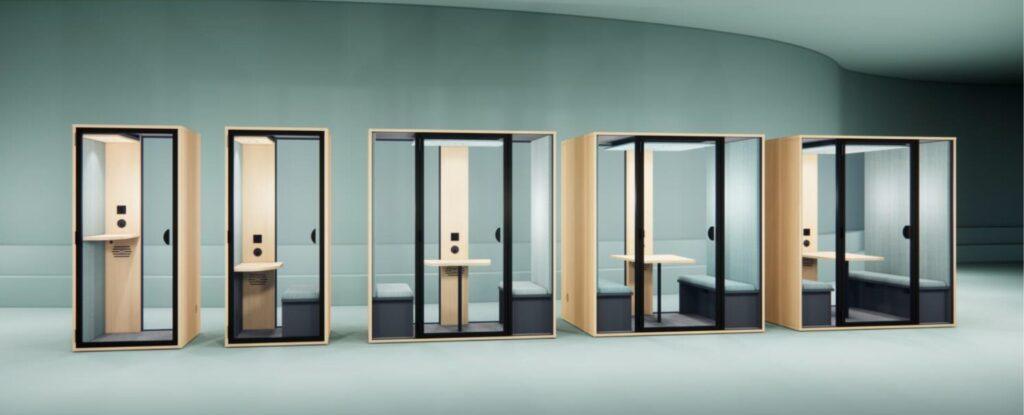
Dimensions, layout and logistics: what to check before purchasing
Dimensions to always ask for
Before buying, you need to know the external dimensions (layout, access, footprint), the internal dimensions (actual comfort), the door dimensions and the weight (delivery logistics).
Essentielle L Essentielle XL
| Essentielle L | Essentielle XL | |
| Capacity | 1 to 4 people | 1 to 6 people |
| External dimensions | 136 × 190 × 212 cm | 160 × 190 × 212 cm |
| Internal dimensions | 129 × 177 × 198 cm | 153 × 177 × 198 cm |
| Floor area | 2,4 m² | 3 m² |
| Net weight | 490 kg | 610 kg |
| Table | 78 × 92 cm (h. 73 cm) | 78 × 115 cm (h. 73 cm) |
| Benches | 129 × 38 cm (h. 45 cm) | 153 × 38 cm (h. 45 cm) |
Ceiling height: the first constraint to check
Ceiling height often derails projects ‘at the last minute’, whereas it should be checked right from the start. The guideline is clear: a minimum of 230 cm, and 240 cm recommended to facilitate installation and ensure ease of use. In a ‘no-renovation’ scenario, this is typically the kind of constraint to anticipate as early as the quotation stage.
Air clearance: let the cabin breathe
A bubble must breathe. If air circulation is blocked, the user experience deteriorates even if the product performs well. The guideline: allow at least 10 cm between the wall and the air inlets/outlets for optimal circulation.
The classic mistake is to stick the booth right up against the wall to save space. This is often counterproductive: you gain a few centimetres of floor space, but lose out on comfort — and therefore user adoption.
Delivery, installation and commissioning
The access route: the number one sticking point
Before planning anything, you need to gather very specific information: door widths, corridors, lifts, parking, floors. These factors determine handling requirements, and therefore cost and feasibility.
A bubble lift may look perfect on paper but turn into a headache on delivery day if nothing has been planned in advance. This issue deserves to be treated as a separate stage of the project.
Assembly: predictable timescales
Assembly is not the same as handling. And handling is not the same as commissioning. A ‘no-construction’ project is still a project that requires planning.
Guidelines for the Essentielle range:
| Model | Number of people | Assembly time |
| M | 2 people | 60 minutes |
| L | 2 people | 60 minutes |
| XL | 3 people | 60 minutes |
(Excluding handling in all cases.)
These timescales allow for smart planning: choosing a slot outside peak times, minimising disruption on set, and ensuring the installation does not interfere with operations.
Commissioning: immediate checks
Once the pod is installed, you must immediately check the key operational elements: ventilation running, dimmer switch working, lighting operational, connections tested, stability ensured by the jacks. A properly carried out commissioning avoids the minor frustrations that hinder adoption in the first few weeks.
Focus on the Essentielle range: which pod for which need
Essentielle M — The duo: one-to-one and two-way video calls
The Essentielle M covers one of the most common uses in the workplace: one-to-one interactions. Individual meetings, two-way video calls, quick updates between a manager and an employee.
Its features: external dimensions of 95 × 190 × 212 cm for a floor area of 1.8 m², a net weight of 400 kg, ventilation of 575 m³/h with air renewal in under 40 seconds, an 800 lm LED spotlight at 3,000 K, and the standard connectivity of the range (220 V, 2 USB-C, USB-A, RJ45). The door measures 90 × 204 cm with 8 mm Silence laminated glass.
Essentielle L — The mini meeting room for 2 to 4 people
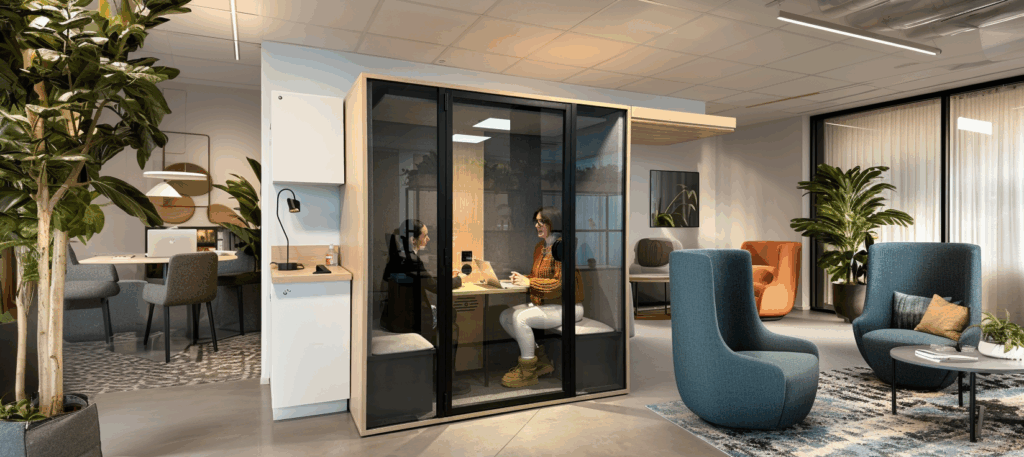
This is the typical format for a ready-to-use meeting pod: team briefings, group video calls, hybrid meetings, confidential discussions. Its 78 × 92 cm table at standard height (73 cm) and 129 × 38 cm benches comfortably accommodate up to 4 people.
With a ventilation flow rate of 750 m³/h and an internal area of 2.4 m², it is designed to host group sessions lasting 30 to 60 minutes without compromising on comfort. As an option, a screen mount with a dedicated socket and cable grommet can be added for hybrid meetings.
Essentielle XL — The team space for up to 6 people
The XL format meets a broader need: accommodating more participants, holding a short workshop or having a flexible room without the need for building work. Its 78 × 115 cm table and 153 × 38 cm benches provide the necessary space for meetings of 5–6 people.
With a floor area of 3 m², two 800 lm LED spotlights and the same ventilation flow rate as the L (750 m³/h), the XL maintains a level of comfort suitable for larger groups. A screen mount is also available as an option.
Materials and durability for intensive use
In everyday office use, durability also depends on the finishes. The exterior cladding is made of PPSMHD compressed melamine (available in white, anthracite or light oak), the interior fabrics are 100% PES with a Martindale resistance of over 100,000 cycles in category A, and the floor is covered with 100% polyester carpet. The Category B fabric option (M1-rated, post-consumer recycled polyester) is available to meet stricter fire safety or environmental responsibility requirements.
Meeting pod vs traditional meeting room: why companies are switching
When there is a shortage of meeting rooms, ‘adding a room’ without renovating becomes a rational choice. The pod allows meeting capacity to be increased quickly, without tying up offices in a building site. The main benefit is flexibility: you can add, move and adapt. It is also a way of optimising existing floor space without altering the building’s structure.
The fact that the solution incorporates ventilation, adjustable lighting, full connectivity and the option for a screen mount is no minor detail: these elements determine actual usage, particularly for video conferencing and hybrid meetings, which have become part of daily life for most teams.
Common mistakes to avoid
Choosing a space that’s too small
When a mini-meeting room is too small, everything suffers: posture, comfort, perceived temperature, and fatigue. Meetings of 3–4 people become ‘cramped’ and the team ends up avoiding the pod, even if it seemed like a good idea at first.
Underestimating the layout
A pod placed in a busy corridor or near coffee areas and printers is subject to noise spikes and creates social discomfort: users feel as though they are being watched or interrupted. This reduces its usage.
Neglecting logistics
The access plan, photos of the route, door widths, lift capacity, parking and delivery times are simple but crucial details. Neglecting them leads to avoidable extra costs or delays.
Conclusion
A meeting pod is cost-effective when it becomes second nature. The choice should be made in this order: the right size (2–4 or up to 6 people), comfort (ventilation, lighting), connectivity for video conferencing, then layout and logistics (ceiling height, access, air clearance).
If you had to sum up the project in a single rule, here it is: the best mini meeting room isn’t the one that looks impressive on a spec sheet; it’s the one that fits seamlessly into daily life and reduces friction within the team.