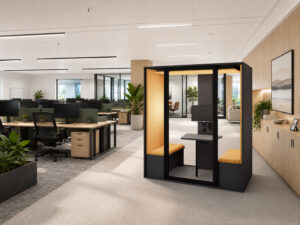

In a call centre, noise is not merely a matter of comfort. It has a direct impact on concentration, fatigue and the quality of interactions. When calls come one after another all day long, conversations overlap and cold calling sets the pace of the work, the acoustic environment becomes a performance factor in its own right.
The effects are immediate. Concentration drops, mental effort increases, teams raise their voices, video calls become less fluid and confidentiality suffers. The more the hubbub takes hold, the more it tires sales staff and complicates their work.
Reducing noise in a call centre is not about seeking absolute silence. The objective is more practical: to reduce noise pollution, improve speech intelligibility, limit the propagation of sound, and protect calls that require concentration or confidentiality.
The right approach is based on four simple steps: diagnose, treat, structure, protect.
The most effective strategy for reducing noise
In a call centre, you don’t eliminate noise. You reduce perceived noise and control its spread.
In most cases, the most effective strategy relies on three complementary measures.
First, you need to reduce reverberation. This involves treating surfaces that cause sound to bounce, particularly the ceiling, walls and certain very hard surfaces.
Next, you need to break up the propagation of speech. Partitions, dividers and clear zoning prevent noise from spreading throughout the open-plan space.
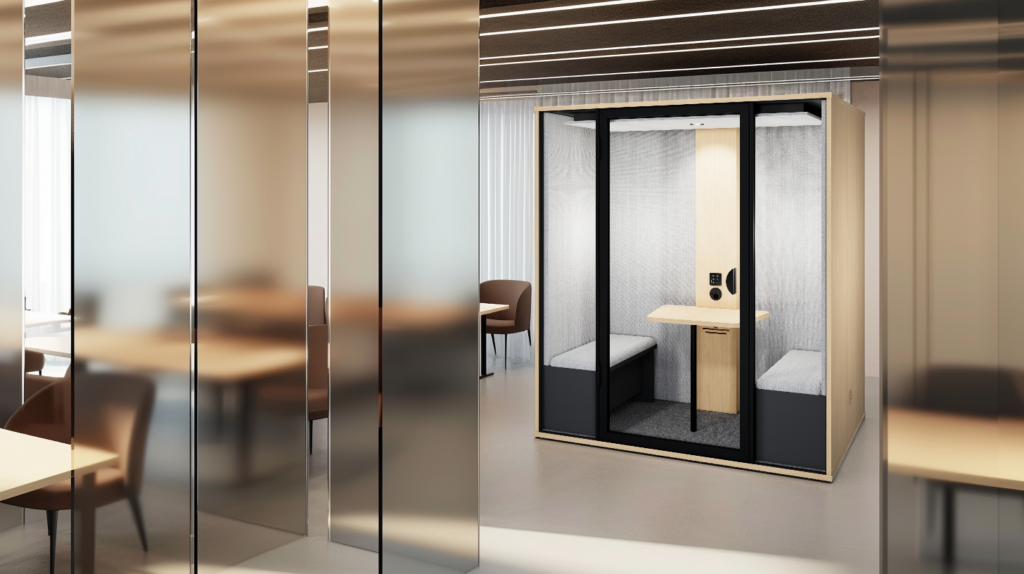
Finally, you need to create dedicated ‘bubbles’ for sensitive calls. This is where acoustic booths and phone boxes really come into their own.
This approach works on two levels. On the one hand, it improves the overall sound environment of the open-plan office. On the other, it immediately protects moments that require better voice quality and greater confidentiality.
Understanding the real acoustic problem in a commercial open-plan office
A commercial open-plan office is not meant to be silent. Some noise is useful: a team briefing, a quick chat, a manager’s coordination. This noise is part of the job.
The problem stems from background noise. On a commercial set, this is mainly an excess of voices. Overlapping calls, nearby conversations, interruptions, sound spikes, and frequent movement: all of this creates a constant hubbub that makes listening more difficult and increases fatigue.
Open-plan offices exacerbate this phenomenon when they feature hard surfaces. Sound bounces off them, builds up and raises the ambient noise level. The higher the level rises, the louder everyone speaks to compensate. The noise then feeds on itself.
It is also important to distinguish between two concepts that are often confused. Sound insulation serves to limit the transmission of sound between two spaces. Acoustic treatment is used to reduce echo and reverberation within a single space. In a commercial office, both issues can coexist, but the main problem often stems from insufficient acoustic treatment.
Start with a simple assessment
Before installing acoustic panels or a booth, you need to identify precisely what is generating the noise.
A quick assessment can already help clarify the situation. This involves identifying fixed sources such as corridors, the coffee area, printers, the entrance or slamming doors. You also need to pinpoint areas where speech dominates: incoming calls, cold calling, SDR centres, business development, manager briefings.
It is also useful to distinguish between noise peaks and background noise. Peaks can often be addressed through better layout and a few usage guidelines.
Background noise, on the other hand, requires real work on reverberation and the layout of the open-plan office.
Even without specialised equipment, an assessment is still possible. Simply observe the open-plan office at various times of the day and note what is most disruptive: rising voices, overlapping conversations, auditory fatigue at the end of the day, difficulty holding a video call or making a sensitive phone call.
No-construction solutions that make a difference
The first lever, in many commercial open-plan offices, remains the ceiling. It is often the largest reverberation surface. When it is hard, sound rises, bounces and returns throughout the space. Acoustic tiles, baffles or suspended islands help reduce this reverberation and mitigate the ‘canteen effect’.
Wall-mounted acoustic panels are also very useful, especially in busy areas or near surfaces that strongly reflect sound. Their purpose is simple: to calm the acoustic environment and improve speech intelligibility.
Furniture can also contribute to acoustic comfort. Bookcases, textiles, curtains, alcoves or carpets increase sound absorption and help make the open-plan office more pleasant. However, these solutions are not sufficient to guarantee the confidentiality of an important call.
Structuring the workspace to limit noise propagation
Reducing noise is not just about absorption. It also involves organising how the space is used.
Acoustic partitions, workstation dividers and movable partitions help to break up the direct paths of sound propagation. Their effectiveness depends as much on their placement as on the product itself. When positioned correctly, these elements limit sound propagation without completely closing off the space.
Zoning is just as important. In a commercial open-plan office, it is useful to distinguish three zones: a call zone, a focus zone and a discussion zone. This layout prevents all activities from intermingling everywhere and stops noise from spreading continuously.
Finally, usage rules play an essential role. They must remain simple, practical and easy to apply. Knowing where to take a long call, where to hold a briefing or where to position oneself for a video call helps to maintain the quality of work for the whole team, without making the floor’s operations too rigid.
Why the soundproof booth quickly becomes indispensable
In a commercial office, certain discussions cannot be held amidst the hubbub. Negotiations, pricing proposals, sensitive client matters, HR discussions, important video calls, dispute resolution: these situations require greater confidentiality and clearer voice quality.
It is precisely in this context that the soundproof booth becomes a particularly relevant solution. It creates a dedicated space without monopolising a meeting room and without requiring major building work.
A soundproof booth does not replace the overall acoustic treatment of the set. However, it effectively protects strategic discussions and provides a designated space for calls, video conferences and sensitive conversations.
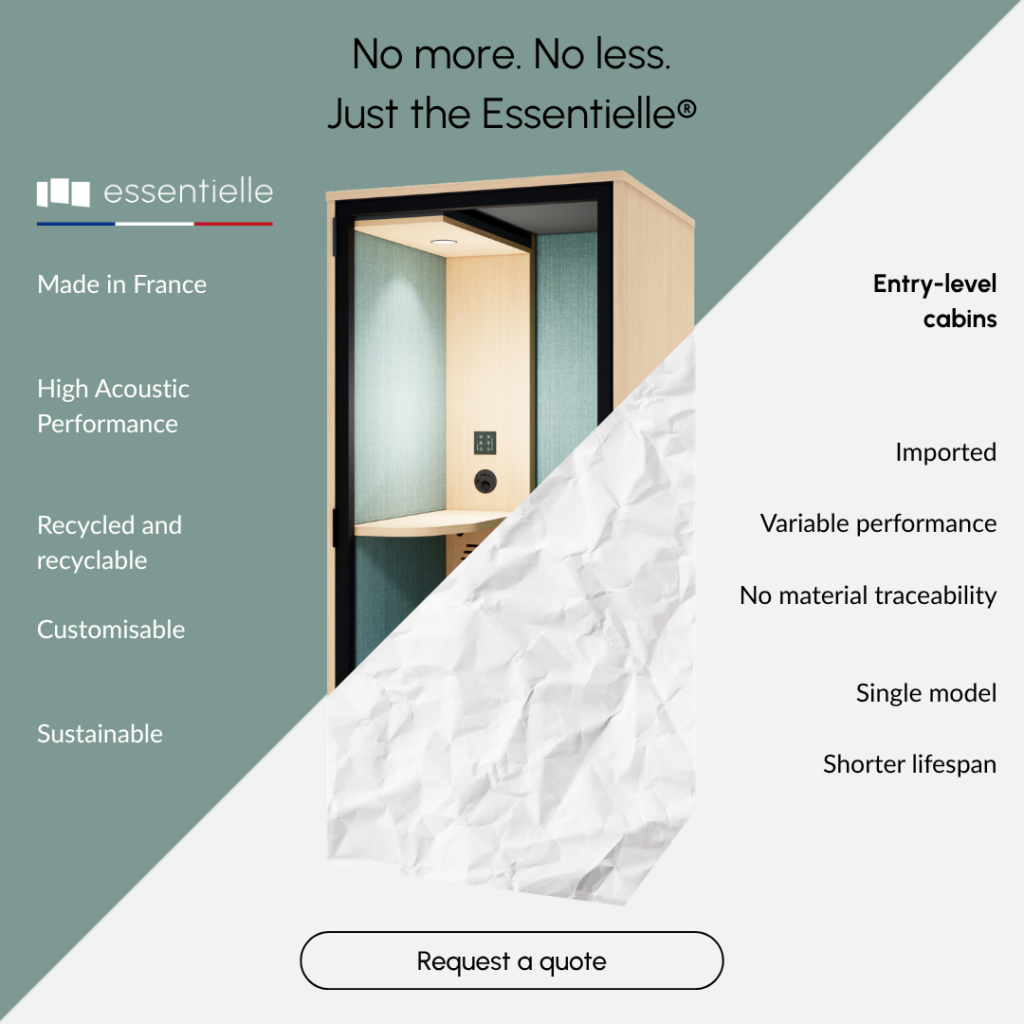
Essentielle offers acoustic booths capable of reducing speech levels by up to 30.3 dB. They feature 8 mm Silence laminated glass, a design specifically engineered to minimise sound leakage, comprehensive connectivity, a reversible door and a mobile base. On certain models, complete air renewal is achieved in under 40 seconds.
Which booth to choose for a sales floor
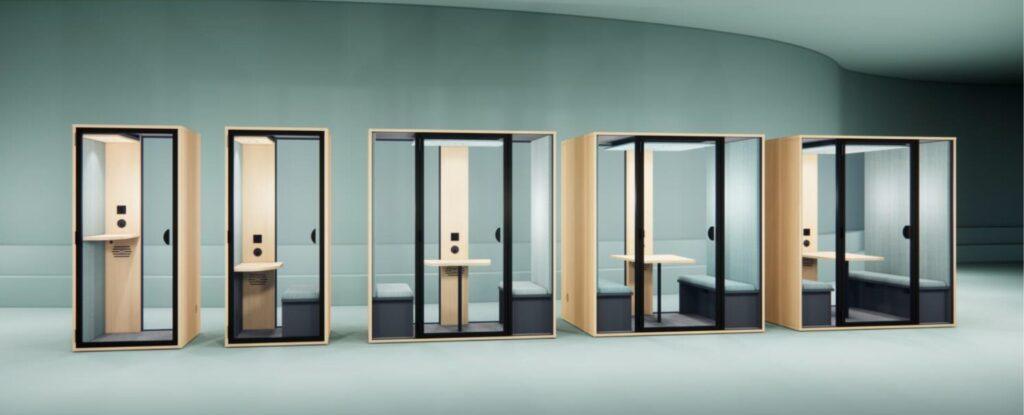
For SDR and business development teams, the single-person format is often the most useful. It allows you to isolate a call, secure a video conference or conduct a prospecting session without being disturbed by the noise of the open-plan office.
The Essentielle S booth is particularly well suited to this purpose. It features 280 m³/h ventilation, air renewal in under 40 seconds, 800 lm LED lighting at 3000 K with dimmable brightness, and connectivity including a 220 V socket, USB-C, USB-A and RJ45.
Whenever you need to debrief a meeting, prepare for an appointment, hold a video call with two people, or run a mini sales meeting, a larger format becomes a good option. The Essentielle M, L and XL booths can accommodate between 1 and 6 people depending on the configuration, with ventilation of up to 750 m³/h in the larger sizes.
Beyond technical performance, the decisive factor remains actual usage. The best booth is the one that gets used. To achieve this, it must be close to teams, visible, accessible and associated with clear uses.
Points to consider during installation
The layout plays a direct role in comfort and adoption.
To ensure good air circulation, allow at least 10 cm between the wall and the air inlets or outlets. You should also check the ceiling height beforehand, with a recommended minimum of 240 cm to facilitate installation. Finally, the power supply and network must be planned from the outset to avoid a booth that is impractical for everyday use.
7-day action plan
On the first day, map out noisy areas, quiet areas, foot traffic patterns and voice-related activities.
On the second and third days, treat the surfaces with the highest reverberation, prioritising the ceiling and walls in high-traffic areas.
On the fourth and fifth days, clarify the zoning, install partitions where voice carries the furthest, and establish simple rules of use.
On the sixth and seventh days, create a dedicated space for strategic calls using an acoustic booth, then check that teams are using it and adjust its location if necessary.
Conclusion
Reducing noise in a commercial open-plan office is not simply a matter of adding a single piece of equipment. A successful outcome stems from a coherent approach: reducing reverberation, limiting the spread of speech, organising usage patterns and protecting strategic calls.
In this context, acoustic booths have a vital role to play. They do not aim to solve everything on their own. However, they perfectly address a key need in sales floors: providing a space for concentration, confidentiality and voice quality where the open-plan layout no longer naturally allows for it.
Essentielle supports this approach with acoustic booths designed for the real-world needs of teams, whether it’s a quick call, a video conference, a sensitive discussion or a mini sales meeting.
I can also provide you with an even more premium and editorial version now, with a more high-end tone reflecting the Essentielle brand.