
‘Soundproof’ does not mean ‘total silence’
When you type ‘soundproof booth’ into Google, you’re usually looking for a simple solution to reduce noise in an open-plan office: to make phone calls more clearly, have successful video calls, regain concentration, protect confidentiality, and stop being subjected to everyday background noise. This expectation is legitimate, but it needs to be put into perspective.
An acoustic booth reduces sound transmission, particularly of speech, and improves user comfort. However, it does not create a sound vacuum nor does it transform an open-plan office into a silent studio. Some residual noise may remain, and that is normal: the realistic goal in the office is to make voices less audible from outside, to improve the experience inside, and to create a more peaceful working environment.
The term ‘soundproof’ is, in fact, ambiguous. Google lumps together acoustic booths, soundproof booths, phone boxes, acoustic panels, alcoves and acoustic treatment solutions.
This article clarifies the difference between these solutions, explains how a booth works in practice, and then provides a selection method based on concrete criteria.
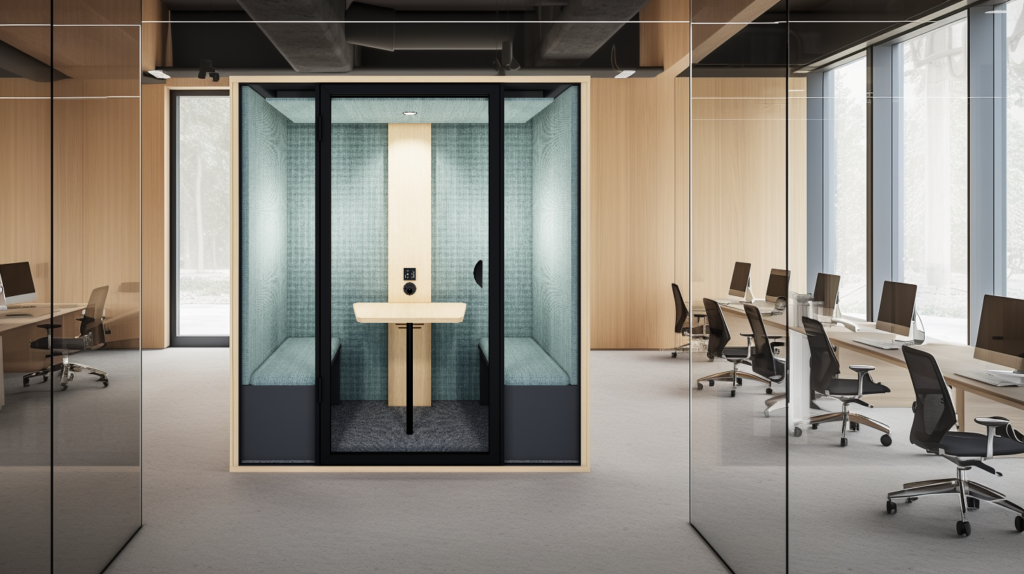
The best booth is the one that suits your needs
If your priority is calls and video conferences, a single-person phone box is often the best starting point, provided it has effective ventilation, comfortable lighting and suitable connectivity.
If you’re looking for extended focus (writing, production, complex tasks), a single-person booth with a desk and chair is a better fit. Ergonomics makes all the difference over time.
If you need a space for meetings of two to four people, you’ll need a booth with better ventilation, a table, and possibly a monitor stand.
In the real world, three factors make a far greater difference than marketing promises: soundproofing (door and seals), ventilation (otherwise the cubicle will be avoided), and positioning (if the cubicle is poorly ventilated or badly placed, it will be used less).
Identify the noise you want to reduce
Background noise, peaks and the hubbub of voices
In an open-plan office, noise is not a single, monolithic block. Constant background noise (general ventilation, distant conversations) is tiring and erodes concentration without us even realising it. Noise spikes (a nearby phone call, laughter, a door) create immediate disruption and break focus. And the hubbub of voices, in an office where there are frequent calls, grabs attention, overlaps with conversations and makes confidentiality virtually impossible.
Understanding what you experience most often prevents you from tackling the wrong problem with the wrong solution.
Confidentiality as the real objective
If you’re talking about a soundproof booth, there’s a good chance your real objective is confidentiality. And the correct definition is not “I can’t hear a thing”, but rather “I can no longer make out the conversation”. For sensitive calls (sales, HR, finance, legal), the priority becomes reducing speech transmission and ensuring soundproofing around the most vulnerable areas: doors, glazing and seals.
Enclosed booths, alcoves, panels: don’t buy the wrong solution
Google often confuses soundproofing with acoustic treatment, even though they are two different concepts. An enclosed booth focuses on reducing sound transmission and providing localised privacy. Panels or sound-absorbing solutions tackle reverberation and echo: they improve the overall comfort of a room, but do not guarantee high levels of confidentiality a few metres away.
The right approach is to choose based on the intended use. Are you looking to protect a call, or to make the open-plan space more pleasant overall? The two complement each other, but do not address the same need.
An acoustic alcove may suffice if noise levels are moderate and you are primarily looking to step away for a short call or a review. However, it is not sufficient when calls are critical or when confidentiality is a genuine concern. Without a door or soundproofing, voices can be heard, and speech intelligibility remains too high in the immediate vicinity.
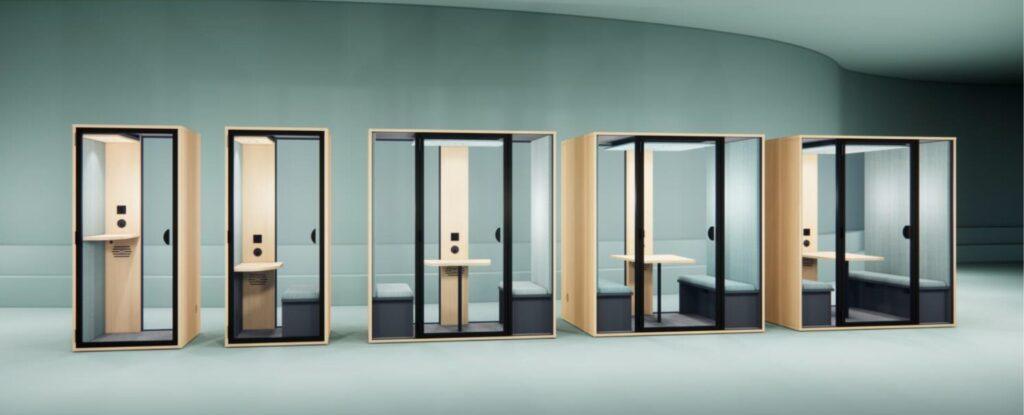
The criteria that define a true soundproof booth
Acoustic performance
The classic pitfall is vague promises (‘soundproof’, ‘noise-reducing’) without usage-oriented metrics. For an office booth, you should prioritise metrics that address voice and confidentiality. The benchmark for the Essentielle range: speech level reduction of up to −30.3 dB, measured by an independent acoustic consultancy.
The door and glazing
In a booth, the more air leaks there are, the more sound gets through. And the most critical point is almost always the door: closure, alignment, seals, glazing. The Essentielle benchmark: 90 × 204 cm door made of 8 mm Silence laminated glass. The door and its glazing are not merely an aesthetic detail; they are a critical factor in performance.
Ventilation
A cubicle may perform well on paper but prove a failure in practice if the air is stagnant. When the air becomes stuffy or is poorly ventilated, the cabin becomes a source of fatigue and is eventually avoided.
Essentielle specifications by model:
S and S Bureau: 280 m³/h, air renewal in under 40 seconds. M: 575 m³/h, same air renewal. L and XL: 750 m³/h, same air renewal.
Lighting and connectivity
Lighting affects fatigue levels and the image quality during video calls. The Essentielle range features one or two LED spotlights up to 800 lm in warm white (3,000 K), with a touch-sensitive dimmer.
In terms of connectivity, professional use requires the ability to connect a computer, charge a phone and sometimes stabilise a video call via a wired network. Every Essentielle booth comes as standard with: 1 x 220 V socket, 2 x USB-C ports, 1 x USB-A port and 1 x RJ45 port.
Ergonomics
For short calls, a tablet may suffice if the height is suitable. For longer use, a standard-height desk and a seat make all the difference. The Essentielle S features a tablet measuring 33 × 79 cm at a height of 103 cm. The Essentielle S Bureau offers a desk measuring 43 × 79 cm at a height of 73 cm and a bench seat with a seat height of 45 cm.
Which format to choose
Single-person booth (phone box): for calls, video meetings and short bursts of concentration. This is the most straightforward format for reducing perceived noise and protecting frequent callers. Essentielle S: external dimensions 95 × 96 × 212 cm, surface area 0.9 m², net weight 255 kg.
1-person booth with desk: for producing content, writing, and back-to-back video calls without fatigue. The key difference is posture. A standard-height desk and a seat make for sustainable use. Essentielle S Desk: same dimensions, net weight 270 kg.
2-person pod: for one-to-ones, interviews and two-way calls. Essentielle M: external dimensions 95 × 190 × 212 cm, floor area 1.8 m², ventilation 575 m³/h, table 51 × 78 cm with two benches.
4-person pod: mini meeting room requiring no building work. Essentielle L: external dimensions 136 × 190 × 212 cm, floor area 2.4 m², ventilation 750 m³/h, table 78 × 92 cm.
6-person pod: meetings, workshops, team discussions. Essentielle XL: external dimensions 160 × 190 × 212 cm, floor area 3 m², 2 LED spotlights, same ventilation as the L.
For the M, L and XL models, a screen mount with a dedicated socket and cable grommet is available as an option.
The layout that makes or breaks the soundproofing effect
Even a good pod can be disappointing if it is poorly positioned. Soundproofing in the office is a matter of usage: if the pod is uncomfortable, poorly ventilated or placed in a noisy area, it will be used less.
Ceiling height: minimum 230 cm, 240 cm recommended to facilitate installation and ensure comfort during use.
Ventilation clearance: allow at least 10 cm between the wall and the air inlets/outlets. Placing the booth right up against the wall is the most common mistake.
Power and network: cable outlets are provided at the top or bottom (rear) of the booth. The aim is a tidy installation, with no cables on the floor that make the booth difficult to use.
Compare prices without falling into traps
Comparing prices without defining the scope leads to poor decisions. The most reliable method is to clearly separate the price of the booth, delivery, installation and options (screen mount, finishes, glass back panel). Ask for a line-by-line quote to compare on an equal basis.
Combine the booth with acoustic treatment
A booth is primarily for privacy and calls. To reduce overall noise in an open-plan office (and the associated fatigue), room treatment remains a logical complement: panels, ceilings, and sound-absorbing materials.
The most robust combination pairs booths for strategic calls and privacy with acoustic treatment around them to reduce reverberation and make the open-plan office a calmer environment.
Conclusion
Choosing a soundproof booth for the office depends first and foremost on its intended use: calls and video conferences, extended focus periods, or small meetings. Next, you need to check the fundamentals that determine actual performance: speech-oriented sound insulation, doors and glazing, ventilation, lighting, connectivity and ergonomics. Finally, the layout is key: ceiling height, air clearance and clean electrical installation.
The most effective approach before placing an order is to start with a checklist of requirements: a floor plan, a few photos, your access constraints and your actual usage. This is what enables you to choose the right format and avoid mistakes that turn a soundproof booth into a rarely used item.