
Why the term ‘demountable’ has become a key criterion in modern offices
In today’s offices, it’s no longer just about reducing noise. It’s about creating, in the right place at the right time, a private space for calls, video meetings or focused work — whilst retaining the freedom to adapt the layout without starting a building project. This is where the word demountable has come to the fore. The problem is that it is often used interchangeably with mobile, modular, movable, or ‘no building work required’… whereas these concepts do not always describe the same reality.
An acoustic booth is, above all, relocatable
A dismantlable acoustic booth is generally designed to be assembled, dismantled, transported and sometimes reassembled without altering your offices. On the market, this approach is often found in kit form, which makes assembly and dismantling simpler.
Be careful, however: some booths are primarily movable (for example, thanks to a base with castors), without being designed for regular dismantling. A booth can therefore be mobile without actually being demountable. Finally, the ‘no building work required’ promise is common: with many manufacturers, installation is designed to be quick and often requires nothing more than an electric socket.
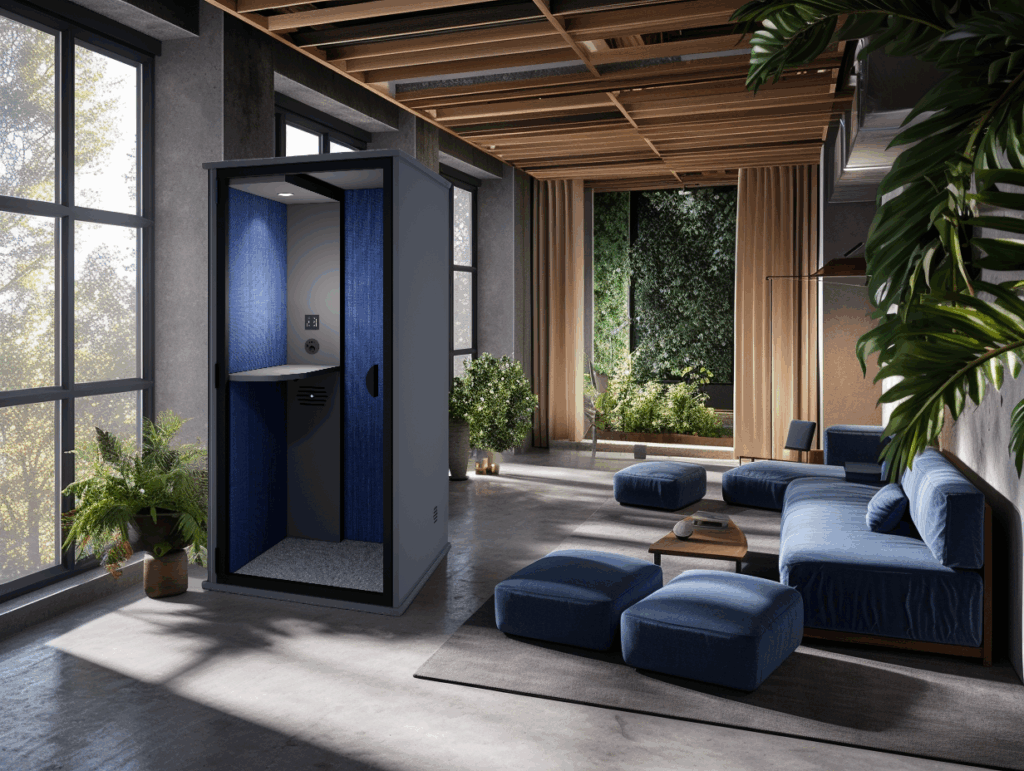
Dismantlable, mobile, modular:
The cubicle designed to be dismantled and reassembled
A dismantlable cubicle features a panel/assembled structure design, which allows for dismantling and reassembly during a move, a workspace reorganisation or a change of location.
The key consideration is mechanical: the more you dismantle and reassemble it, the more the cubicle must remain robust at its critical points: door, joints, alignments, technical access points, ventilation.
The cubicle moves
“Mobile” refers to the ability to move the cubicle around the office. For example, in the Essentielle range: the base is designed with castors and an adjustment/stabilisation system.
This is useful in a flex office, when teams move around or when you want to optimise a layout. But “mobile” does not mean “leaving it on castors”: the point is precisely to move it and then stabilise it correctly.
The building-block approach
“Modular” refers more to the concept of range (1 person, 2 people, meeting) and options (glass back panel, screen mount, etc.). In practice, you’ll mainly link this modularity to your specific uses: phone booth for calls/video calls, office cubicle for working, meeting cubicle for 2–4 people, etc.
Why choose a demountable acoustic booth for the office
No building work: create a private space without a construction site
The benefit is immediate: you create a “mini-room” on the open-plan floor without partitions or major building work. Many solutions highlight quick and easy installation, with power supplied via a socket.
Flex office: adapting the office to the pace of teams
When a team grows, when a department moves to a new area, or when you reorganise workstations, a demountable/mobile booth retains its value because it adapts to usage.
Privacy: calls, video calls, sensitive discussions
An acoustic booth primarily serves to limit the intelligibility of the conversation from outside. Essentielle achieves a reduction in speech level of up to -30.3 dB.
Productivity: regaining true concentration in an open-plan office
When ambient noise and interruptions become tiring, the booth becomes a space for concentration that is always available, without relying on a meeting room.
Optimising floor space: adding a mini-room without losing the open-plan layout
A booth creates a functional space directly within the open-plan area, without permanently fixing the layout.
Sustainability: demountable can also mean recyclable
Some brands highlight a design intended to be demountable and recyclable, with a focus on end-of-life recovery. At Essentielle, this aspect is explicitly emphasised (Cradle to Cradle).
What a ‘dismantlable’ cubicle must guarantee
- Effective sound insulation: the classic pitfall is the ‘noise-cancelling’ promise. In reality, what you’re looking for is privacy of use: from outside, you hear less and, more importantly, you understand less. Essentielle achieves a reduction in speech levels of up to -30.3 dB.
- Office-oriented ventilation: a demountable booth remains a closed space; without ventilation, it is underused. Essentielle offers 280 m³/h for the S and S Bureau models, with an air change rate of 40 seconds.
- Lighting that prevents eye strain: the booth is used for video calls and repeated sessions, so lighting is really important. Essentielle booths are equipped with 1 or 2 LED spotlights (800 lm, 3000 K).
- Integrated connectivity: for seamless use of IT equipment, you need to be able to rely on integrated connectivity. On each booth, Essentielle offers a power strip comprising 1 x 220 V socket, 2 x USB-C, 1 x USB-A and 1 x RJ45.
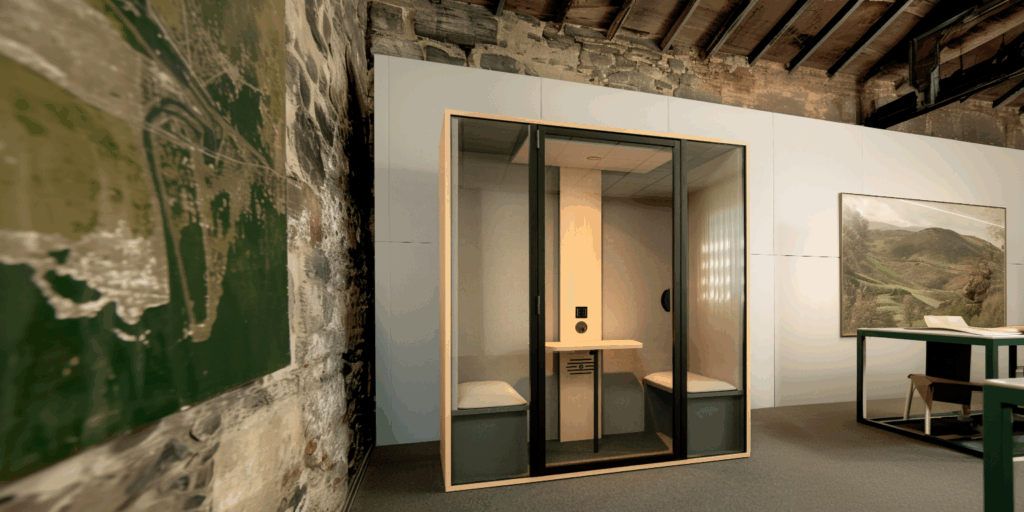
Criteria for a portable booth
When discussing portable booths, it is not enough to check that they can be moved ‘in theory’: you must ensure it remains easy to move, quick to install and reliable once in place. The first key criterion is the trio of base + castors + levelling feet, which determines the product’s true mobility. On the Essentielle S, the technical specifications mention 5 integrated castors, an ultra-slim 2.8 cm base and 8 levelling feet. In practical terms, this reflects a fundamental principle: move the unit, then stabilise it. And this stabilisation is no minor detail, as it directly affects user comfort (a feeling of solidity, no wobble, good ground contact) and the overall perception of quality.
Second criterion: assembly time, often presented as a selling point for simplicity. Essentielle provides ‘express’ assembly guidelines — for example, 2 people / 40 minutes for the S model — with comparable times across versions, though generally excluding handling. This is an important point, as one must not confuse the time taken to assemble the cabin with the entire operation: access to the building, unpacking, moving components and final adjustments can account for a significant proportion of the actual time.
In many cases, it is even access constraints (corridors, lifts, corners, floors) that determine whether the project will run smoothly or be more complex.
Finally, logistics is a decisive factor, often underestimated at the outset, yet it answers the real on-site question: “will it fit?”
For the Essentielle S cubicle, the logistics information specifies 1 unit measuring 120 × 120 × 235 cm, a gross weight of 330 kg and a volume of 3.4 m³; the product page also indicates a net weight of 255 kg. This data allows you to plan transport, handling and on-site installation in practical terms, and to avoid unpleasant surprises at the time of delivery.
Installation without building work
One of the major advantages of a demountable acoustic booth, such as those offered by Essentielle, is that it can be installed without major building work. But be careful: without building work does not mean without installation guidelines. In practice, a poorly positioned booth can compromise comfort, ventilation and usability.
First point to note: ceiling height. On the Essentielle website, an article mentions a minimum of 230 cm and 240 cm recommended, whilst the Buronomic (Essentielle) documentation sets out a more stringent recommendation, with a minimum of 2.40 m to allow for assembly and to maintain space above the booth. The rule of thumb is therefore simple: always check the available height before confirming the order, referring to the technical specifications of the chosen model.
Second key point: clearance for air circulation, essential for the ventilation to function properly. Several guidelines are repeated in the Essentielle content and the Buronomic documentation, with a recommendation to leave approximately 10 cm of space between the cabin and the walls, particularly around the air inlets and outlets (and according to the documents, 10 cm on each side).
Finally, power and network outlets must be planned for right from the layout phase. The challenge is not simply to plug the booth into a power strip, but to provide a well-placed power supply to avoid visible cables, preserve the aesthetics of the space and ensure a seamless user experience. Because a well-installed booth is a booth that is actually used — and that is where performance comes into play.
Conclusion
A demountable soundproof booth is only valuable if it truly delivers on three complementary dimensions.
The first is flexibility: the ability to dismantle it, clear logistics and well-thought-out mobility, with careful attention to the base, castors and stabilisation once the booth is in place.
The second is user comfort, which ensures a booth is used on a daily basis — and not just “well-chosen” on paper: effective ventilation, suitable lighting, practical connectivity and a consistent level of privacy for discussions.
The third, often underestimated, concerns the building constraints: ceiling height, clearance for ventilation, access, circulation and installation conditions. Because even if it can be dismantled, a cabin is always dependent on the realities of the site.In summary, a successful project does not rely on a single criterion, but on the right balance between mobility, user experience and on-site feasibility.