
Concentration is first and foremost a question of environment
In many offices, concentration has never been put to the test quite like this. Open-plan offices, flex offices, co-working spaces: these ways of organising work have led to a surge in interactions — and, with them, interruptions. Between phone calls, video meetings, spontaneous conversations and people coming and going, safeguarding periods of deep work has become a daily challenge.
The evidence is clear: noise and interruptions in open-plan offices are not mere logistical details. They shape the working day and directly influence the ability to stay focused. This is where the issue takes on a different dimension. Concentration is not merely a matter of willpower or personal discipline. It is first and foremost a question of the working environment: noise, visibility, light, footfall, and physical comfort. A poorly situated space—one that is too exposed, too hot, or too reverberant—will not be used, even by the most motivated employees. Conversely, a well-designed and well-structured space can become a real driver of productivity.
The aim of this article is to explain the principles of a space conducive to concentration, propose a practical implementation method, and then review solutions that require no building work—furniture, alcoves, acoustic booths—specifying when each is appropriate. The goal is not to create a ‘quiet corner’ on paper, but a space that is genuinely adopted by teams.
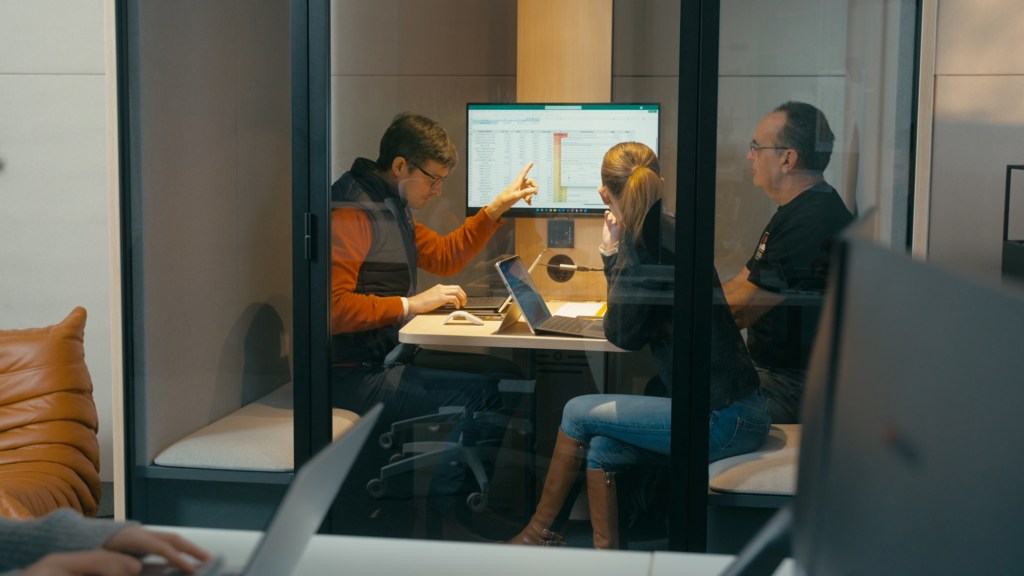
The 7 factors that create a genuine focus space
Creating a focus space that works rarely relies on a single solution. In most offices, it is a combination of seven factors that makes the difference.
Reduce perceived noise. Action must be taken on both background noise and sudden noise spikes: calls, people passing by, machinery, and unexpected events. In open-plan offices, these elements accumulate, increasing fatigue and undermining focus.
Minimise visual distractions. A concentration space situated in a constant flow, with total transparency, creates a ‘showcase’ effect: the brain remains on alert even without noise. Movement is a distraction in itself.
Create a clear social cue. The space doesn’t really exist until the team knows how to react when someone settles in. A simple rule and explicit signage are needed: when someone is inside, they must not be disturbed.
Pay attention to ergonomics. Concentration is easier when seating, posture and screen height are adjusted for 30 to 90 minutes. Physical discomfort quickly becomes a source of distraction.
Adjust the lighting. Unstable lighting—whether too cold, too harsh or causing glare—accelerates eye strain and makes work more cognitively demanding.
Ensure a comfortable indoor climate. If the space feels stuffy, too hot or poorly ventilated, it simply won’t be used. This is particularly true in enclosed or semi-enclosed spaces.
Ensure accessibility. A focus space that is too far away from teams, or too ‘theoretical’, will remain empty. Adoption depends on proximity and ease of access.
Focus space, meeting room, quiet zone: clarifying the terms
What distinguishes a focus space
A focus space is designed for complex tasks: writing, analysis, production, reflection, in-depth work. Its aim is to protect individual focus, not to encourage collaboration.
A meeting room, even a small one, is primarily intended for group work. It can serve as a stopgap for concentration, but it is often monopolised by calls or individual tasks, which creates pressure on availability.
A quiet zone aims primarily to reduce overall noise, without necessarily providing complete isolation. It improves the acoustic comfort of the environment, but does not guarantee either vocal isolation or high levels of confidentiality.
Three levels of concentration, three types of solutions
Distinguishing between these levels helps in choosing the right solution.
Micro-focus (15 to 30 minutes) can be achieved with a quiet corner, a few team rules, headphones and a ‘no-meeting zone’ policy.
Deep focus (30 to 90 minutes) requires a dedicated area, a clearer separation and often sound-absorbing furniture to stabilise acoustic comfort.
Privacy or voice isolation — calls, video conferences, concentration requiring genuine perceived quiet — calls for more protective solutions: acoustic booths, phone boxes or ‘workstation’ booths.
What disrupts attention in day-to-day open-plan offices
Noise: background noise and sudden interruptions
The major disruptions are well identified: phone calls, video conferences, and conversations between colleagues. Even when the noise level isn’t extreme, the repetition and density of voices eventually wear down one’s attention.
It is useful to distinguish between two mechanisms. continuous noise is tiring: it keeps the brain in a constant state of filtering. sound spikes disrupt concentration: they create sudden breaks, forcing us to stop and then refocus — a process that can take several minutes each time.
Human interruptions: an underestimated cost
Noise is not the only culprit. Rapid requests, whispered questions and questioning glances take their toll. These interruptions are often amplified by visibility: if a colleague is ‘within sight’, they become more readily available to others.
The answer is not to make teams feel guilty, but to establish simple rules and create agreed-upon visual cues. A focus space works when it reduces interruptions without creating social tension.
The physical environment: an often-overlooked factor
A focus space can fail for very practical reasons: poor lighting, screen glare, heat, stuffy air. Cognitive fatigue is directly linked to these factors, even when noise is better controlled. This is why any isolated space must be well-ventilated and physically comfortable to be truly adopted.
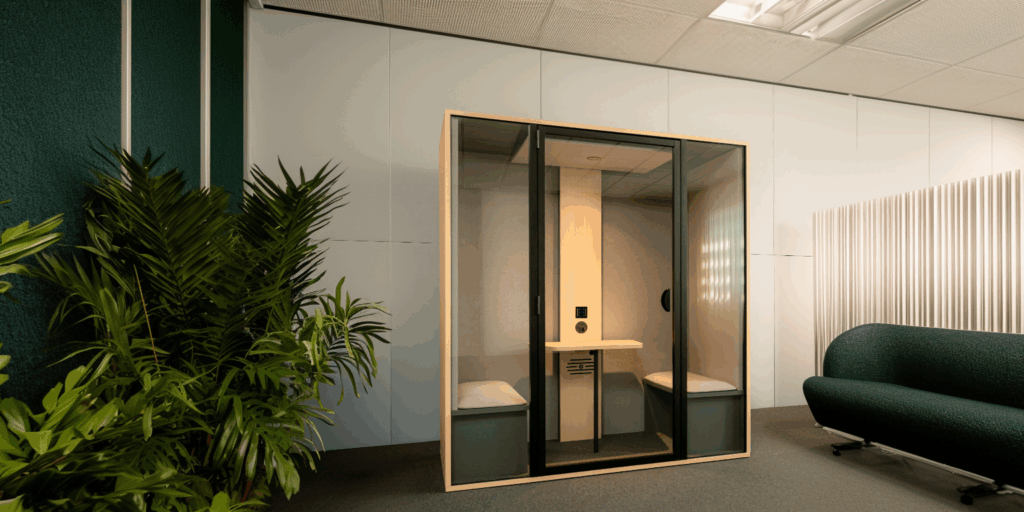
Designing a focus space: a 4-step method
Step 1 — Mapping usage
Before moving a piece of furniture or purchasing a solution, you need to understand the needs. Which tasks require deep focus? Who needs to regularly write, analyse or produce content? Who spends a lot of time on calls or video conferences?
Needs naturally fall into distinct categories: managers, sales staff, developers, creatives, customer support. The challenge is also to assess scale: how many people need a focus space at the same time, and at what times of the day.
Step 2 — Establish clear zoning
An effective open-plan office is not a uniform space: it is zoned. Each zone has a distinct noise level and function.
You can define collaboration zones, social zones (coffee, informal chats) and focus zones.
You also need to identify high-traffic areas, sources of noise (printers, entrances, coffee machines, proximity to meeting rooms) and natural pockets of quiet. A focus area should not be placed ‘wherever there’s space left’, but where it is likely to be protected.
Step 3 — Choosing the right format
The format depends on the level of concentration required:
- Open focus area: visual separation, sound-absorbing furniture, without actual acoustic insulation
- Alcove or acoustic furniture: partial noise reduction, suitable for micro-focus
- Acoustic booth / phone box: voice isolation, privacy, stable perceived quiet
- Dedicated focus room: small enclosed room, where fit-out work is feasible
The right format isn’t the one with the best soundproofing, but the one that matches the actual need, the team culture and the volume of use.
Step 4 — Define usage rules
Without rules, the space quickly falls into disrepair. It may be squatted in, misused, or conversely ignored. The key decisions are simple: booking or open access, recommended duration (sessions of 30 to 60 minutes, for example), whether calls are permitted depending on the zone, and a clear ‘focus’ signal (sign, flag, Slack/Teams status, LED).
A focus space works when the rules are understood, accepted and visible.
Solutions requiring no building work to create a focus space
The focus corner: simple but limited
The focus corner is often the first step. It should be placed away from walkways, ideally with its back to the flow of traffic. To create a calming atmosphere, you can add bookshelves, plants, lightweight partitions, a rug or fabric surfaces that reduce reverberation.
Its limitations are well known: low privacy, residual noise, and heavy reliance on behaviour. It is a useful solution for quick focus sessions, but much less reliable for deep work.
Alcoves and acoustic furniture: an intermediate solution
Alcoves and certain types of acoustic furniture improve acoustic comfort and may be suitable for short calls in moderately noisy environments. However, the lack of soundproofing limits their effectiveness: voices can be heard outside, and isolation remains partial.
It is a good intermediate option, provided you do not expect it to provide the protection required for a confidential call or prolonged concentration.
The acoustic booth: when voice isolation is essential
When the aim is to isolate the voice — calls, video calls — or to ensure a stable perceived level of quiet, the acoustic booth becomes the appropriate solution. It protects not only the person concentrating, but also the open-plan office: calls no longer disturb colleagues.
A common misconception is to think ‘booth = silence’. What really matters are the conditions of use: ventilation, lighting, connectivity, interior comfort. A technically advanced but uncomfortable booth will not be adopted.
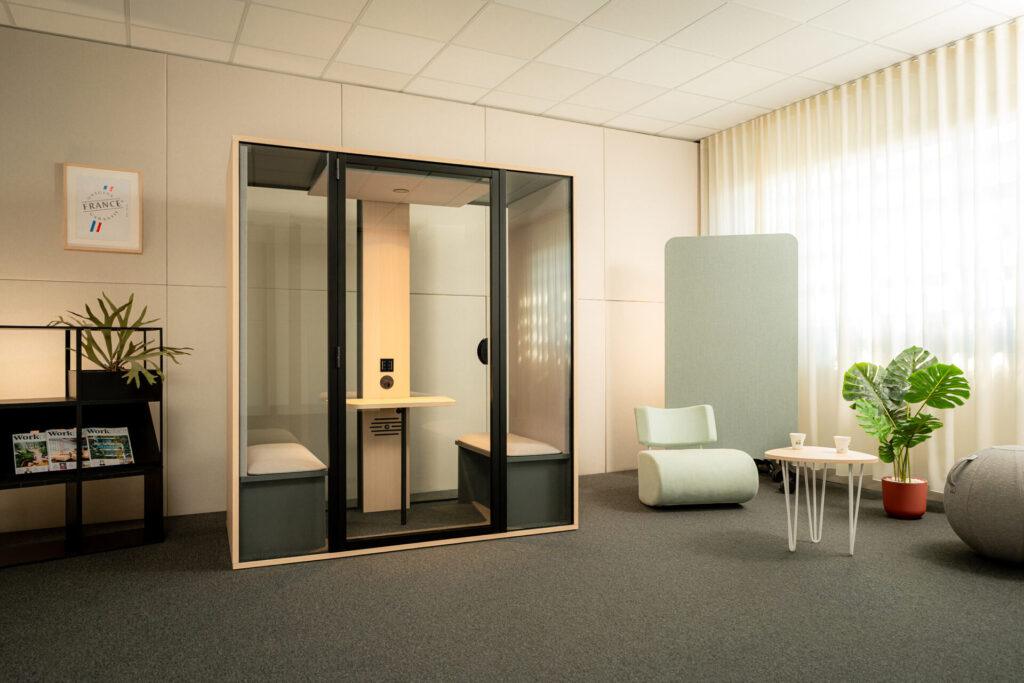
Soundproof booths and concentration: what you need to understand and check
What creates the sensation of a concentration bubble
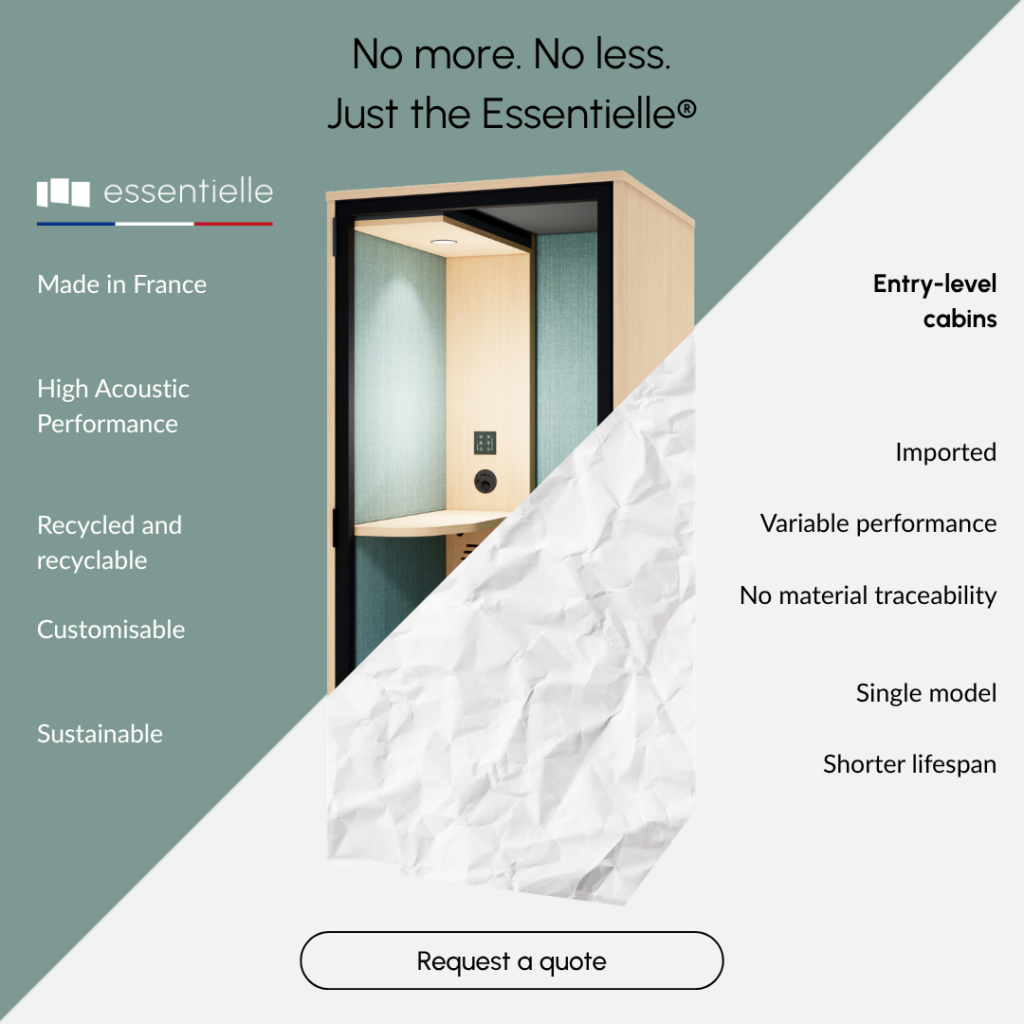
A booth becomes a true space for concentration when it reduces speech intelligibility sufficiently for the user to feel protected. The benchmark for the Essentielle range: a reduction in speech level of up to −30.3 dB, measured by an independent acoustic consultancy.
This ‘bubble’ sensation also depends on very practical elements: the quality of the seals, the door’s closure, and 8 mm ‘Silence’ laminated glazing. It is these sealing details that ensure a booth truly ‘closes’ and that concentration is protected.
Air comfort: the decisive factor for adoption
A booth may boast excellent acoustic performance but fail in practice if the air is not refreshed. Without air comfort, the user will cut their session short, avoid the booth or reserve it solely for emergencies.
Ventilation specifications for the Essentielle range by model:
| Model | Airflow | Complete air change |
|---|---|---|
| S and S Bureau | 280 m³/h | < 40 seconds |
| M | 575 m³/h | < 40 seconds |
| L and XL | 750 m³/h | < 40 seconds |
These figures directly link comfort to usage: a breathable pod is a pod that gets used.
Lighting and connectivity: transforming the pod into a focus station
Lighting affects visual comfort and fatigue. The Essentielle range features an 800 lm LED spotlight in warm white 3,000 K (two spotlights for the XL model), with a touch-sensitive dimmer to adjust the brightness to suit individual preferences. This customisation is a key factor in user adoption: everyone can set their own level of comfort.
The connectivity options allow the pod to be transformed into a fully-fledged workstation: 1 x 220 V socket, 2 x USB-C ports, 1 x USB-A port, 1 x RJ45 port. This is the equipment needed to connect a laptop, headphones, start a video call or work on a long session without relying on a battery.
Mobility and layout: a key advantage in a flexible office
In a flexible office, a focused workspace must be able to adapt to reconfigurations. The Essentielle range features a mobile base with integrated castors and height-adjustment levers, as well as a reversible door (opening direction of your choice). These elements facilitate movement and allow the layout to be adjusted to traffic flows and space constraints.
Technical point to bear in mind: a clearance of at least 10 cm between the wall and the air inlets/outlets is required to ensure proper airflow, and the ceiling height must be at least 230 cm (240 cm recommended for installation).
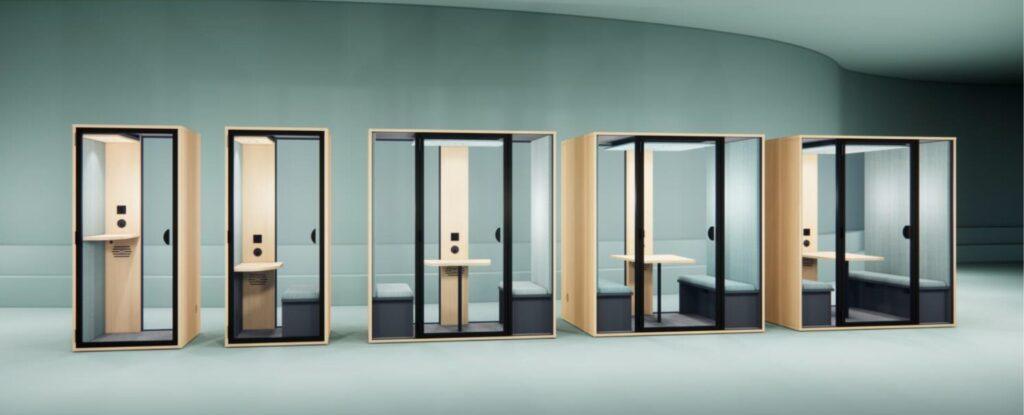
Practical examples tailored to your needs
“We want to reduce call noise in the open-plan office”
The most effective approach is to move calls and video conferences to a dedicated area, separate from the focus zones. The soundproof booth directly addresses this need: it protects the caller’s privacy and reduces disruption for the entire floor.
“We want deep focus for complex tasks”
Zoning and visual separation are priorities. A booth can also be useful if the team needs complete isolation, with stable air and lighting conditions for sessions lasting 30 to 90 minutes. The Essentielle S Bureau, with its 73 cm high desk and integrated bench seat, is designed for this type of prolonged use.
“We’re in a flex office; everyone’s on the move, nobody knows where to settle down”
The challenge is as much about space as it is about organisation. We need clearly identified, accessible zones, with a mix of solutions: booths, focus corners, small rooms. The key is to measure usage (occupancy rates, reported irritants) and gradually adapt the setup.
“Coworking: lots of footfall, lots of calls”
In coworking spaces, a concentration area situated in a constant flow of people almost always fails. A robust approach involves grouping booths together in a ‘hub’ and clearly separating a quiet zone. The aim is to make the rule obvious: calls here, focus there.
The usage rules that make a focus area successful
Five rules are enough
A focus area works when the rules are simple and visible.
First rule: no interruptions in the focus zone, except in emergencies. Second rule: calls are restricted to dedicated spaces — booths or rooms. Third rule: the duration of use is reasonable, especially during periods of high demand (sessions of 30 to 60 minutes). Fourth rule: a clear, visible ‘focus’ signal accepted by everyone. Fifth rule: respect for silence, reduced notifications, appropriate behaviour.
How to avoid an empty space
Adoption is the true measure of effectiveness. A space too far from teams will not be used, regardless of its quality.
To avoid this mistake, it is useful to test two locations before finalising the choice: a simple floor template can already help validate traffic flows and perception. Once the space is in place, feedback after two weeks allows for adjustments. The aim is to improve the layout, not to penalise usage.
Conclusion
Creating a focus area in an open-plan office is not simply a matter of finding a quiet corner. It involves designing a comprehensive system: noise management, visibility control, appropriate lighting, fresh air, controlled traffic flow and shared rules of use. Without comfort, the space will not be used. Without rules, it will fall into disrepair. Without adoption, even the best furniture will fail.
The right approach is to start with usage patterns, establish clear zoning, choose the appropriate format — focus corner, alcove, soundproof booth — then set out simple rules and measure effectiveness over time.