

Why “soundproofing” and “soundproof booth” are often misunderstood
In an open-plan office, noise isn’t just a nuisance. It seeps in everywhere: phone calls, video calls, conversations, ringtones… and, by the end of the day, concentration starts to wane.
This is precisely why acoustic booths have become a staple in workspaces: they create a bubble where you can retreat, speak freely, and work without disturbing others (or being disturbed yourself).
The problem is that the terms ‘soundproofing’, ‘sound insulation’, ‘acoustic insulation’ and ‘acoustics’ are often used interchangeably. Many people imagine that a booth ‘completely eliminates noise’. Others think that acoustic panels or foam will have the same effect as a closed booth.
The result: people choose the wrong solution, or buy a booth that looks good on paper… but proves disappointing in practice.
The aim here is simple: to explain how it works, in plain terms. To understand the mechanisms, know how to interpret performance figures, and above all, identify what causes a booth to fail in real life.
We’ll be talking about soundproof booths, sound insulation, sound levels, but also foam, panels and so on.
How does a soundproof booth actually reduce noise?
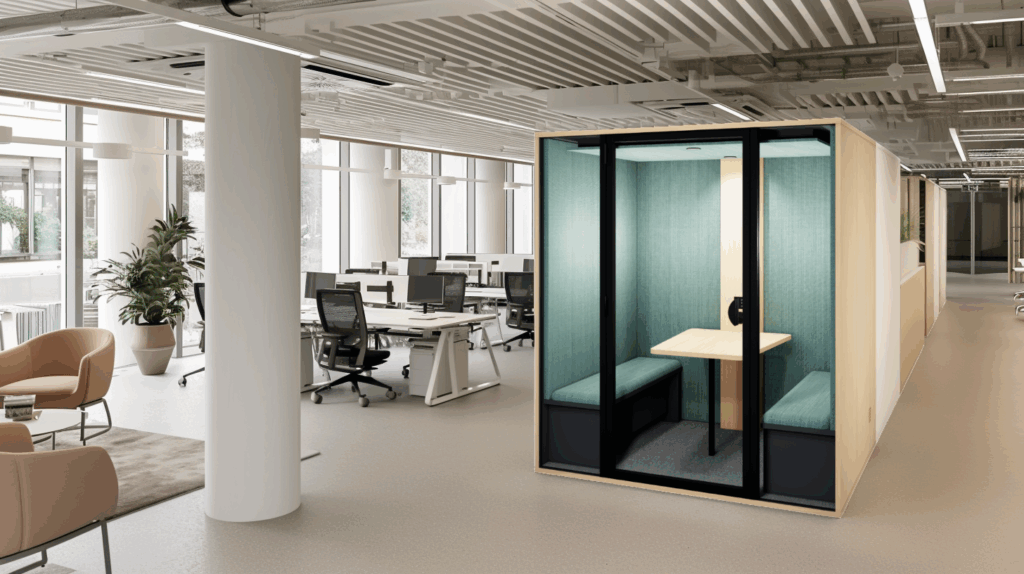
A soundproof booth reduces noise through six mechanisms that work together:
- The mass of the walls: ‘denser’ walls limit sound transmission.
- Air tightness: without effective seals and a properly adjusted door, sound gets through.
- Decoupling (mass-spring-mass principle): we break the transmission by separating the layers.
- Internal absorption: chipboard, fabrics and foam reduce the echo inside.
- Sealing leaks (airtightness): doors, glazing, cable penetrations, joints… every detail counts.
- “Acoustic” ventilation: air must be renewed without creating a “noise tunnel”.
Key point to remember: a booth does not “make noise disappear”. It reduces transmission and, above all, improves privacy, particularly for speech.
And in the majority of cases, what causes performance to drop is not the wall itself: it is an air leak (door, seals, cable passages, ventilation).
Understanding what we want to isolate: noise, speech and frequencies in an office environment
Before explaining how a booth insulates, we must clarify what we are seeking to isolate. Because “noise” is not a single, uniform phenomenon.
2.1 Airborne noise and structure-borne noise: two different problems
In an office, there are two main categories:
Airborne noise: voices, conversations, ringtones, calls. These are the primary targets for soundproof booths, as they travel through the air and propagate easily.
Structure-borne noise: vibrations and impacts transmitted through the structure (floor, partitions, furniture). A thud, a door slamming, heavy footsteps… this type of noise can be transmitted differently, and is often harder to completely neutralise.
A booth is primarily a solution for airborne noise — the kind that most disrupts confidentiality and video or telephone conversations.
2.2 Why the voice is the number one “use case” for booths (phone boxes and meetings)
The voice is unique: even when it isn’t very loud, it attracts attention. And above all, it conveys information: we understand what is being said. This is where the concept of confidentiality comes into play.
There is a big difference between:
- “I can still hear a little something”
- and
- “I can clearly make out the conversation”.
A well-designed booth often aims to reduce intelligibility from the outside: background noise may be perceptible, but individual words can no longer be distinguished. This is generally the main objective in open-plan offices.
2.3 Noise reduction and acoustic comfort: two complementary objectives
Finally, we must distinguish between two expected outcomes:
- reducing what goes out (confidentiality) and what comes in (isolation),
- improving comfort inside (less echo, more pleasant video calls, reduced fatigue).
And this is precisely where we begin to understand the fundamental difference: isolation vs absorption.

Sound insulation and sound absorption: the distinction that changes everything
3.1 Sound insulation: preventing noise from entering and escaping
Sound insulation is based on the principle of a barrier: the aim is to prevent sound from passing through from one space to another. In practical terms, this depends on:
- the quality of the “barrier” (walls, glazing),
- and above all on the presence or absence of leaks and acoustic bridges: anything that allows sound to bypass the barrier.
A booth may have excellent walls; if air passes under the door or through a poorly fitted seal, sound will pass through too.
3.2 Sound absorption: reducing echo and improving speech intelligibility inside the booth
Absorption serves a different purpose. It acts on reverberation: it prevents sound from bouncing around inside.
This is what makes a video call more pleasant: the voice becomes clearer, less “tinny”, and you get less tired. The materials typically associated with this comfort are fabrics, internal panels, and acoustic foam.
Important: absorption improves comfort inside the booth. It does not replace the insulation between the cubicle and the outside.
3.3 Why everything gets mixed up on Google (and how to avoid falling into the trap)
The classic mistake: buying acoustic panels with the idea of “insulating” an open-plan office. In reality, these solutions often improve overall comfort, but they do not create a private space.
This is also why booths, alcoves and panels are not interchangeable. We’ll come back to this later: they are solutions to different problems.
The 6 mechanisms behind the sound insulation of an acoustic booth
4.1 The law of mass: the heavier a wall is, the better it insulates (for equivalent designs)
First simple principle: for comparable designs, a ‘denser’ wall lets less sound through. This is the basis: mass slows down the transmission of sound energy.
In a booth, this translates into engineered walls, often multi-layered, which are not simply ‘a panel’. But mass alone is not enough.
A heavy wall that “leaks” remains a leaky wall.
4.2 The mass-spring-mass principle: the recipe for high-performance walls
This is one of the most effective mechanisms: rather than having a single mass, there are two, separated by a “spring” (air and a more flexible material). The advantage is that it breaks the transmission, as if introducing a buffer zone.
This principle requires one thing: that the system is properly installed and effectively decoupled. If the layers become “bridged” by poorly controlled rigid contact, some of the benefit is lost.
4.3 Airtightness: the number one factor (doors, seals, thresholds)
This is often the decisive factor. A soundproof booth that is not airtight loses a great deal in terms of performance. It makes sense: sound travels very easily through air. A small opening can have a major impact.
That is why an entry-level booth, which is very well sealed, can be more satisfactory than a poorly adjusted ‘premium’ booth.
4.4 Glazing and the door: how glass insulates (and why laminated glass matters)
Laminated glass is often highlighted because it improves certain acoustic properties, particularly for speech sounds, whilst remaining transparent.
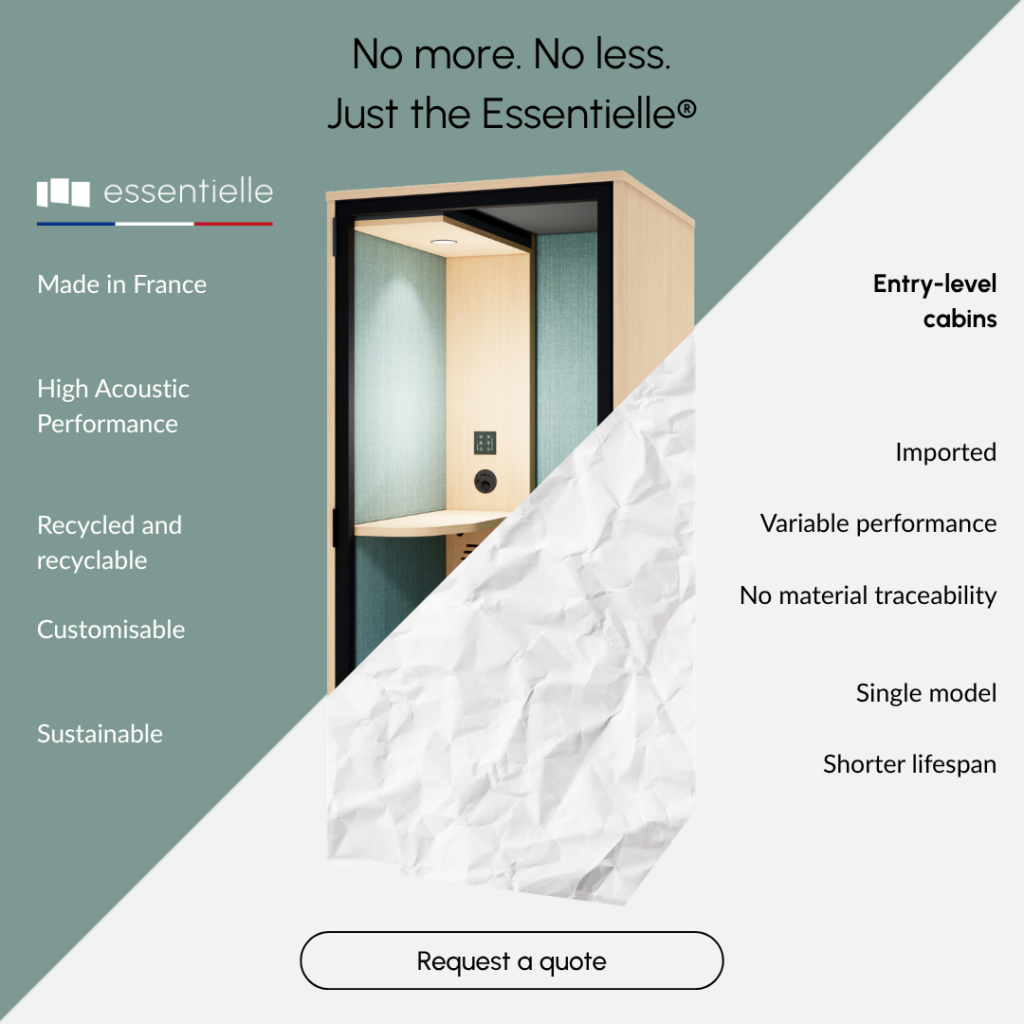
A concrete example from the Essentielle range: 8 mm laminated “Silence” glass door. This kind of detail is important, because it shows that the door is treated as part of the system, not simply as an “entry point”.
4.5 “Acoustic bridges”: all the areas where sound bypasses the booth
The cabin is a system. And there are numerous potential bypass points:
- cable passages (top, rear, bottom),
- connections, technical holes,
- joints between panels,
- corners,
- base, castors, jacks,
- contact with a wall or structural element.
Even a very good wall can be bypassed if the cabin creates leakage points. It is this level of detail that distinguishes a “decent” cabin from one that is truly satisfactory in everyday use.
4.6 Interior treatment: panels and foam for improved acoustic comfort
Inside, the objective is clear: to limit echo, make the voice clearer, make video calls more pleasant, and reduce fatigue.
This is where terms such as “panels”, “acoustic foam”, “melamine foam” and “cab interior” come into their own: these are comfort features. They aren’t everything, but they transform the experience, particularly during prolonged use.
Ventilation and sound insulation: the paradox of acoustic cabins
5.1 Why ventilation is essential (and an acoustic risk)
A booth is an enclosed space. Without ventilation, it quickly becomes uncomfortable: stuffy air, heat, reduced usage. Ventilation is therefore essential.
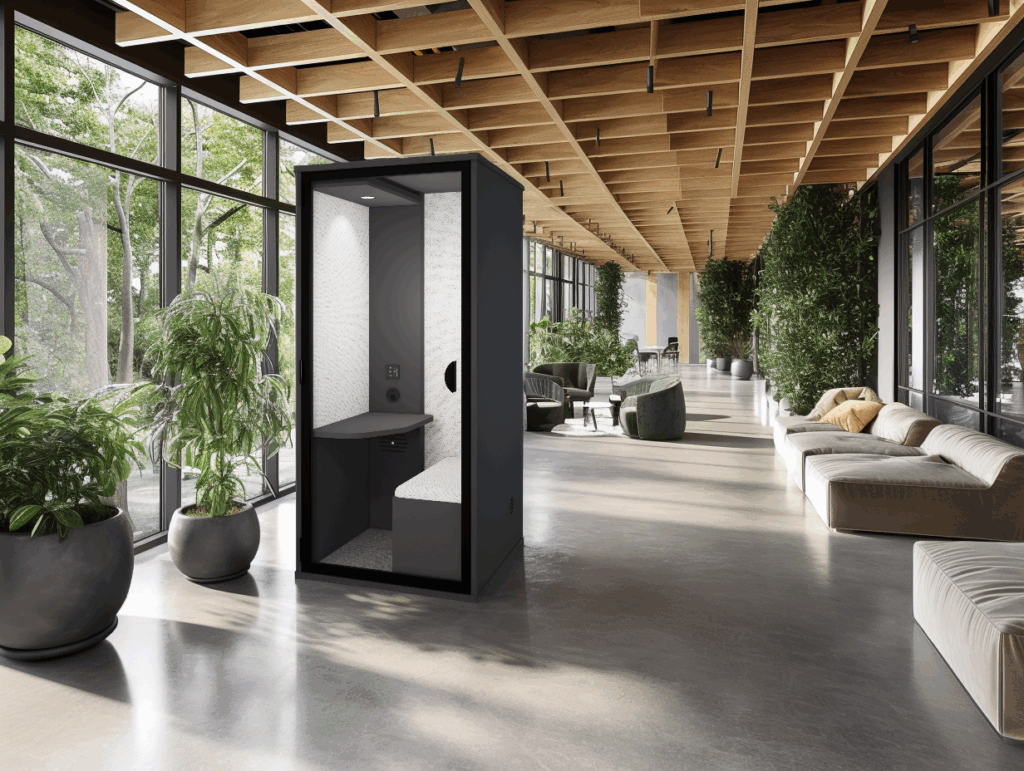
However, it creates a paradox: letting air in and out creates a potential pathway for sound. That is why booths use ventilation systems designed to limit transmission: air circulates, but noise must not travel in a ‘straight line’.
5.2 What to check: airflow, air exchange rate, fan noise and air circulation
For the user, the question is simple: ‘Do I feel comfortable after 10 or 15 minutes?’.
Whether on a video conference or a call, you should be able to breathe and stay focused without being bothered by excessive airflow.
Key benchmark: a complete air change in under 40 seconds depending on the model.
This kind of data helps bridge the gap between technical specifications and real-world use: comfort, duration of use, and acceptance by teams.
5.3 Installation rules relating to ventilation (often overlooked)
Even good ventilation can be compromised by poor installation.
Example of an Essential rule: allow at least 10 cm between the wall and the air inlets/outlets for optimal airflow.
A common mistake is to push the booth right up against the wall “to save space” . This results in a loss of comfort… and sometimes performance, simply because the booth is no longer being used under the right conditions.
How do you measure the sound insulation of an acoustic booth?
6.1 The indicators you see in product specifications: dB, “speech level reduction”
In product specifications, you will often come across values in dB. Without getting into the maths, remember one thing: a dB value is a measure of attenuation.
The concept of “speech level reduction” is often more meaningful: it reflects real-world office use. And, beyond the figure, you must always relate the advertised performance to reality: soundproofing, installation, positioning, ambient noise in the workspace.
What causes sound insulation to fail in practice (even with a good booth)
7.1 Installation errors in open-plan offices: positioning, walls, foot traffic, noisy areas
Two errors are common:
- placing the booth right up against a wall (which particularly impairs ventilation),
- placing it in a high-traffic area (noise, disruption, slamming doors, psychological discomfort).
A booth is not just a technical object: it is a tool. If the environment is hostile, so is the experience.
7.2 Installation and adjustment errors: door, struts, level, base
Poor adjustment of the door or seals can be enough to cause a leak. And a leak in a booth reduces performance: speech becomes audible again, confidentiality is compromised, and then one wonders “why is it not working as well as expected?”.
The following must be checked:
- stability,
- levelling (jacks),
- the quality of the seal,
- the absence of play.
7.3 Building constraints: ceiling height, cables, services, false ceilings
Building constraints sometimes necessitate compromises: false ceilings, services, electrical outlets. And, if you don’t plan ahead, you end up forcing cable routes, creating service holes “at the last minute”, and the seal suffers as a result.
Key Point: minimum ceiling height 230 cm, 240 cm recommended to facilitate installation and maintenance.
This detail may seem simple, but it prevents many situations where the installation turns into a DIY job.
Acoustic booth vs alcoves and panels: which solution for which noise problem?
8.1 When panels and acoustic treatment are sufficient
If the main problem is a room that is too reverberant, or an overall noise level that is too tiring, panels and acoustic treatment can improve the working environment. Echo is reduced, the workspace becomes more pleasant, and everyone benefits.
8.2 When only a booth provides privacy
As soon as privacy becomes a necessity – for sensitive calls, video conferences, HR interviews or small meetings – a closed booth offers a solution that panels cannot: voice isolation and reduced audibility from outside.
8.3 How to combine both for better results (the ‘zoning’ approach)
The best approach in many offices is a smart mix: booths for “confidential” uses, and layout design to improve overall comfort. The result is often more stable and satisfying than relying solely on a single solution.
Purchasing checklist: how to choose a booth with proper soundproofing
9.1 What to look for in a technical specification
Before even discussing price, check the specific details:
- type of door and glazing,
- details on sealing (seals, closure),
- ventilation (logic, air renewal rates),
- internal dimensions (actual comfort),
- intended use (solo vs meetings).
A technical specification sheet that fails to clarify these points leaves you with no choice but to buy blindly.
9.2 Questions to ask in the showroom or during a demo
On site, test it as a user would:
- external noise and privacy,
- ventilation and fan noise,
- video call comfort (internal reverberation).
The key is to test with the door closed, in a real-life situation, even for just a few minutes: this is when the booth reveals its true nature.

Maintenance and durability: how to maintain sound insulation levels over time
A booth can remain effective for a long time, provided you maintain the critical components:
- Seals: inspection, cleaning, wear and tear.
- Door: adjustments, alignment, quality of closure.
- Ventilation: dust removal and maintenance
The aim is simple: to maintain the seal, keep the air quality stable, and prevent the gradual deterioration that eventually makes the booth less pleasant… and therefore less used.
FAQ — Soundproofing an acoustic booth: answers to the most frequently asked questions
11.1 Is an acoustic booth really 100% soundproof?
A booth significantly reduces noise, but it does not create total silence – and that’s just as well. Absolute silence is generally not pleasant to live with on a daily basis. Moreover, an acoustic booth is not intended to be completely soundproof: it is neither an anechoic chamber nor a bunker.
11.2 Why can we still hear a little noise from outside even though the booth is advertised as high-performance?
The most common causes are leaks (door, seals), ventilation, the booth’s positioning within the space, or sound transmission through the structure. Often, the problem stems from an installation detail rather than the booth itself.
11.3 What level of performance should be aimed for in a noisy open-plan office?
The correct approach is to focus on voice privacy: the aim is for conversations to no longer be intelligible from outside, rather than seeking an unrealistic ‘zero noise’.
11.4 Do acoustic foams improve sound insulation?
They mainly improve absorption, and thus interior comfort and reverberation.
They do not replace the primary barrier, which relies on mass, decoupling and, above all, sealing.
11.5 – What are the characteristics of good acoustic booths?
Good acoustic booths are first and foremost recognised by their sound balance: they effectively reduce noise pollution without seeking to create total silence (which is often uncomfortable).
The quality of the materials plays a key role, both for acoustic performance and durability. They must also blend naturally into the office environment: a truly effective booth is aesthetically pleasing and, above all, customisable (colours, finishes, options), so as to align with the identity and layout of the workspace.
Finally, a good booth must be pleasant to use on a daily basis. This requires a genuine level of comfort (seating, space, lighting, ergonomics) to allow users to stay in it for long periods, as well as effective airflow (ventilation) to prevent any feeling of stuffiness and maintain good concentration.