
Why the dimensions of a soundproof booth determine its use, comfort and layout
In an open-plan office, we’ve all been there: a call that drags on, a video call that pops up without warning, a conversation that’s a bit too loud… and, suddenly, the team’s concentration takes a hit. This is exactly where an soundproof booth (or phone box, or office phone booth) becomes a real game-changer for comfort: it creates an enclosed space to get away from it all, make a call, work in peace or hold a quick meeting.
But an “effective” booth isn’t just a “well-insulated” one. It must also fit into the office, be easy to set up, and above all remain pleasant to use on a daily basis. In practice, it is the dimensions that dictate everything: the floor space required, the space to move around, the sense of space, room for a screen, a table, a bench seat, the ceiling height… and even the perception of ventilation and LED lighting.
The aim of this guide is simple: to provide you with “standard” benchmarks (what is generally found on the market), a clear selection guide based on usage, and then the exact dimensions and specifications of the Essentielle booths, from the 1-person to the 6-person formats.
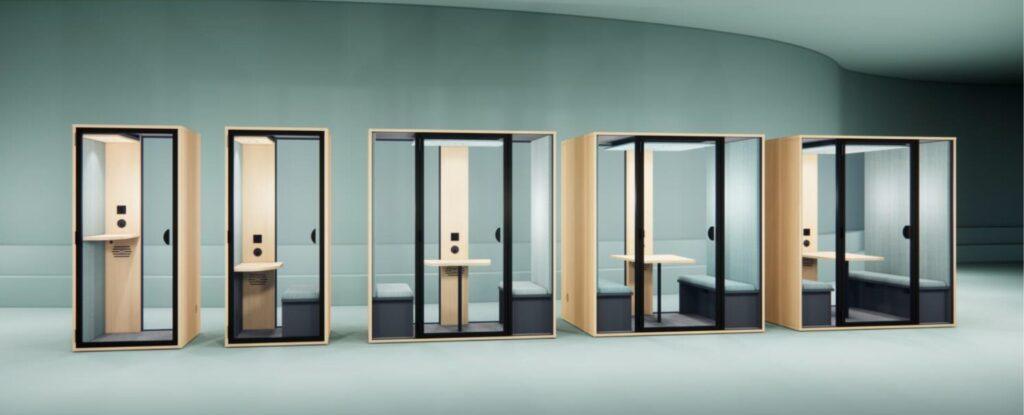
What “standard dimensions” really mean for an office soundproof booth
1.1 External dimensions vs internal dimensions: the most common confusion
When we talk about the “size” of an acoustic booth, we often confuse two things that do not have the same impact.
- The external dimensions determine the layout: floor space, circulation around it, access, logistics and, quite simply, the question “will it fit in our office space?”.
- The internal dimensions, on the other hand, determine actual comfort: your posture, how easily you can sit, the distance from the screen, legroom, and whether or not you feel cramped.
This is a key point, because soundproofing involves walls: the more elaborate they are, the more they “eat into” usable space. Two booths occupying almost the same floor area can offer very different experiences inside.
1.2 The 4 dimensions to check before buying: width, depth, height and floor space
Even before comparing brands, there are four measurements to bear in mind.
Width: this determines ease of movement (shoulders), where furniture fits, and comfort for one person… or two. It is often the first difference between a phone box and a “1:1” booth.
Depth: this affects the distance from the screen, comfort when sitting or standing, and the ease of getting in and out without contorting yourself, with the door closed.Height: this must be compatible with the ceiling (and its constraints), but it also influences the sense of space and perceived comfort.Floor area (m²): this is the most telling measurement for layout. When you are reorganising an open-plan space, this figure quickly becomes your basic unit.
1.3 Ceiling height and the immediate surroundings: the constraint that holds projects back
Many projects hinge on a single detail: what lies above the chosen area. A false ceiling, light fittings, sprinklers, ductwork, technical floor panels… can limit the available height and complicate installation.
And one must not think solely in terms of a “pre-assembled cubicle” . You must also allow for handling and assembly space: access, corridor angles, doors, the lift, and the ability to handle the panels safely.
“Standard” dimensions on the market (by type of use)
The idea here is not to dictate a single format (there isn’t one), but to provide a quick answer to the question: “what does a standard booth look like”, and then to help you choose the right format.
2.1 Single-person acoustic booth (phone box): calls, video calls, short bursts of concentration
On the market, a phone box is generally designed for one person, for short to medium-length uses: a call, a video call, a quick meeting, or half an hour of focused work.
Common dimensions often found:
- a floor area of around ~100 × 100 cm,
- a height of around ~218 cm.
Depending on the configuration, some models may be slightly more compact, sometimes under 90 cm in width or depth. In any case, actual comfort depends less on the model’s “name” than on specific details: the presence of a desk, desk height, sitting/standing position, and the quality of ventilation (because a booth that is too hot or too cramped ends up… empty).
2.2 “Single-person with desk” cabin: private workspace and long sessions
When usage shifts towards longer tasks (writing, analysis, concentration), we move away from the “telephone” approach towards a genuine private workspace.
The requirements change:
- a more ergonomic desk (not just a narrow shelf),
- a seat, a stable posture,
- sufficient space for a monitor or laptop,
- and a “usable interior volume” that doesn’t become tiring after 20 minutes.
The key difference here, therefore, is the furniture (desk + chair) and the way the interior has been designed for prolonged work.
2.3 2-person soundproof booth: 1:1 meetings, HR interviews, two-way video calls
For a 2-person booth, market benchmarks often lie around:
- ~200 to 210 cm in width,
- ~100 cm deep.
This layout is ideal for one-to-one meetings, HR interviews or video calls between two people. However, it is also a layout where movement within the space and comfort depend heavily on the layout: central table, benches, usable depth, and adequate ventilation (two people = twice the heat and CO₂).
2.4 4-person soundproof booth: a ‘micro-meeting room’ requiring no building work
For four people, the concept is that of a ‘micro-meeting room’: a space where you can sit down, set up a computer, sometimes add a screen, and hold a short meeting without taking over a proper meeting room.
On the market, we see models that often exceed 2.0 m in at least one dimension, with heights approaching ~2.3 m depending on the model. The points to check become more “system-oriented”:
- video conferencing comfort (screen),
- cabling and connectivity,
- more generous ventilation,
- and circulation around the booth within the open-plan office.
2.5 6-person booth: meetings, workshops, team briefings
The 6-person format caters to a wider range of uses: mini-meetings, quick workshops, team briefings, and occasionally hybrid discussions.
Here, sizing depends as much on usage as on the available space. Key points to check:
- accessibility,
- logistics (installation, movement),
- weight and installation constraints,
- and the cabin’s ability to remain comfortable when used by several people.
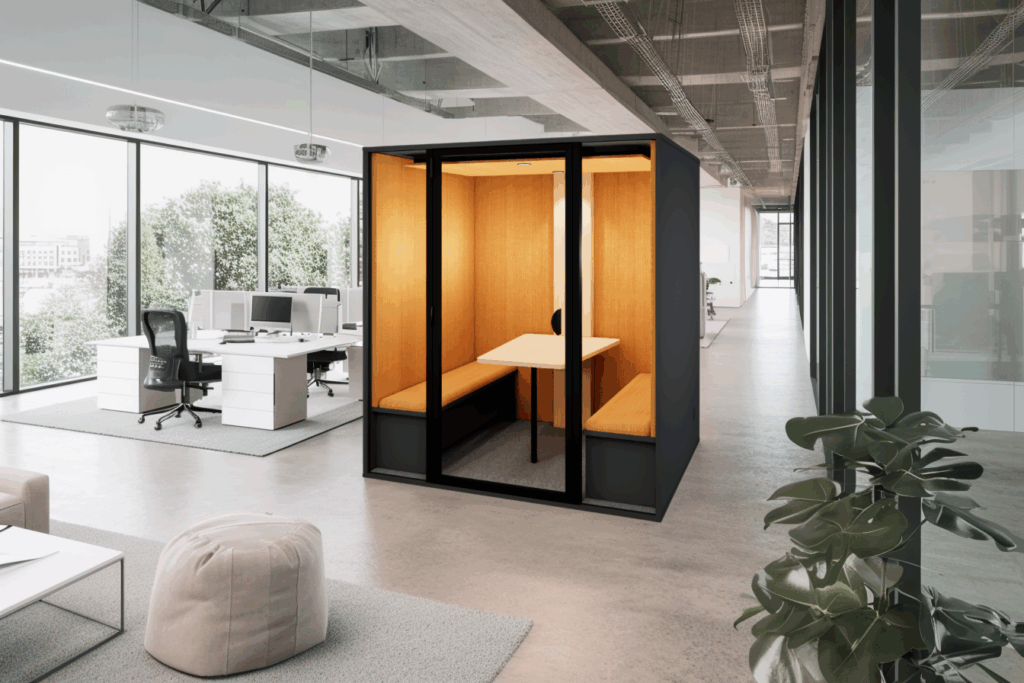
Exact dimensions and specifications of Essentielle cabins — from 1-person to 6-person formats
3.1 Essentielle summary table: exterior, interior, floor space, door, furniture
To make a proper comparison, the simplest approach is to draw up a clear table showing:
- External L × W × H
- Internal L × W × H
- Floor area (m²)
- Door
- Fittings (table/shelf, dimensions and height)
Then a second ‘comfort & technical’ table:
- ventilation (airflow + air exchange)
- lighting (lm/K)
- connectivity
- acoustics
Table 1 — Dimensions and fittings (Essentielle)
| Model | External dimensions (W × D × H) | Internal dimensions (W × D × H) | Floor space | Door | Fittings |
| Essentielle S | 95 × 96 × 212 cm | 87 × 83 × 198 cm | 0,9 m² | 90 × 204 cm – 8 mm laminated “Silence” | Shelf 33 × 79 cm – H 103 cm |
| Essentielle S Bureau | 95 × 96 × 212 cm | 87 × 83 × 198 cm | 0,9 m² | 90 × 204 cm – 8 mm laminated “Silence” | Desk 43 × 79 cm – H 73 cm; Bench 88 × 38 cm – H 45 cm |
| Essentielle M | 95 × 190 × 212 cm | 88 × 177 × 198 cm | 1,8 m² | 90 × 204 cm – 8 mm laminated “Silence” | Table 51 × 78 cm – H 73 cm; Benches 88 × 38 cm – H 45 cm |
| Essentielle L | 136 × 190 × 212 cm | 129 × 177 × 198 cm | 2,4 m² | 90 × 204 cm – 8 mm laminated “Silence” | Table 78 × 92 cm – H 73 cm; Benches 129 × 38 cm – H 45 cm |
| Essentielle XL | 160 × 190 × 212 cm | 153 × 177 × 198 cm | 3 m² | 90 × 204 cm – 8 mm laminated “Silence” | Table 78 × 115 cm – H 73 cm; Benches 153 × 38 cm – H 45 cm |
Table 2 — Comfort and technical specifications (Essentielle)
| Model | Ventilation | Lighting | Connectivity | Acoustics |
| Essentielle S | 280 m³/h; air change rate < 40 s | 1 LED spotlight 800 lm, 3000 K | 220V + 2 USB-C + USB-A + RJ45 | Speech level reduction up to -30.3 dB |
| Essentielle S Bureau | 280 m³/h; air change rate < 40 s | 1 LED spotlight 800 lm, 3000 K | 220V + 2 USB-C + USB-A + RJ45 | Speech level reduction up to -30.3 dB |
| Essentielle M | 575 m³/h; air change rate < 40 s | 1 LED spotlight 800 lm, 3000 K | 220V + 2 USB-C + USB-A + RJ45 | Speech level reduction up to -30.3 dB |
| Essentielle L | 750 m³/h; air change rate < 40 s | 2 LED spotlights 800 lm, 3000 K | 220V + 2 USB-C + USB-A + RJ45 | Speech level reduction up to -30.3 dB |
| Essentielle XL | 750 m³/h; air change rate < 40 s | 2 LED spotlights 800 lm, 3000 K | 220V + 2 USB-C + USB-A + RJ45 | Speech level reduction up to -30.3 dB |
Note: when comparing booths, this type of table helps you avoid common pitfalls: a “large” booth with poor ventilation, or a “compact” booth with inadequate connectivity.
3.2 Essentielle S (1-person soundproof booth): compact “phone box” format
The Essentielle S is a format clearly designed for phone box use: calls, video calls, short periods of concentration, without taking up too much space.
External dimensions: 95 × 96 × 212 cm
Internal dimensions: 87 × 83 × 198 cm
Floor area: 0.9 m²
Door: 90 × 204 cm (8 mm “Silence” glazing)Desk: 33 × 79 cm; desk height 103 cmVentilation: 280 m³/h; air change rate < 40 sLighting: 1 LED spotlight 800 lm, 3000 KConnectivity: 220V + 2 USB-C + USB-A + RJ45Acoustics: speech level reduction up to -30.3 dB
Key takeaways: a very reasonable footprint (0.9 m²), an optimised interior, and features tailored to real-world use (ventilation, lighting, connectivity).
3.3 Essentielle S Desk (1 person with desk + bench): private workstation
Here, we retain the same external dimensions as the S version, but change the use: we move from a “call/video” tablet to a proper seated workstation.
- External dimensions: 95 × 96 × 212 cm
- Internal dimensions: 87 × 83 × 198 cm
- Footprint: 0.9 m²
- Desk: 43 × 79 cm; height 73 cm
- Bench: 88 × 38 cm; height 45 cm
- Door: 90 × 204 cm – 8 mm laminated “Silence”
The advantage of this size is that it remains compact on the floor but allows for longer sessions: stable seating position, standard-height desk, and comfort better suited to “work” than “calls”.
3.4 Essentielle M (1 to 2 people): versatile “1:1” format
The M format is typically chosen when you want to do 1:1 comfortably, or alternate between one person sitting very comfortably and two people taking turns.
- External dimensions: 95 × 190 × 212 cm
- Internal dimensions: 88 × 177 × 198 cm
- Floor area: 1.8 m²
- Table: 51 × 78 cm; height 73 cm
- Benches: 88 × 38 cm; height 45 cm
- Ventilation: 575 m³/h; air change < 40 s
- Door: 90 × 204 cm – 8 mm laminated “Silence”
This is the quintessential “one-to-one meeting” format: it comfortably seats two, without the space feeling cramped at the slightest movement.
3.5 Essentielle L (1 to 4 people): compact meeting pod
The L model takes things a step further: this is a micro-room, designed to accommodate up to 4 people, whilst remaining “compact” in terms of the service it provides.
- External dimensions: 136 × 190 × 212 cm
- Internal dimensions: 129 × 177 × 198 cm
- Floor area: 2.4 m²
- Table: 78 × 92 cm; height 73 cm
- Benches: 129 × 38 cm; height 45 cm
- Ventilation: 750 m³/h; air change < 40 s
- Door: 90 × 204 cm
- – 8 mm “Silence” laminated glass
- Lighting: 2 LED spotlights 800 lm, 3000 K
Here, the layout requires more careful consideration: 2.4 m² of floor space isn’t huge for a “meeting”, but you need to allow for movement around it and think about how it will be used: video conferencing, computers, sockets, etc.
3.6 Essentielle XL (1 to 6 people): meeting and workshop pod
The XL model is designed for “team” use: meetings, workshops, quick discussions with several people, without relying on a traditional meeting room.
- External dimensions: 160 × 190 × 212 cm
- Internal dimensions: 153 × 177 × 198 cm
- Footprint: 3 m²
- Table: 78 × 115 cm; height 73 cm
- Benches: 153 × 38 cm; height 45 cm
- Ventilation: 750 m³/h; air change < 40 s
- Lighting: 2 LED spotlights 800 lm, 3000 K
It’s a very practical layout: 3 m² of floor space for up to 6 people, with ventilation and lighting designed for a larger space.
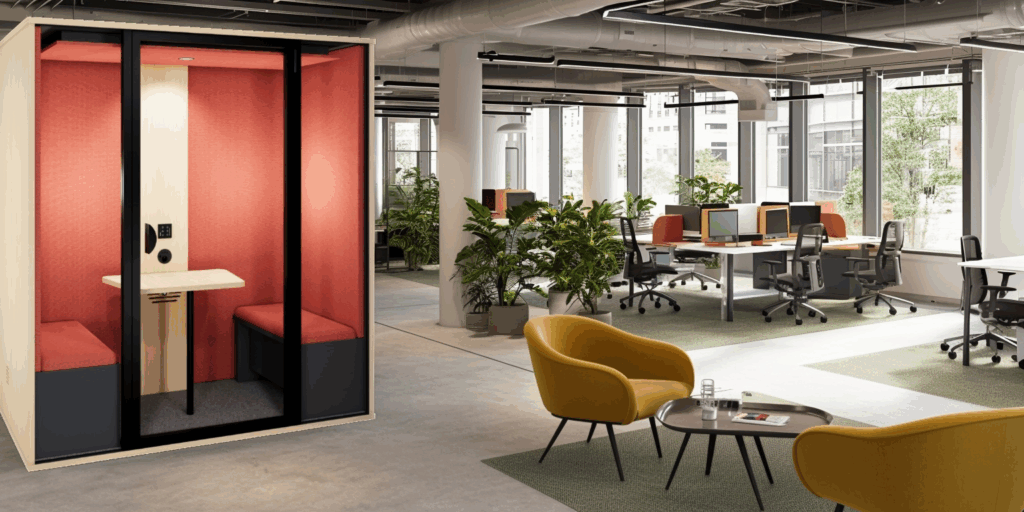
How to choose the right size: a simple method for fitting it into an office
4.1 Measure the available space: floor plan, constraints and “no-go zones”
Before asking “which model?”, you need to answer a simpler question: “where can we actually put it?”.
Start by measuring — don’t just guess:
- crowded areas (pillars, service ducts, radiators),
- traffic routes (corridors, natural passageways),
- and areas where a pod would cause disruption (near an exit, a security access point, a heavily used door).
In an open-plan office, also identify noisy areas and quiet areas: a cubicle can absorb some of the noise, but the surrounding environment always influences the experience.
4.2 Allow for space around the cubicle: circulation, door opening and user comfort
A cubicle is not assessed solely “down to the last centimetre” in terms of its footprint. It coexists with the surrounding space.
- Consider the door clearance: direction of opening, ease of entry and exit, and comfort when someone is waiting nearby.
- Ensure there is sufficient space for movement and accessibility: a booth that is too “crammed” into a corner can feel restrictive, even if it technically fits.
4.3 Match each layout to a specific use: calls, concentration, meetings, video calls
A simple grid works very well:
Phone box: calls / short video calls
Office: long periods of focus (seated workstation)
M: 1:1 / interview / confidential discussion
L / XL: meeting / micro-meeting room (and multi-person video calls)
The aim is not to maximise size “just to be on the safe side”, but to choose a format that will be used, in the right place, for the right purposes.
The technical criteria that change the perception of “the right size”
5.1 Ventilation: comfort, fatigue and air quality in the cubicle
Ventilation is the factor that transforms a cubicle that looks “good on paper” into one that is “actually used”.
The flow rates listed on Essentielle give an idea of the logic by use:
- 280 m³/h (1-person format),
- 575 m³/h (1–2-person format),
- 750 m³/h (meeting formats).
With an air change rate of < 40 seconds, the intention is clear: to maintain constant comfort, even when the cabin is in continuous use. And in practical terms, the higher the capacity (4–6 people), the more this figure becomes non-negotiable.
5.2 Acoustics: why performance affects wall thicknesses and interior volume
The reference to “reduction in speech level” (up to -30.3 dB) highlights a simple reality: sound insulation does not happen by magic. It is achieved through design, materials, sealing… and therefore the walls. This is precisely what explains the difference between external and internal dimensions.
In other words: if you compare two “similar” cabins on the ground, don’t be surprised if the interior tells a different story.
5.3 Furniture and ergonomics: desk, bench, posture and screen use
It is often the furniture that makes all the difference to the experience.
- A 73 cm desk (standard height) makes sitting at work feel natural: relaxed shoulders, a stable computer, and a sustainable posture.
- A 103 cm table is perfect for a more dynamic posture: calls, standing video calls, quick use.
Add to that the distance from the screen (video), legroom, and the ability to put things down. It’s easy to see why “two single-person booths” can be designed for very different uses.
5.4 Materials, finishes and perception of space: light/dark, fabric, wood, maintenance
Even with the same dimensions, a booth can appear more or less “spacious” depending on its finishes: dark or light colours, the presence of fabric, a wood-effect finish, and the clarity of the interior. Without exaggerating or overpromising, the key point is simple: comfort isn’t just about centimetres; it’s also a feeling.
For a “reassurance” section, one could also mention eco-design or the “Origine France Garantie” label if these are among the points to highlight, without making them the sole selling point.
Logistics and installation: the “hidden dimensions” to check before buying
6.1 Access to the site: lifts, stairwells, corridors, doors, goods lifts
This is the part we tend to forget… until the day the lift car arrives outside the building.
Before placing an order, draw up a simple checklist:
- width of doors, corridors and bends,
- dimensions and load capacity of the lift,
- truck access (parking, parking bays),
- building operating hours.
A lift car may look perfect on paper, but it can be impossible to deliver without a clear plan.
6.2 Packaging, handling and assembly: plan ahead without disrupting the open-plan office
The same logic applies on the operational side:
- check the handling requirements,
- anticipate the impact on the office (noise, traffic flow, temporary storage of packaging),
- and allow for the necessary time.
As a rough guide, assembly times stated as “depending on model” are typically around 40 to 60 minutes, which helps plan an installation without turning the team’s day into a permanent building site.
Practical examples: which size to choose depending on your context (offices, co-working, flex office)
7.1 “We want a phone booth to reduce call noise”
- Priority: compactness + availability + intuitive use
- Key points: ventilation, shelf, lighting
- Natural format: 1-person phone box
7.2 “We want a private workstation to concentrate for several hours”
- Priority: desk at 73 cm, seating, screen distance, comfortable lighting
- The right signal: “if you can spend an hour there without feeling trapped”
- Natural format: 1 person with desk (S layout)
7.3 “We want a space for 1:1 manager/HR meetings”
- Priority: comfort for two + privacy + central table
- Check: internal circulation, benches, ventilation
- Natural format: 2 people (M layout)
7.4 “We want a micro-meeting room without any building work”
- Priority: 4–6 people, video (screen), connectivity, enhanced ventilation
- Consider: circulation around it + adoption (where to place it so it gets used)
- Natural format: L (up to 4) or XL (up to 6)
Quick comparison: Essentielle vs market size benchmarks
8.1 1-person phone box: what really varies from one brand to another
In the “1-person” segment, variations often come down to:
- a few centimetres in width/depth,
- optimisation of the interior (usable volume),
- and ergonomics (tray vs desk).
Well-known brands on the market illustrate this diversity of approaches well: some booths focus on compactness, others on greater interior comfort for a comparable floor area. The key is to compare based on concrete criteria: interior dimensions, furnishings, ventilation, and intended use.
8.2 Meeting booths for 2 and 4 people: the differences that affect layout
With meeting formats, a difference of just a few dozen centimetres can make all the difference:
- movement around the booth,
- layout within a floor plan,
- ability to integrate a screen,
- actual comfort for multiple users.
It is typically with these formats that floor space (m²) becomes your guiding principle. And it is also here that the ‘technical’ details (ventilation, lighting, connectivity) carry as much weight as the size.
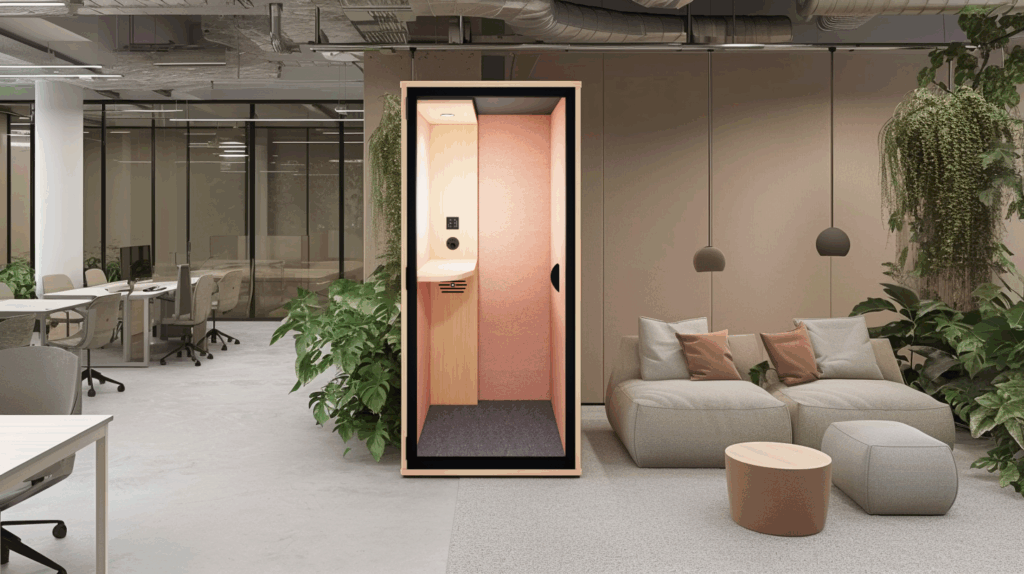
FAQ — Standard dimensions of an acoustic booth: the most frequently asked questions
9.1 What are the standard dimensions of a single-person soundproof booth (phone box)?
There is no single standard size, but formats close to ~100 × 100 cm on the floor are common, with a height of around ~218 cm. The most important thing is to check the internal dimensions, the presence of a shelf or desk, and the ventilation.
9.2 How much floor space should be allowed for a 2-person soundproof booth?
The correct approach is: floor area + clearance. A 2-person booth is often around 1.8 m² in the Essential range (M size), but you must add the circulation space and door opening to ensure a comfortable layout.
9.3 What ceiling height is required to install an acoustic booth?
In addition to the height of the booth itself, check for anything ‘hanging down’ from the ceiling: false ceilings, light fittings, sprinklers, ductwork. And consider the installation process: you must be able to handle the components without obstruction.
9.4 Interior dimensions: how can you tell if a booth will be truly comfortable?
Use a simple checklist:
- screen distance (video),
- legroom,
- usable width (shoulders),
- height and depth of furniture (table, shelf, benches),
- thermal comfort and ventilation with the door closed.
9.5 Does a larger booth necessarily provide better sound insulation?
Not necessarily. Insulation depends mainly on the design, materials, airtightness and how weak points are addressed (door, seals, ventilation). Size influences usage and comfort, but it does not, on its own, guarantee better insulation.