
An office that adapts to new ways of working
The world of work is undergoing a profound transformation. Remote working, shared offices, coworking and flex office are no longer just trends, but established realities.
As a result, businesses are facing a drop in the occupancy rate of their workspaces and a strong demand for flexibility.
In this context, the modular office is emerging as a key solution. Flexible, reusable and cost-effective in the long term, it addresses the challenges of a constantly evolving professional environment.
The aim of this article is to help you understand what a modular office is, its practical applications and the benefits it can bring to your business.
Definition: what is a modular office?
A modular office refers to a set of workstations, furniture or structures designed to be adaptable, movable and reconfigurable. It is not temporary or dismantlable furniture, but rather a system of modules designed to last, adjust and evolve according to needs.
Modular elements can be fixed or mobile, on castors, stackable or foldable. Examples include:
- Workstations with height-adjustable desks
- Removable partitions to define spaces without closing them off
- Modular seating and chairs
- Stackable and flexible storage
Modular furniture thus allows you to transform a space in a matter of minutes, without the need for building work or significant investment.
Why is the modular office appealing to businesses?
The success of the modular office is no accident. It meets several practical needs:
- Adaptability: ideal for growing businesses, hybrid teams or those undergoing reorganisation.
- Space optimisation: spaces can be easily reconfigured without building work.
- Cost reduction: lower property costs, better use of every square metre.
- Modern image: innovation, comfort and design attract talent and partners.
From start-ups to large corporations and co-working spaces, modular furniture adapts to all types of organisations.
The different types of modular offices
| Type of furniture | Description | Key benefits |
| Modular tables | Separable, foldable, adjustable | Flexibility, space-saving |
| Movable partitions | On castors or with magnetic fixings | Delimiting without partitioning |
| Modular storage | Lockers, shelves, stackable boxes | Individual customisation |
| Variable seating | Pouffes, benches, stools, modular sofas | Creation of adaptable relaxation zones |
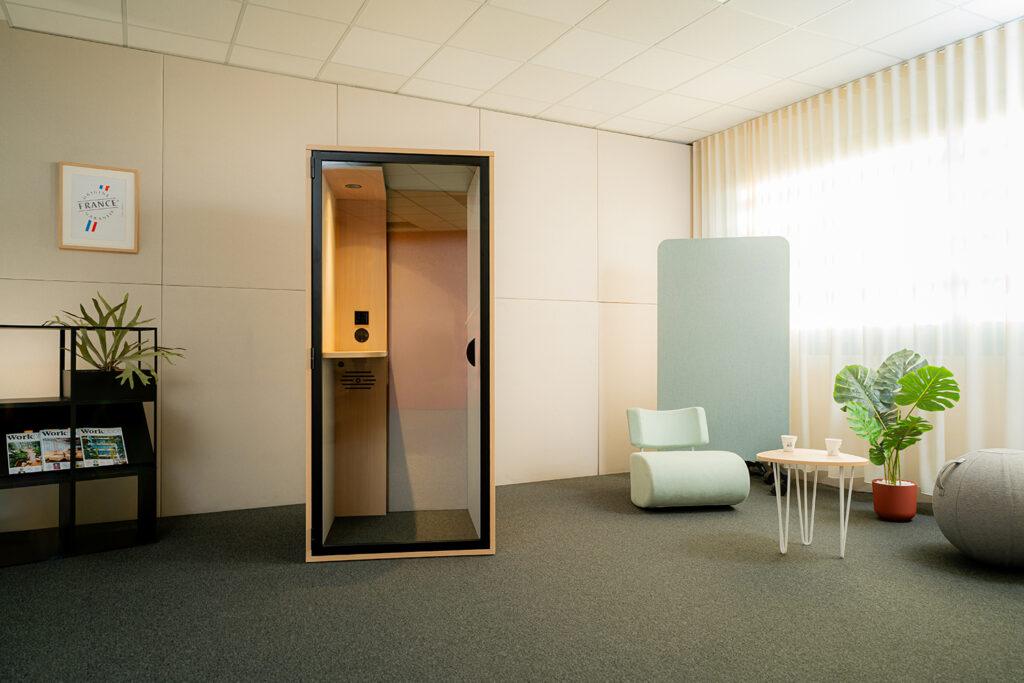
| Mobile acoustic booths | Movable enclosed spaces (e.g. Essentielle range) | Privacy, comfort, mobility |
The role of acoustic booths in a flexible office
One of the major challenges of the open-plan office is noise:
- overlapping conversations,
- impromptu meetings,
- video calls…
The need for concentration becomes critical.
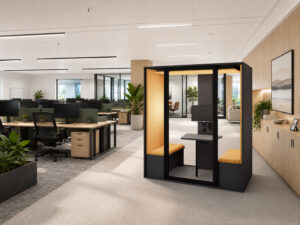
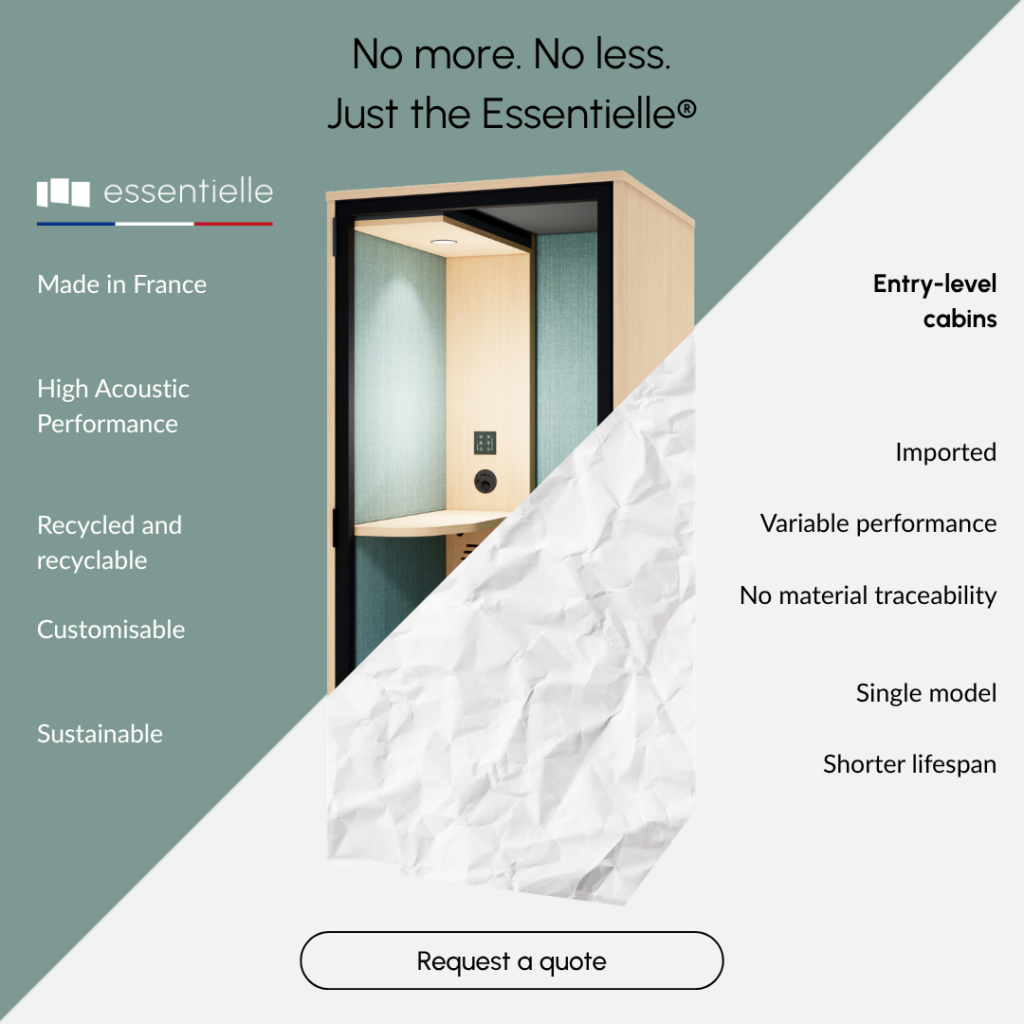
This is where modular acoustic booths come in, such as the Essentielle range:
- Movable without any building work thanks to integrated castors and gas struts.
- Available in several sizes: for 1, 2, 4 or 6 people.
- Customisable interiors: table, lighting, connectivity, fabric.
Benefits of booths in a modular office:
- Creation of enclosed areas without altering the infrastructure.
- Reusable in the event of a move or reorganisation.
- Comfort and privacy guaranteed for video calls or focused work.
Real-world examples of a modular office
Modular furniture isn’t just for a handful of companies. It fits easily into many contexts:
- Start-ups: grow from 5 to 20 employees without moving.
- Consultancy firms: switch between formal meetings and collaborative work.
- Coworking spaces: adjust zones according to daily footfall.
- Incubators and schools: managing multiple training courses and events in the same space.
- Multi-site SMEs: pooling equipment and creating temporary spaces.
Modular office vs traditional furniture: the comparison
| Criteria | Traditional furniture | Modular office |
| Initial cost | Lower | Higher initially |
| Scalability | Requires building work | Infinitely reconfigurable |
| Depreciation | Fixed, not easily reusable | Reusable and depreciable over time |
| Durability | Varies depending on materials | Designed to last and evolve |
| Well-being | Less adaptable | Bespoke comfort and ergonomics |
| Environment | Often not very recyclable | Certified timber, recycled fabric, eco-designed |
What materials and certifications should you look for in an eco-friendly modular office?
High-performance modular furniture is not just about flexibility. It must also comply with environmental and safety standards.
Preferred options:
- FSC or PEFC certified wood
- Recycled and recyclable foam
- Oeko-Tex or Gabriel Chili recycled fabrics
- Environmental certifications:
- Eco Impact A,
- Cradle to Cradle
- Safety standards: M1 fire resistance
- Circular design: demountable, repairable, recyclable
These criteria are met, for example, by the acoustic booths in the Essentielle range.
Conclusion: the modular office, the foundation of hybrid working
The modular office is not a trend. It is a structural response to changing ways of working.
It allows spaces to be adapted without rebuilding, optimises costs, promotes well-being… and supports business growth with ease.
With solutions such as the Essentielle mobile acoustic booths, furniture becomes a driver of agility, comfort and performance.