
Charities, too, need a separate space
In a charity, no two days are the same. There are office hours, sensitive calls with service users, video calls with partners, discussions with local authorities or funders, and meetings where staff and volunteers come together. All this often takes place in shared premises, with few private rooms… and an organisation that is constantly evolving.
In this context, creating a dedicated space is by no means a luxury. It is a simple solution to very real irritants: noise, interruptions, fatigue, difficulty concentrating — and above all, the lack of privacy when a conversation needs to be protected.
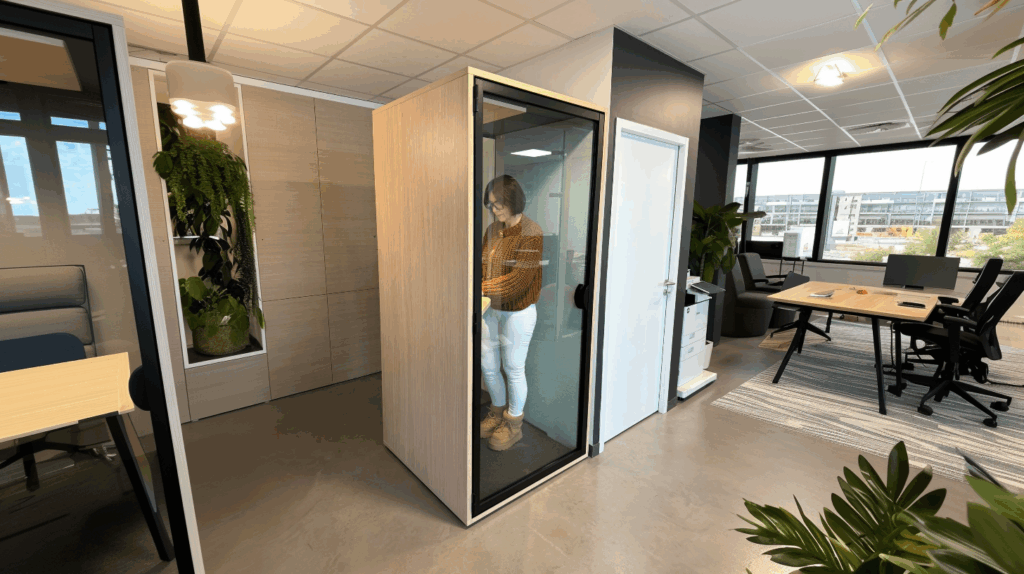
An soundproof booth allows you to create a bubble right at the heart of the action: a closed, quiet space that’s immediately available, without major building work and without taking over an already scarce room.
In this Essential guide, we help you make the right choice: when a booth is the right solution, which format to choose (single-person, workstation, mini-room for 2–4 people), how to install it, and what criteria to check before investing (acoustics, ventilation, equipment, logistics).
The best noise-reduction solution
You want to ensure sensitive discussions remain private
In this case, the most effective solution is a closed booth (phone box style). Its purpose is clear: to limit the transmission of speech, so that a conversation cannot be heard or understood from outside.
You need a space for short meetings
A mini meeting booth is often more suitable than an open meeting area. It provides a quieter setting, reduces interruptions and allows you to hold a discussion without disturbing the whole floor.
You have a reverberant and tiring space
If sound bounces around, and the atmosphere is harsh and exhausting, you often need to start by addressing overall comfort: sound absorption (panels, partitions, furniture). Next, the booth becomes the ideal solution for discussions that require a genuine level of confidentiality.
Key takeaway: absorption solutions improve the general atmosphere, whilst the booth creates a confidential bubble.
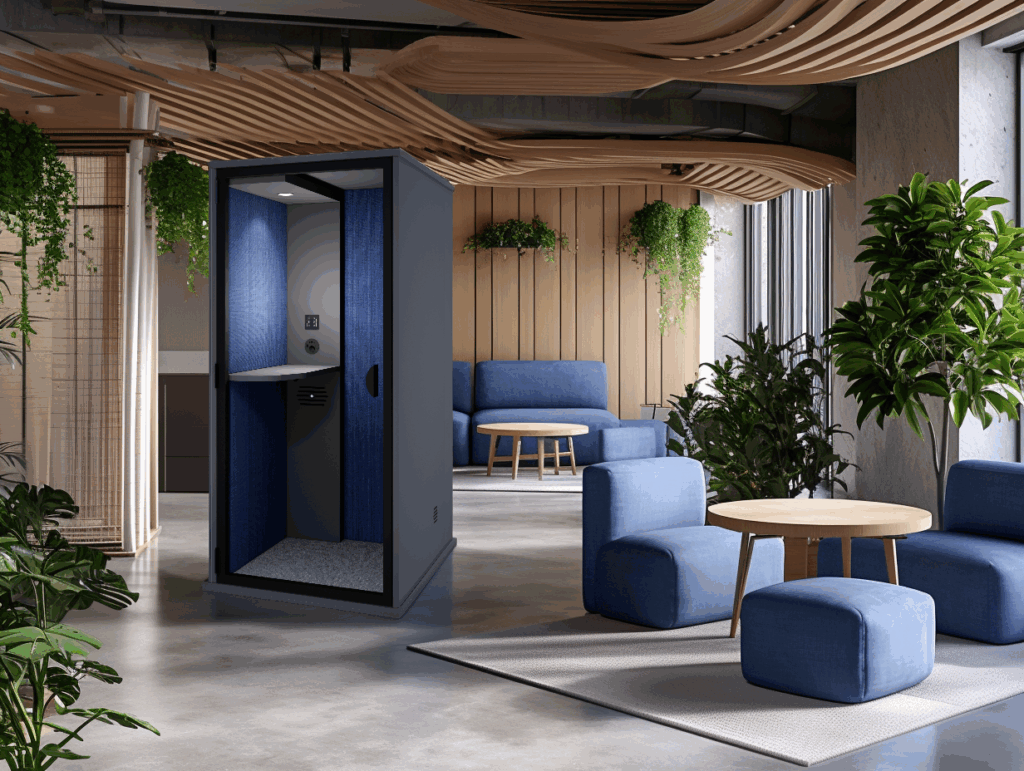
The 5 use cases that justify an acoustic booth in a shared workspace
Hotlines and strategic calls
Certain situations cannot be handled by speaking quietly in the middle of a shared space. An soundproof booth creates a space where you can speak calmly, whilst minimising noise disturbance for the team and visitors.
Video calls with partners, local authorities and funders
During video conferences, background noise and audio clarity affect credibility. A booth provides a stable environment: better intelligibility, fewer disruptions, a more professional demeanour — without having to rely on a room that needs booking.
Confidential interviews
HR discussions (with staff or volunteers), mediations, support sessions, sensitive matters: whenever confidentiality is an issue, having a private space makes all the difference. A booth doesn’t remove the complexity of a subject, but it provides a calming environment.
Focus and productivity
Charities produce a great deal of work: grant applications, reporting, annual reviews, minutes, content, coordination. When things get busy, having an accessible space for concentration helps restore quality and speed of execution.
Quick meetings for 2 or 4 people without tying up a room
Many discussions are not formal committee meetings: they are coordination points, decision-making sessions, or project meetings. A mini acoustic room for 2–4 people accommodates these moments without disrupting the rest of the space.
Booths, partitions, panels
What an acoustic booth offers
An acoustic booth provides localised privacy: it reduces speech transmission thanks to a closed enclosure, a door, seals and a design tailored to the voice.
However, it does not transform the acoustics of the entire room. If your room is very reverberant, the atmosphere can remain tiring — even with a high-performance booth.
What acoustic panels and furniture offer
Panels, partitions and sound-absorbing elements make the atmosphere more comfortable: less echo, less noise build-up, less fatigue. This is often the first step in very lively community spaces.
The simple rule
- If you need to protect a conversation: the soundproof booth takes priority.
- If you need to make a space more pleasant for everyday use: start with sound absorption, then add a soundproof booth for sensitive situations.
This approach avoids disappointment, because it aligns the purchase with actual usage.
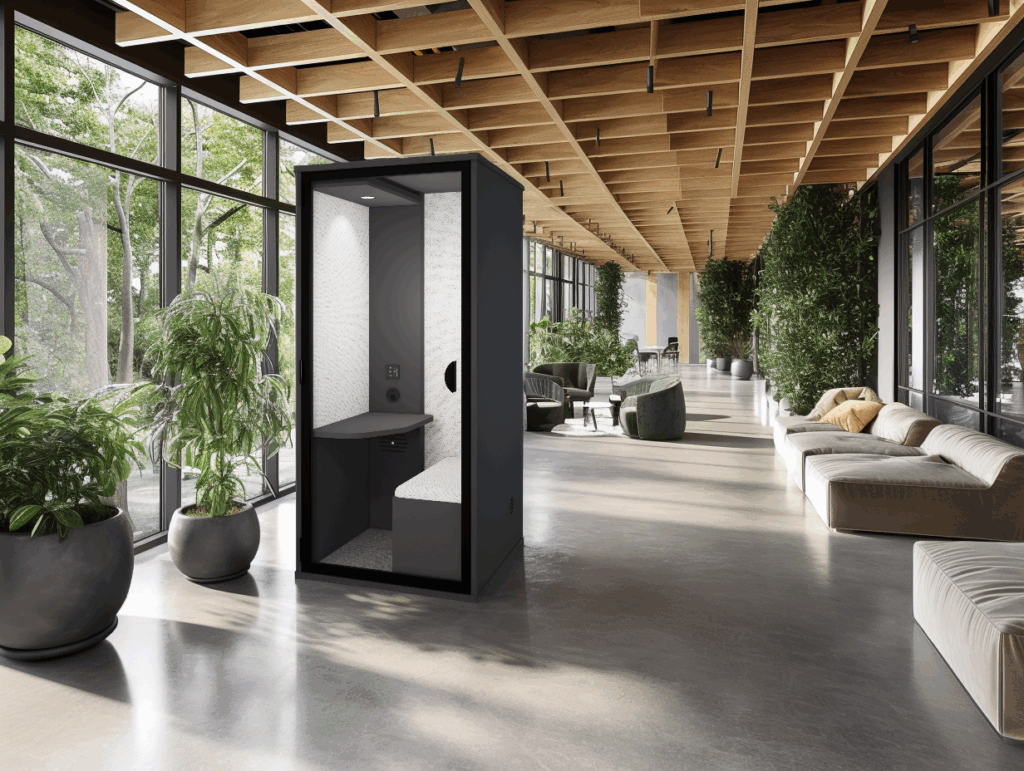
The criteria that really matter for a community organisation
Privacy
The aim is not to achieve total silence. The aim is that conversations cannot be heard from outside. On certain models, Essentielle claims a reduction in speech levels of up to -30.3 dB: a useful benchmark for calls, video calls and interviews.
Important: perceived performance also depends on very practical details (door, seals, installation). A booth is never effective if the installation is neglected.
Ventilation
A booth that becomes stifling ends up unused. And in a charity, that’s the worst-case scenario: the investment is there, but usage doesn’t follow. Essentielle models feature airflow rates according to size (for example 280 / 575 / 750 m³/h) and rapid air renewal.
Equipment
For video calls and remote working, equipment must not be optional. On the Essentielle range, connectivity is designed for real-world use: 220V socket, USB-C, USB-A, RJ45. In terms of visual comfort, some models feature adjustable LED lighting up to 800 lm, at 3000 K.
Mobility
Charities move premises, reorganise, launch new services and adapt their reception areas. A booth with a mobile base (castors, height adjustment via gas struts depending on the version) facilitates these adjustments — provided the necessary clearance for ventilation is maintained.
Which format should you choose?
1-person phone box
This is the simplest and often the most cost-effective format: calls, video calls, and brief but sensitive discussions. It integrates easily and does not monopolise a room.
Before deciding, clarify your habits: calls whilst standing or sitting, quick exchanges or long video calls, a tablet or a proper work surface.
Workstation booth
If your priority is concentration and productivity (grant applications, writing, coordination), a format designed as a proper workstation becomes more appropriate. Once you’re looking at 30 to 60 minutes of use, ergonomics, ventilation and lighting quality become crucial.
Mini meeting room for 2 to 4 people
Ideal for project updates and group discussions, with a real difference in comfort: table, benches, internal circulation, enhanced ventilation, and sometimes a screen mount depending on your organisation.
Essential guidelines
To keep things practical, here are some guidelines that can serve as a checklist when making a choice for your association:
- Reduction in speech level by up to -30.3 dB.
- Specified ventilation with flow rates depending on size (e.g. 280 / 575 / 750 m³/h) and rapid air renewal.
- LED lighting with output up to 800 lm, at 3000 K depending on the model.
- Full connectivity: 220V, USB-C, USB-A, RJ45.
- Reversible door and mobility features depending on version.
A word on the responsibility aspect
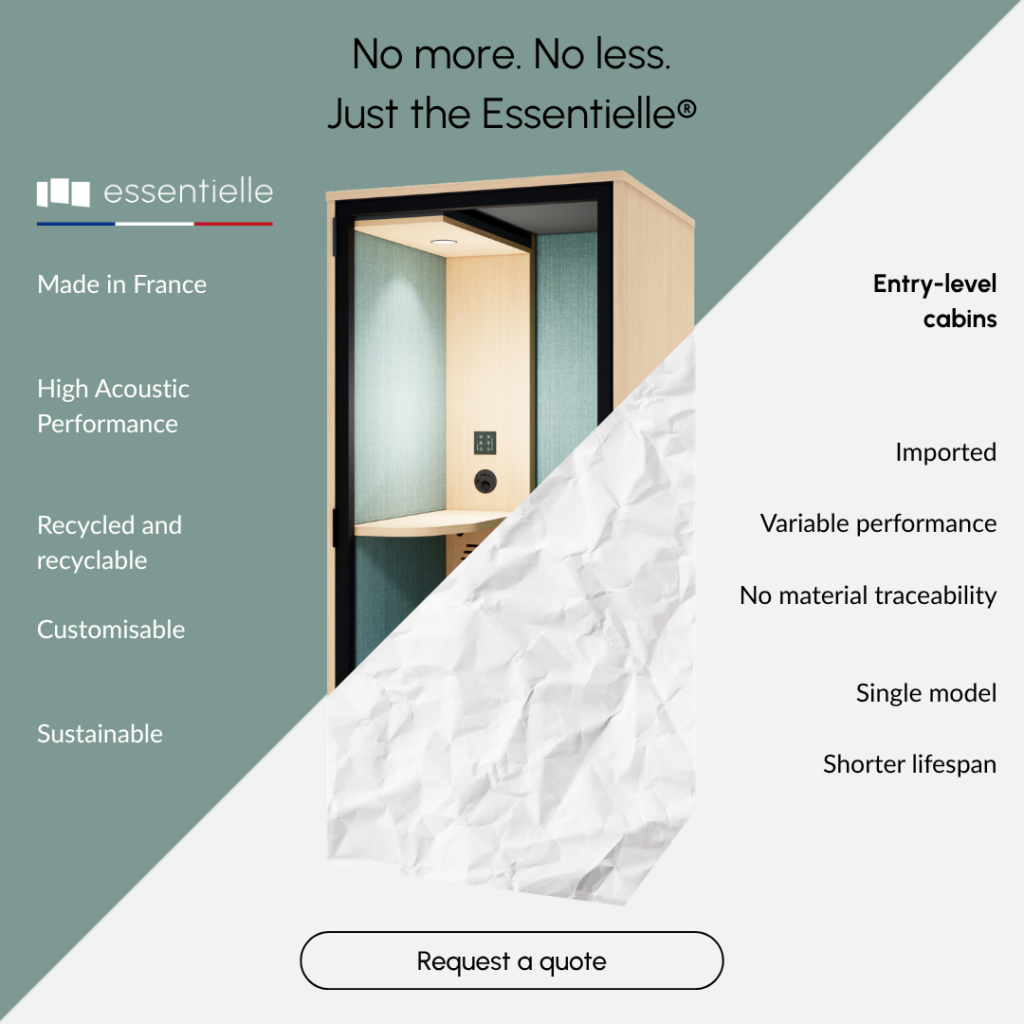
Essentielle also highlights concrete features:
- Eco Impact A,
- manufactured and assembled in France.
The key here is to rely on what is explicitly documented, to ensure a credible narrative — particularly if you are putting together a funding application.
Where should the cabin be installed in a community centre?
Ensure adequate clearance for ventilation
A practical rule mentioned in the documentation: maintain a minimum clearance (for example 10 cm on the air inlet/outlet sides) to ensure effective airflow. Squeezing the cabin into a corner that is too tight risks compromising comfort — and therefore usability.
Check the ceiling height
This is an issue that holds up projects more often than you might think. Check your available headroom before purchasing, referring to the installation recommendations.
7Finding the right spot
If it’s too far away, the booth gets forgotten. If it’s too exposed, it becomes uncomfortable (noise + echo effect). The right spot is generally close to people making phone calls or video calls, but away from noise hotspots: reception, corridor, printer, coffee area.
Conclusion
An acoustic booth can be a huge asset to an organisation… provided you remain practical. The right approach is simple: use → size → location → comfort → adoption.
An acoustic booth is not a gimmick. It is a tool for organisation, confidentiality and a high-quality reception experience, which avoids the need to convert an entire room and can be installed without major building work.
If you want to make a confident choice, the best place to start is with a mini checklist: a few photos, a floor plan, your access requirements, and your priority uses.
From there, Essentielle can guide you towards the right format (phone box, workstation, mini-room for 2–4 people) — the one that will actually be used, week after week.