
The real issue is not noise, but confidentiality
In a law firm, client calls, video conferences and internal discussions often concern sensitive cases. They involve data, confidential information and, above all, the need to uphold professional secrecy.
In this context, the aim is therefore to reduce ambient noise whilst preserving the confidentiality of conversations. The real challenge, on a day-to-day basis, is to create spaces where people can speak freely, without fear of being overheard.
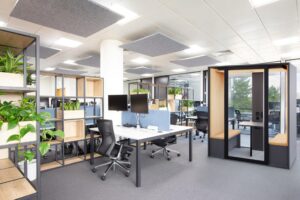
In practice, the reality is well known: open-plan offices, shared desks, meeting rooms already in use, noisy corridors. Under these conditions, confidentiality by default becomes impossible, even with the best will in the world. This is precisely where an soundproof booth can provide a simple solution: a dedicated, readily available option designed to ensure the acoustic privacy of conversations, without the need for building work.
In this article, you will understand why an acoustic booth is particularly suitable for law firms, how to choose the right type (phone box, telephone booth, office booth or meeting booth), and what to check before buying: sound insulation, ventilation, layout, connectivity and installation.
Which soundproof booth should a law firm choose?
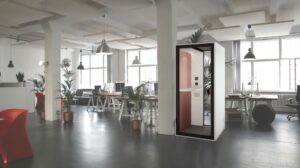
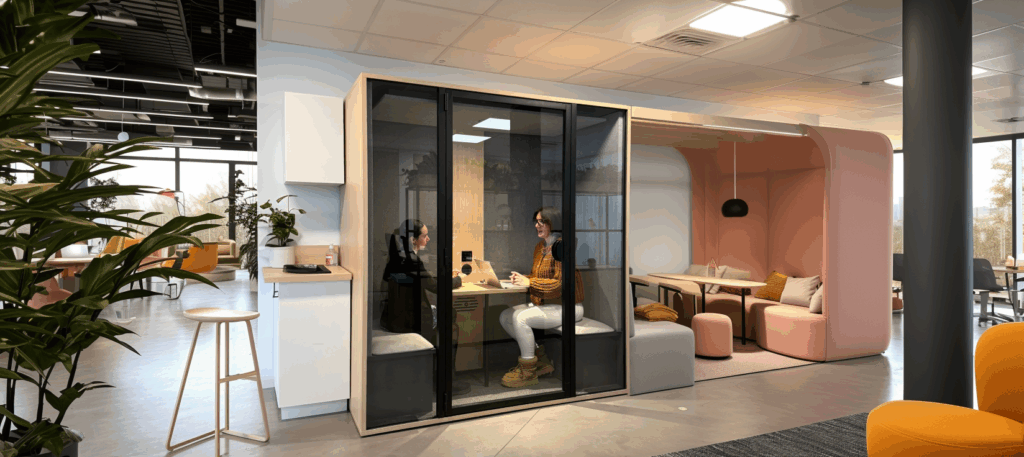
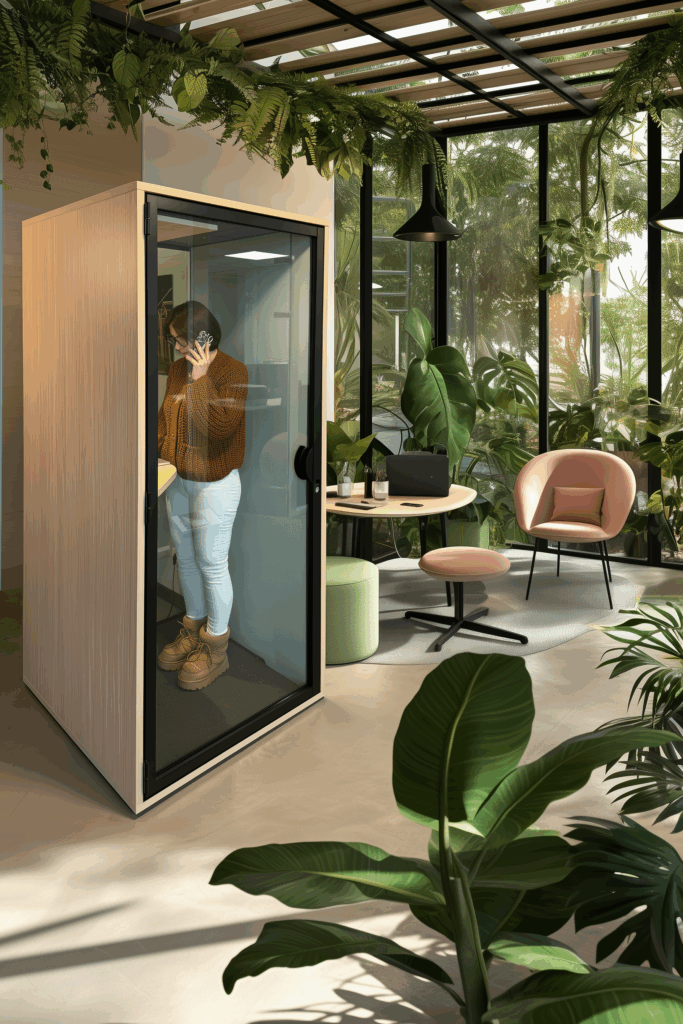
The right choice depends first and foremost on actual usage. For one-to-one phone calls and video conferences, a phone box is often the most effective: it is compact, quick to access, and provides the level of voice privacy suitable for day-to-day conversations.
For drafting, concentration and longer sessions, a single-person soundproof booth with a desk makes more sense, as it offers a genuine enclosed workspace.
For client meetings, HR discussions or sensitive one-to-one conversations, you should opt for a booth for 1 to 2 people, designed to accommodate users comfortably and ensure confidentiality.
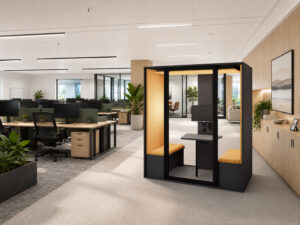
Finally, for a short meeting or a video call with several people, a 1- to 4-person booth allows you to create a micro-meeting room without any building work.
Why acoustic booths are particularly suited to law firms
Client confidentiality: reducing the intelligibility of conversations
The realistic aim of an acoustic booth is not to promise total silence. It is to reduce the intelligibility of conversations from the outside, i.e. to prevent the content from being understood. The distinction is important: in an office environment, there will always be a level of background noise. What we want to avoid is not that sound exists, but that the content becomes understandable. This point relates directly to strategic calls, sensitive cases and personal information. In a law firm, confidentiality is not a luxury. It is a requirement.
Video calls and hybrid meetings
Video calls with a client, a colleague, a court or an expert require a stable environment. Reverberation, interruptions and the noise of an open-plan office immediately undermine the perception of quality. The problem is a classic one: the microphone picks up ambient noise, and the conversation sounds less professional. A well-designed acoustic booth combines soundproofing, connectivity and LED lighting to deliver a clearer, more stable and, above all, more credible video call.
Concentration and productivity
Drafting documents, proofreading, preparing for a hearing: these tasks require a proper workspace.
The booth acts as a flexible, enclosed office. It avoids building work and partitions, and allows for quick installation. In a practice where every workstation counts, this flexibility changes the game.
What really makes a booth confidential
Insulation vs absorption: don’t confuse booths, panels and alcoves
A closed cubicle aims to reduce voice transmission: this is based on soundproofing and acoustic insulation. Conversely, panels or alcoves mainly improve reverberation and overall comfort. They can be useful in an open-plan office, but they do not create the ‘client’ confidentiality expected in a law firm.
Key areas to check: door, seals, glazing, cable ducts
Confidentiality hinges on the details. A small leak can have a significant impact on the perceived outcome. The door, seals, glazing and cable ducts must be consistent, and post-installation adjustment really matters. Rough levelling or a poorly fitted door can spoil the experience.
Ventilation
A booth must provide fresh air to be used effectively. The layout must therefore comply with air circulation requirements. Furthermore, there must be at least 10 cm between the wall and the air inlets/outlets.
User comfort
Ventilation and a feeling of freshness
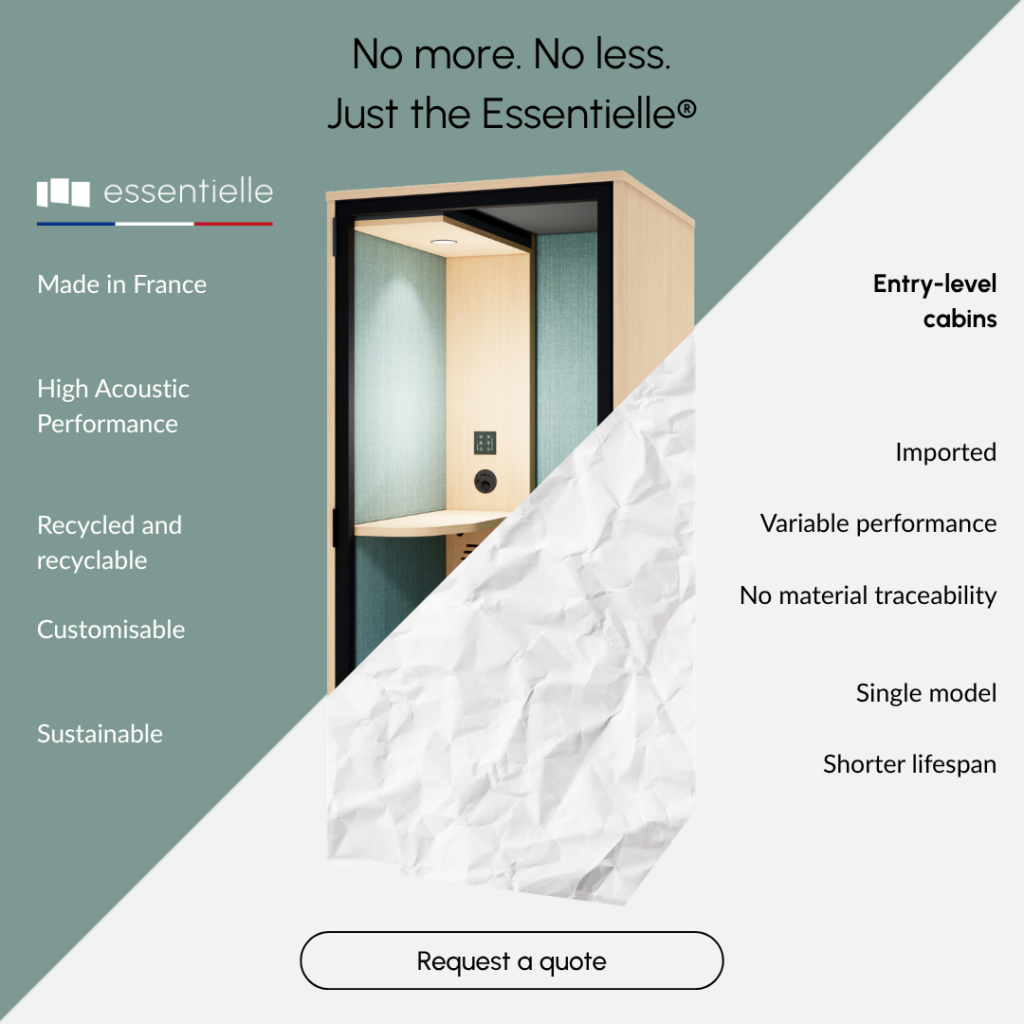
In a law firm, an uncomfortable booth ends up unused, even if it provides good soundproofing. For long calls or video conferences, ventilation becomes the key factor in adoption. The Essentielle booths offer complete air renewal in under 40 seconds. For example, the L model has a ventilation flow rate of 750 m³/h and achieves air renewal in under 40 seconds.
LED lighting
Lighting has a direct impact on eye strain and perceived video call quality.
Essentielle specifications: LED spotlights up to 800 lm, 3000 K, dimmable. For the XL model, the specification is 2 LED spotlights of 800 lm, 3000 K.
Installation in a practice
Areas that work
A booth placed near staff areas is used more frequently. Conversely, certain areas undermine privacy and comfort: reception, the coffee machine, printers, corridors, or slamming doors. Placement directly influences perceived quality and the ability to hold a confidential conversation.
Technical clearances to observe to avoid poor performance
For ventilation, the minimum clearance to observe is clear: 10 cm between the wall and the air inlets/outlets. Regarding ceiling height, the benchmark is a minimum of 230 cm, with 240 cm recommended to facilitate installation and maintenance.
Discretion in the law firm
Confidentiality is not limited to sound. Perception matters. A poor layout can create an ‘aquarium effect’ where people cluster together or speak through the glass. A simple layout, sometimes with ‘occupied/vacant’ signage, helps to streamline usage and avoid awkward situations.
Installation and logistics: what a firm must check before ordering
Access and handling
Before ordering, access must be checked: dimensions of doors, corridors, lifts, corners, and parking conditions for delivery. One must also anticipate time slots imposed by the building and any security constraints.
Cabling
A tidy installation requires careful planning of the power supply and, if necessary, the network. Cable outlets may be located in various positions depending on the configuration (top, rear, bottom). The aim remains the same: to avoid visible cables and maintain a tidy workspace.
The purchase checklist
Before making a decision, confirm the intended use: phone calls, video calls, interviews, mini-meetings or focused work. Next, check the external dimensions, internal dimensions and floor area, as these determine the layout. Check the door, its dimensions, the type of glazing (such as laminated glass), the seal and perceived quality, as a leak can compromise confidentiality.
Regarding comfort, check the ventilation: flow rate, air change rate, fan noise and required clearance. Check the LED lighting in lumens, the colour temperature (K) and whether there is a dimmer switch. Ensure the connectivity is suitable: 220V mains, USB-C, USB-A, RJ45, if these are required for your purposes.
Regarding furniture, confirm the presence of a desk or work surface, the usable height, and seating or benches if you plan to hold meetings. List the options that are genuinely useful, such as a monitor stand or cable management. When choosing the layout, avoid noisy areas and take into account foot traffic and privacy.
Check the building’s constraints: minimum ceiling height of 230 cm (240 cm recommended) and a 10 cm clearance for airflow. Plan for logistics: access, lift, and parking. Finally, conduct a real-world test in a showroom or during a demo: a 10-minute phone call and video call to assess comfort and confidentiality.
Conclusion
In a law firm, a suitable soundproof booth is, first and foremost, one that protects the confidentiality of speech by reducing the intelligibility of conversations. However, experience shows that acoustic performance alone is not enough. For it to be used effectively, consistent user comfort is essential: ventilation, LED lighting and practical connectivity. The layout also plays a decisive role, both for confidentiality and for adoption: proximity to users, distance from noise sources, compliance with technical clearances, and attention to discretion.
If you want to move quickly, a simple approach works well: validate your layout plan based on a few photos and your access constraints, then obtain a format recommendation tailored to your needs (phone box, office cubicle, interview cubicle or meeting cubicle).