
A soundproof booth transforms sales prospecting
An SDR or Business Development team isn’t looking for extra comfort. They’re looking for an environment that enables them to get the job done. Telephone prospecting, outbound calls, follow-ups, video calls, demos: it all happens in quick succession, often in open-plan offices, flex offices or co-working spaces. And when the environment isn’t suitable, it’s not just a bit of noise — it’s a drop in productivity, scripts executed less effectively, confidentiality compromised, and energy levels sapping away.
The soundproof booth addresses precisely this combination of issues. It provides a dedicated space: a place to handle calls back-to-back in the right conditions, minimise interruptions and manage customer relationships with greater stability. The expected outcome is very tangible: more calls handled properly, better perceived quality during video calls, and more consistent campaign execution.
The aim of this guide: to choose the right format, install it in the right place, equip the booth like a proper sales desk, and avoid the mistakes that ruin adoption.
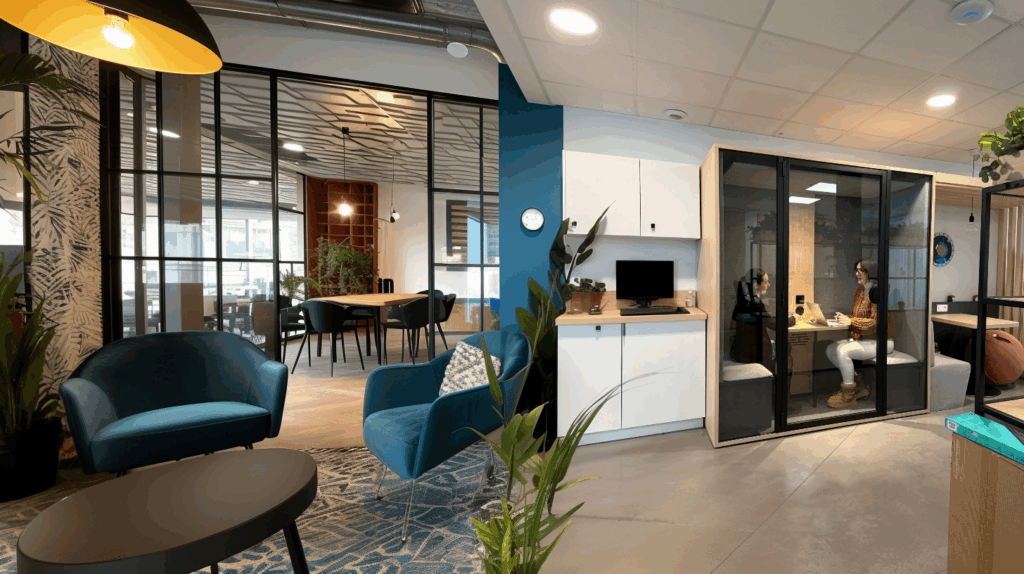
The best booth for a sales team is judged on three criteria
Privacy. Not absolute silence, but a reduction in the intelligibility of conversations from the open-plan area. This is crucial for strategic calls: objections, negotiations, pricing, and client information. The stress of being overheard is sometimes enough to derail a call, even if ambient noise is moderate.
Comfort over 30 to 60 minutes. A sales team cannot maintain a steady pace if using the booth becomes a struggle. Ventilation, lighting, posture and connectivity directly determine how long it can be used. Without these, the booth is avoided and sessions become shorter.
Team adoption. A booth may look excellent on paper but be underused in practice if it is too far away, too hidden or too restrictive. A useful booth is one that is accessible, close to the sales team and simple to use.
Clarifying the need: each typical session requires a different format
Intensive prospecting: pace and repetition
Short, repeated calls, cold calls, follow-ups. The aim is not to settle in comfortably for two hours — it is to keep going without wasting time. The key requirement is access: enter, close the door, make the call, leave, and start again.
There is a twofold risk: ambient noise disrupts concentration, and social discomfort (“everyone can hear”) saps energy, even in teams accustomed to open-plan offices. A single-person phone booth is often the most straightforward solution.
Demos, introductions, video meetings: perceived quality and credibility
In video calls, sound is perceived as a sign of professionalism. Background noise, an echo or a visible interruption undermine credibility faster than you might think. The need becomes perceived quality: a clean acoustic environment, a stable posture, an open CRM and a script in front of you.
A single-person booth with a desk is often more suitable than a simple tablet, because you can easily spend 30 to 60 minutes with your entire setup.
Strategic calls: confidentiality above all
On sensitive calls — pricing, negotiations, demanding clients — the aim is to prevent information leaks and, above all, the stress of being overheard. This stress alters your voice, your rhythm, your ability to handle objections and your composure when closing the deal.
The priority is on voice-oriented acoustic performance, the booth’s effective soundproofing, and a location that isn’t in a high-traffic area.
Coaching and onboarding: the two-person scenario
Coaching in pairs is common in sales teams: manager + SDR, training pairs, listening to calls live, immediate debrief. If this routine is regular, a two-person format becomes the natural solution.
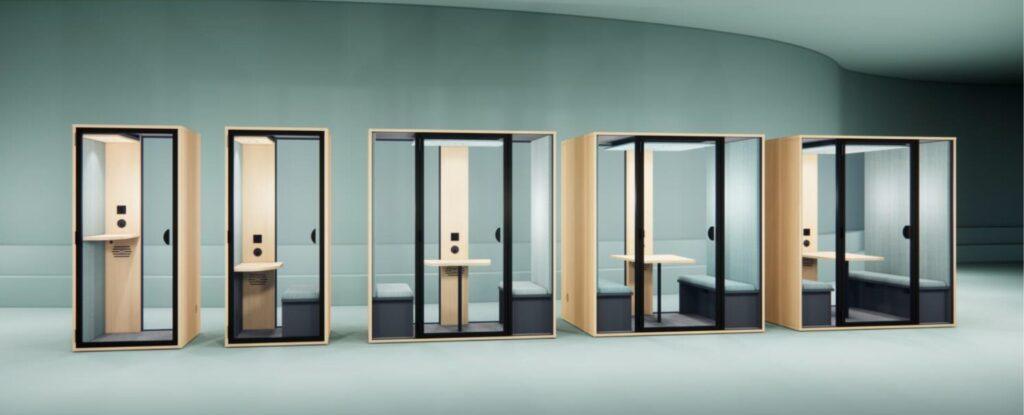
Which format to choose: S, S Desk or M?
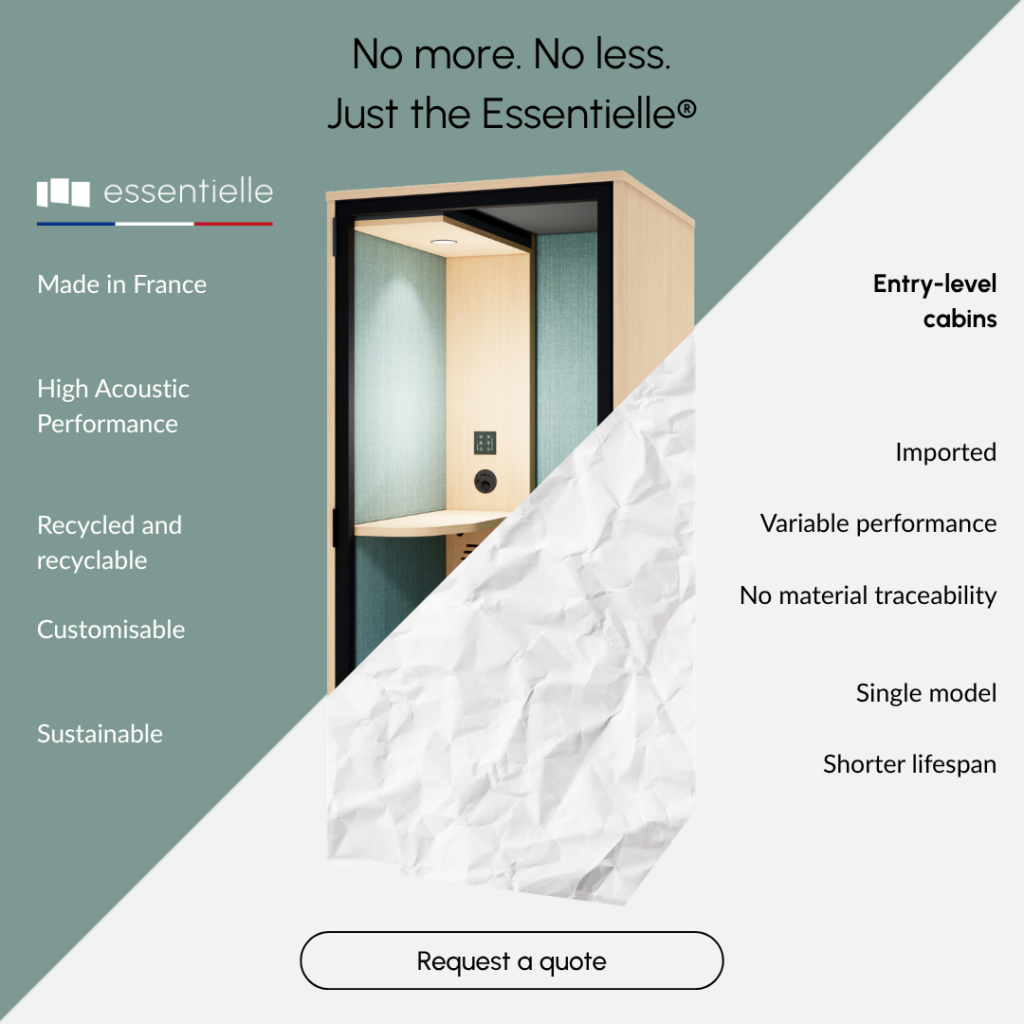
Single-person phone box (Essentielle S): short calls and video calls
This is the format best suited to short, frequent calls. The rotation is natural: you get in quickly, you get out quickly.
This format is the ideal quick-access booth for cold calling and quick video calls.
1-person desk booth (Essentielle S Bureau): CRM sessions and sales routines
The key difference isn’t a detail — it’s posture. Over a 30- to 60-minute session, a proper standard-height desk and a seat make a difference to stamina, concentration and the ability to maintain a pace.
The S Office shares the same acoustic design, ventilation, lighting and connectivity as the S, with the addition of a 43 × 79 cm desk at a height of 73 cm and a bench seat measuring 88 × 38 cm at a height of 45 cm. For a team alternating between calls, CRM, note-taking and video calls, this format often becomes the true ‘sales workstation’.
2-person booth (Essentielle M): coaching, interviews, two-person calls
This format is particularly useful for listening in on live calls, shadowing, onboarding and certain two-person meetings. Ventilation increases to 575 m³/h with the same air change rate in under 40 seconds — designed for two people over a full session.
The Sales checklist: what a booth must offer
Acoustics designed for voice confidentiality
The aim is not total silence — it is to limit intelligibility from the open-plan office. This is the specific requirement for handling objections, pricing and client information. The benchmark for the Essentielle range: a reduction in speech level of up to −30.3 dB.
Ventilation for back-to-back calls
A booth that becomes hot or stuffy saps energy and slows the pace. You can have a high-performance booth that remains unused if, after 10 to 15 minutes, the experience becomes unpleasant. The Essential range benchmarks: complete air renewal in under 40 seconds, with flow rates of 280 m³/h (S and S Office), 575 m³/h (M) and 750 m³/h (L and XL).
Lighting suited to video conferencing
Lighting must prevent eye strain and ensure a clean image during video calls: no harsh shadows, no ‘amateur video’ effect, and long-term comfort. The Essentielle benchmark: LED spotlights up to 800 lm in warm white (3,000 K), with a touch-sensitive dimmer.
Plug & play connectivity
If the team has to tinker, search for sockets or run cables, the user experience suffers. Every Essentielle booth comes as standard with: 1 x 220 V socket, 2 x USB-C ports, 1 x USB-A port, 1 x RJ45 port and a ventilation/lighting dimmer. This covers charging for headsets and phones, connecting a PC and a wired network if the Wi-Fi is unstable.
Door and mobility designed for the flexible office
Two features make life easier in a flexible workspace: the reversible door (opening direction adaptable to the layout) and the mobile base with integrated castors and height-adjustment jacks (effortless repositioning).
Fitting out the booth like a sales desk
Audio
The aim is clear voice quality, reduced background noise and ease of use. A comfortable headset, a stable microphone and a basic but essential rule: keep the door closed during calls.
Video
When video calls become a regular occurrence, ergonomics make all the difference. A screen at eye level, sufficient space behind and a clean visual background help stabilise the conversation. The screen mount option with a dedicated socket and cable grommet, available on the Essentielle range, is a practical solution for teams that conduct many demos.
CRM and scripts
An SDR needs to see their script, follow-ups, notes and sequences. Hence the value of a desk that can be used effectively for 30 to 60 minutes, rather than a tablet designed solely for a quick call. This is what directly links the booth to sales performance: call scripts, campaigns, leads, qualified appointments, conversion rates.
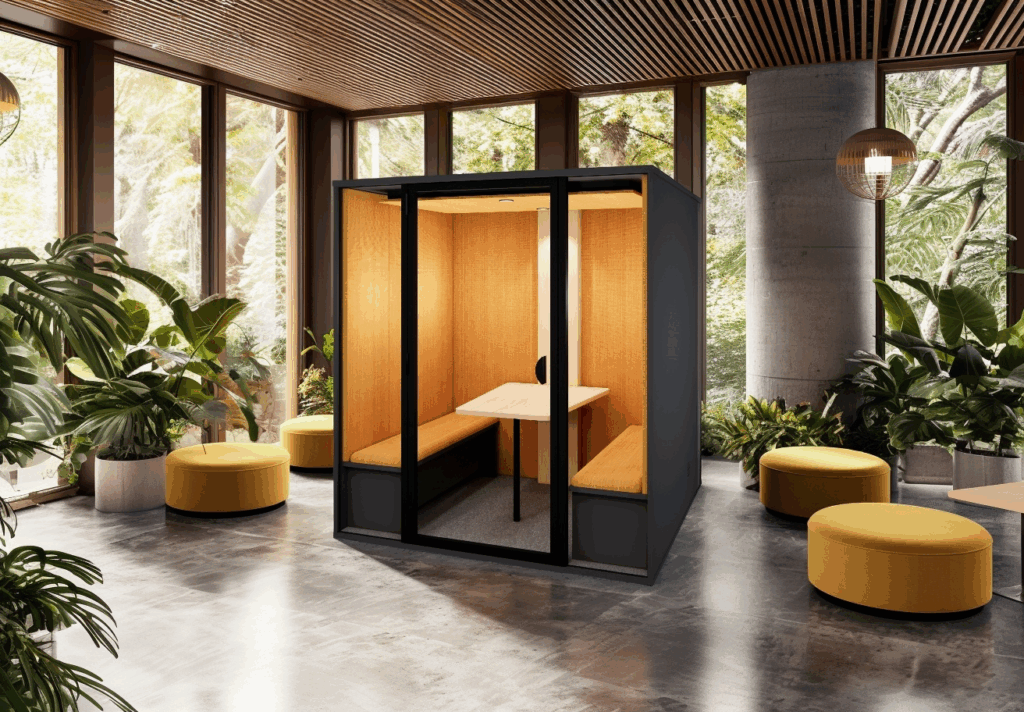
Layout: where to place the booths to maximise usage
Close to sales staff, never in a corridor
The rule of adoption is simple: close = used, too far away = avoided. However, the ‘fishbowl’ effect must be avoided: a booth in a high-traffic area creates social discomfort that reduces usage.
Never block ventilation
Allow at least 10 cm between the wall and the air inlets/outlets for optimal airflow. If the booth doesn’t breathe properly, comfort drops and adoption follows suit.
Use booths as zoning elements
A practical approach is to use booths as a buffer between noisy areas and focus zones. It’s not just about acoustics — it’s about organising space to support sales performance.
Sizing the fleet: how many booths for the team
The calculation doesn’t need to be theoretical. The inputs are simple: number of SDRs/BDs, daily call volume, average call duration and peak times (often 9am–12pm and 2pm–6pm). The idea is to estimate the need in minutes of booth time per hour, then work out a number that avoids conflicts of use.
A point of common sense: too few booths create friction and conflicts, too many create empty spaces, and overly rigid booking can stifle the spontaneity of prospecting. For prospecting, open access often works better.
Booking becomes useful if booths are scarce or if long video calls are the predominant use.
Technical constraints
The ceiling height: minimum 230 cm, 240 cm recommended to facilitate installation. This is something to check before ordering — ceiling constraints are often discovered too late.
Access and delivery: doors, corridors, lift, parking. For the Essentielle S, the package measures 120 × 120 × 235 cm with a gross weight of 330 kg and a volume of 3.4 m³. Assembly: 40 minutes for two people, excluding handling.
The budget: the factors affecting the cost are clear — size (single vs 2-person), options (glass back panel, screen mount), access constraints and number of booths. The best approach is to obtain a quote that breaks down the cost of the booth, delivery, installation and options to allow for a fair comparison.
Conclusion
A successful sales booth is not just a nice-looking object in an open-plan office. It must enhance sales performance. To achieve this, three key factors are paramount: voice privacy, long-term comfort of use, and genuine adoption by the team.
The most robust approach remains the same: start with typical sessions (intensive prospecting, video calls, strategic calls, coaching), choose the right format (S, S Office or M depending on use), install it in the right location, then equip the booth like a proper sales workstation. It is this alignment between sales needs and physical space that transforms a furniture purchase into a performance driver.