
Workshop noise is no minor issue
In a workshop, a construction site or a production area, noise is never just a minor inconvenience. It is a constant background noise punctuated by sudden peaks: impacts, compressors, handling, machinery. Over time, this environment becomes a real hindrance.
The consequences are immediate. Calls with clients or suppliers become impossible to understand. Video calls are almost impossible. Team meetings take place amidst the noise, with information being misheard and decisions harder to make. Confidentiality is compromised, fatigue increases and concentration wanes.
This is exactly what those looking for a workshop soundproof booth, a soundproof office or a palletisable booth are seeking to resolve: a solution to create a quiet workspace or meeting area, as close as possible to production, without major building work and without halting operations.
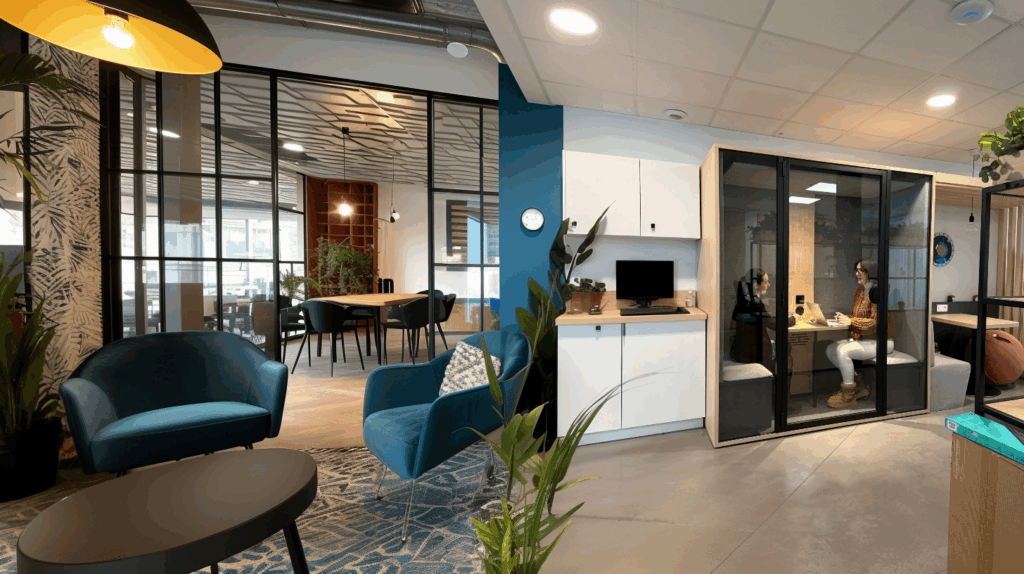
Three scenarios covering 90% of needs
“We want a quiet office in the workshop“
Supervision post, workshop manager’s office, safety briefing, production control: the need is to work without being drowned out by noise pollution. The solution is generally a soundproof workshop office or an industrial booth, with a level of robustness and protection suited to the environment.
“We want a meeting or briefing area“
Team briefings, quality reviews, HSE meetings, site coordination: the need is to hold a structured discussion without the workshop noise taking over. The right format is often a soundproof meeting booth, sized for a small group.
“We want clear phone and video calls without having to completely redesign the space“
The need isn’t necessarily in the heart of the workshop, but in the adjacent administrative area: operations offices, reception, site accommodation, planning room. In this case, a phone-box-style acoustic booth meets the requirements for phone and video calls with very specific criteria: ventilation, lighting, connectivity and speech privacy.
Clearly define the need before choosing
What noise needs to be addressed?
Workshop noise is not the same as office noise. It is often continuous, loud and varies greatly depending on the area. Before choosing a solution, the priority must be clarified: protecting a workstation (supervision, control, planning) or isolating communications (meetings, phone calls, video calls). The appropriate product is not the same.
What are the specific uses?
Common scenarios in workshops and construction firms include: control and coordination offices, team briefings and quality or HSE updates, customer calls and reporting, and multi-site coordination via video conferencing. A space perfect for a call is not necessarily ideal for a meeting of four — and vice versa.
What specific constraints?
The workshop imposes constraints that are easily underestimated. Dust and temperature vary by area and affect comfort. Flow and traffic (machinery, pallets, trolleys) mean that the booth must never obstruct passage or create a hazard. And manoeuvrability can become crucial: the ‘palletisable’ criterion — being able to deliver and move the booth easily — directly addresses the constraints of evolving sites.
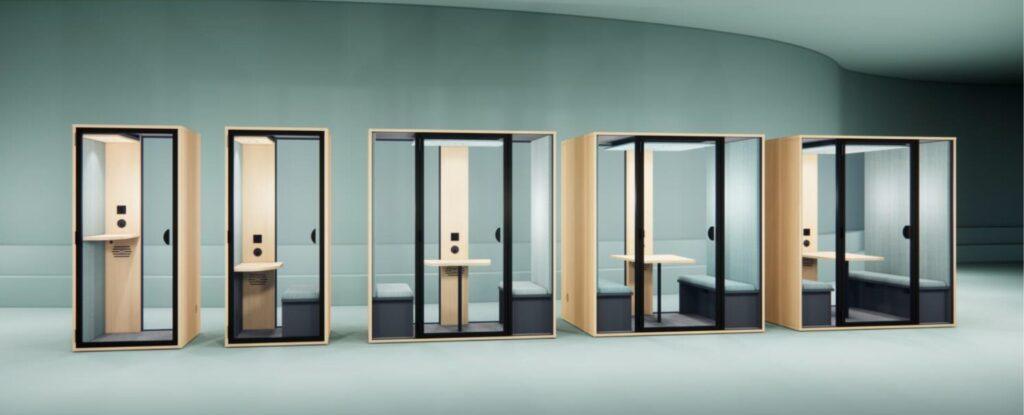
The main categories of solutions
The industrial soundproof cabin: the office within the factory
Designed to reduce noise pollution in a production environment, it recreates a usable workspace: reading, writing, holding a meeting, managing an activity, communicating. It is the logical solution when the requirement is for a workshop office or a meeting cabin at the heart of production, with a noise level that demands a design suited to industrial settings.
The palletisable booth: mobile and quick
The term ‘palletisable’ refers to a module that is easy to deliver and position, sometimes ready to install, sometimes designed to be moved as the site evolves. Its advantages are speed, flexibility and a budget that is often more straightforward. Key considerations include actual comfort, ventilation, lighting and durability under intensive use.
Treating the noise at source: when a soundproof booth isn’t the answer
Sometimes, the best approach is to reduce noise at source rather than creating a soundproof bubble. If the problem stems from a specific machine, an acoustic enclosure may be more appropriate. If general reverberation is the issue (a very hard-surfaced workshop, sound bouncing around), acoustic panels and sound-absorbing materials improve overall comfort.
In many cases, the most sensible approach is combined: a soundproof booth for critical tasks (office work, meetings, calls) and minimal treatment around it to limit reverberation.
The criteria that make the difference
Acoustic performance: focus on the use, not absolute silence
In a workshop, the realistic goal is not to eliminate noise. It is to reduce it sufficiently to make it possible to do what you need to do: work, hold a meeting, make a call.
Before comparing quotes, ask simple questions: what is being measured, and under what conditions? What is the intended use? And above all, what happens in a real-world scenario with the background noise of your workshop? Asking for a demonstration or a test under real conditions is a good idea.
Ventilation and comfort: the number one deal-breaker
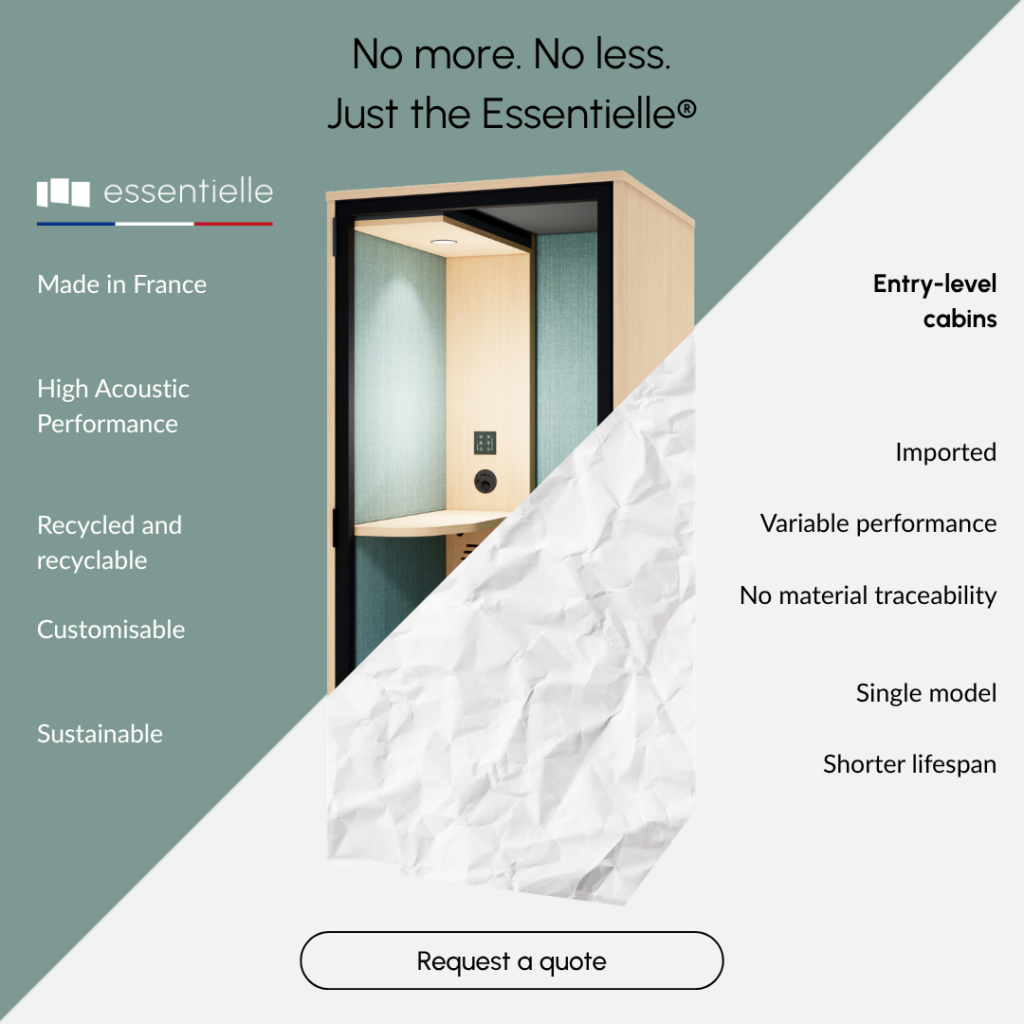
A closed booth without effective ventilation quickly becomes uncomfortable, especially in an environment where the temperature fluctuates. For calls and video conferencing in office environments, the specifications of the Essentielle range are suitable: a complete air change in under 40 seconds, with airflows of 280 m³/h on single-person models (S and S Bureau) and up to 750 m³/h on L and XL models. Adjustable LED lighting up to 800 lm in warm white (3,000 K) completes the user experience.
When it comes to installation, there’s a simple rule to remember: allow at least 10 cm between the wall and the air inlets/outlets for optimal airflow.
Electricity and networking: what we always forget
In workshops, the power supply and network are rarely ‘just a detail’. You need a nearby power supply, neat and secure cabling, and above all, avoid cables on the floor in walkways.
In the office area, the plug-and-play approach saves time. The Essentielle range includes as standard: 1 x 220 V socket, 2 x USB-C ports, 1 x USB-A port and 1 x RJ45 port — enough to cover laptop use, charging and networking without any fiddling around.
Dimensions, weight, access: the decisive trio
A workshop may have large industrial doors, but the project can be held up by a corridor, a secondary access point or an internal route. Before any quotation, check the width of doors and passageways, the ceiling height (minimum 230 cm, 240 cm recommended), the unloading area and the route to the final location.
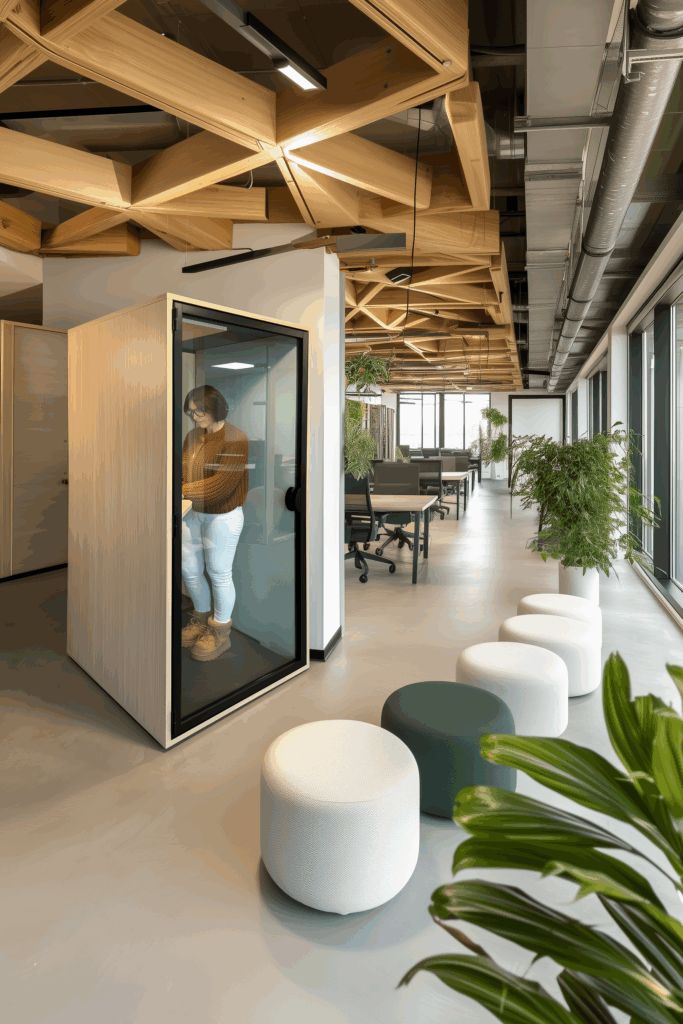
Layout: noise protection without disrupting production
The ideal location is rarely in the middle of the workflow. It is often found at the edge of the workshop, in a supervision area, or close to the teams but out of the way of traffic. The aim is twofold: to reduce exposure to the noisiest machinery whilst maintaining natural accessibility. A booth that is too far away ends up underused; a booth in the middle of a passageway becomes a point of friction, or even a hazard.
In the workshop, traffic flow is a safety constraint before it is a comfort constraint. You must consider the routes of machinery, maintain the necessary clearances and ensure unobstructed access to the door.
Bespoke, palletisable or office-style booth: how to choose
The bespoke option is appropriate when the workshop is very noisy, when the booth needs to fit within a specific constraint, or when you require a proper meeting room on a production line.
The palletisable option is suitable for sites that are constantly changing: frequent refurbishments, organisational changes. Speed and mobility are key, provided comfort and usability are not compromised.
The office-style acoustic booth (phone box) is suitable when the need arises in the office area adjacent to the workshop. For this context, the Essentielle S’s specifications are clear: external dimensions of 95 × 96 × 212 cm, floor area of 0.9 m², net weight of 255 kg, a 90 × 204 cm door made of 8 mm Silence laminated glass, and a speech reduction of up to −30.3 dB as measured by an independent acoustic consultancy. The S Bureau version adds a 43 × 79 cm desk at a height of 73 cm and a bench seat for longer sessions.
Four typical scenarios and the most practical solution
“We have to make customer calls amidst the noise.” Create a call/video zone next to adjoining offices using a phone-box-style cubicle. Requirements: ventilation, lighting, connectivity and speech privacy.
“We want a workshop manager’s office without building a separate room.” A soundproof workshop office allows you to create a control centre without any building work. Key criteria: location, accessibility, thermal comfort and durability.
“We want a mini meeting room in the workshop. » A soundproof meeting booth, sized to accommodate the number of people, the table, any video equipment and ventilation.
“The organisation changes frequently, so we need something mobile.” A palletisable or ready-to-install solution, checking ease of movement, access constraints, installation time and stability once in place.
FAQ — Workshop soundproof booth
Is a soundproof booth sufficient in a very noisy workshop? It depends on the noise level, the location, the type of booth and any surrounding sound treatment. A booth creates a useful bubble, but the result depends on the design, layout and suitability to the actual need.
What does ‘palletisable’ mean? It refers to mobility and quick installation. This is relevant if the layout changes frequently, if areas are reconfigured, or if you’re looking for a solution that’s quick to set up and move.
Should the workshop’s acoustics also be treated? Yes, if the workshop is very reverberant or if the general background noise is high. Sound-absorbing panels and materials improve overall comfort, whilst the booth provides protection for a specific use.
What information should you prepare before requesting a quote? A floor plan and photos, your access constraints, the exact use, the proposed location and your electricity and network requirements. The clearer the brief, the more accurate the quote will be.
Conclusion
Choosing an acoustic booth for an industrial environment is not the same as in a traditional office. The noise is louder, the installation constraints are more demanding, and requirements vary depending on whether you are looking for a control room, a briefing room or a dedicated call centre space.
The logic behind the choice remains simple: define the actual need (office, meeting, calls), identify the site constraints (noise, traffic flow, access, temperature), choose the appropriate format (industrial, palletisable, office-style booth for the service sector), and prepare a clear brief to obtain a quote that stands up to scrutiny. It is this preparation that makes the difference between a cabin that is used on a daily basis and an investment that ends up being underused.